The career archive of a NYC paramedic

Category: paramedic (Page 1 of 3)

Kevin At A Funeral

I had just become a paramedic and started working in East New York, Brooklyn. We were sent to an “asthma” call, which in those days, before EMTs started carrying nebulizers and albuterol, were assigned to paramedic units. The text stated that the patient would meet us outside.

“Well, that’s considerate,” I thought.

“You’re about to meet Kevin,” said my partner, who had spent years working in East New York and could easily discern from the text certain hallmarks of a ‘Kevin call’.

“He’s special,” he told me dryly, with a smirk on his face.

As noted, Kevin was outside waiting. He was smoking a cigarette and when he saw us turn the corner, he held up his arm in the familiar way New Yorkers do when they hail a cab.

Even if Kevin wasn’t the only white guy in an almost exclusively minority neighborhood, he still would have stuck out. His fondness for bright red track suits, often velour, enabled you to see him from a distance, which was possibly the objective. Apparently, he had a whole closet full of them. His ensemble included a gold chain with a large gold Star of David and a jacket that was zipped open, revealing chest hair like a 70’s porn star. He had a mop of messy, curly brown hair, pot-marked skin, and wore thin metal-framed aviator glasses with those lenses that change in the sunlight. He also had one of those newfangled cell phones, a novelty at the time.

“What took you so long?” he complained. He extinguished his cigarette and walked over to the side door. My partners amused smile provided me no comfort.

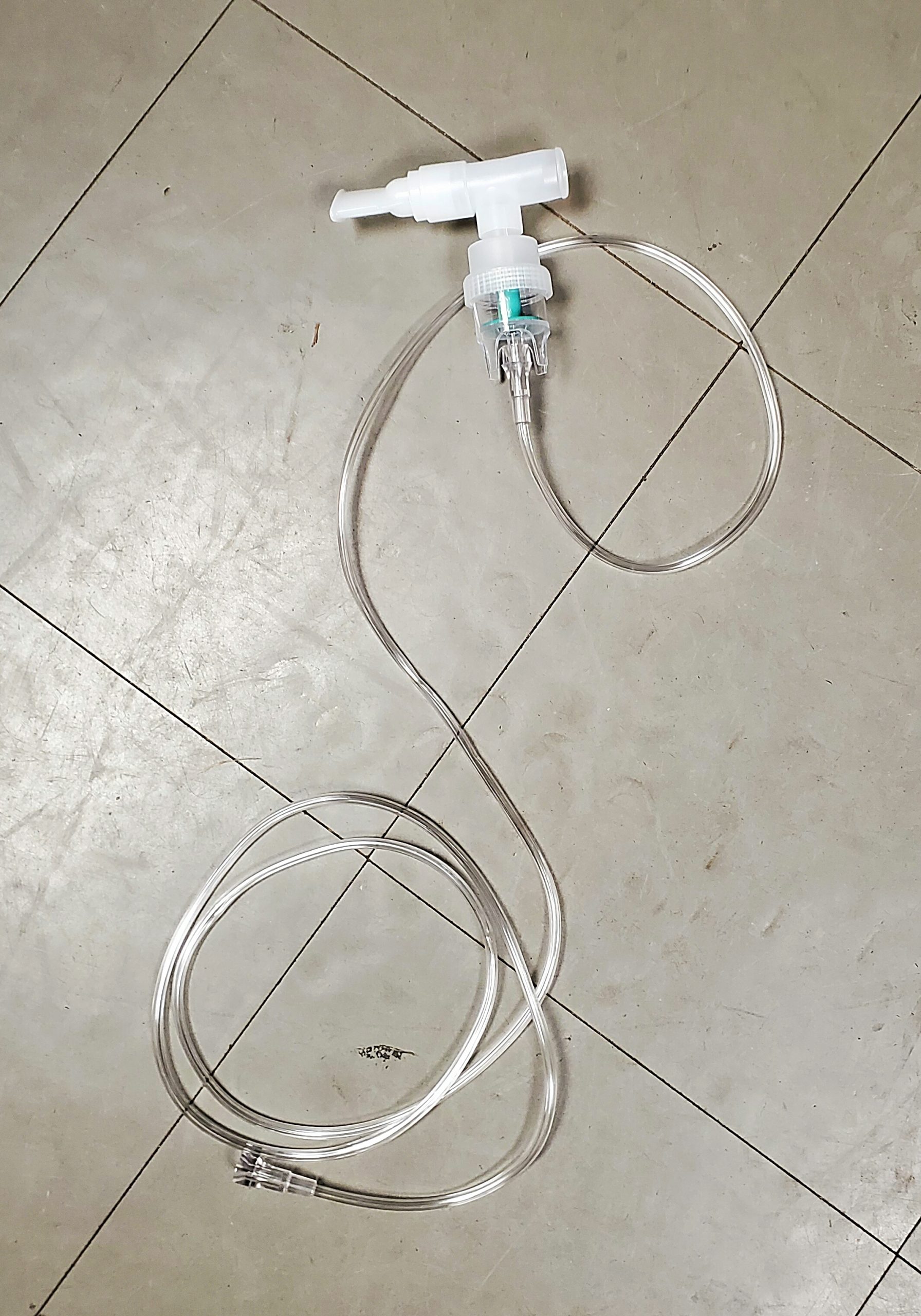
Despite appearing comfortable while breathing, I heard some wheezing, so I started to prepare a nebulizer by squeezing a tube of albuterol into the medication chamber, which was the protocol at the time. Before I screwed the device together, Kevin waved his index finger at me.

“Ah ah,” he reprimanded me, “I get two. You must be new.”

I instantly disliked him.

He also directed me to increase the oxygen flow by a few liters per minute, higher than our protocol specified and exceeding the nebulizer device’s design capacity. My partner rolled his eyes and shook his head.

“Come on, Kevin,” he said. “Don’t be giving my partner a hard time.”

“So she is new,” he said to him.

He turned to me and said, “I know because his regular partner is Devon. Or Shawn. Usually Devon. Shawn does a lot of mutuals.”

He turned back to my partner, who was driving that day, “We’ll be going to Methodist.”

Methodist was on the other side of the borough, far outside of our Ten-Minute-Rule. I was annoyed. What kind of taxi BS was this?

“Listen Kevin, you know we need permission to go so far away. Why don’t we go somewhere closer?” asked my partner, being almost apologetic.

“I’m not going to any of these hospitals. The hospitals around here have had enough of me. I’m done fighting with them. It’s time for a new round of nurses and doctors. Maybe I’ll finally get the care I deserve without having to demand it for once, though I’m not hopeful. Do you want me to call on my phone? I’ve got the number saved.”

He opened his fancy brick of a phone and searched through the directory.

As he scrolled down his list of saved numbers, I noted that it was filled, not with random names of possible friends or relatives, but with titles like ‘EMS complaints’, ‘City Law’, ‘Joe Bklyn Boro’, ‘EMS boro command’, ‘Nurses assoc’, ‘Councilwoman Barbara’, ‘NY hosp complaints’, ‘Medicaid complaints’, ‘City complaints’… The few names I did see noted included of many of our commanding officers, most of which were misspelled. He eventually reached our telemetry number and handed the phone to my partner.

“Hi,” said my partner, providing his name and our unit. “I’m calling for a hospital request outside the ten minutes…yes, it’s Kevin…he called you? Himself? That’s a new one…”

“I thought it would speed up the process,” he whispered to me quietly.

Our Ten-Minute Rule is a procedure for patients who don’t want to go to the closest hospital. Patients are generally entitled to go to any appropriate 911 receiving hospital anywhere within ten minutes from the closest hospital to their location, so if the closest hospital is 8 minutes away, they can go 18 minutes away from their present location. If they desire a hospital farther away, we were required to get permission from our telemetry department. It was my experience that almost all requests were granted, except under special circumstances like high volume at the hospital, certain holidays, and gridlock traffic situations.

My partner went through the procedure on the phone and, as expected, telemetry approved his transport. When he got off the phone, he told Kevin that telemetry wanted their number deleted from his phone. Kevin laughed and said it was memorized.

“They can tell you what to do, but they can’t tell me what to do. Don’t worry, when this is over, I’m going to call them and tell them myself.”

My partner asked him not to, and Kevin just nodded, but I had a feeling he was going to call them anyway.

On the long ride to the hospital, I listened to Kevin tell me all about my job. He had amassed a wealth of information as only someone who utilizes 911 way too often could.

Several times he refilled his nebulizer himself before the treatment was up, expertly going into our oxygen bag and knowing exactly where the medication was kept. When we got to the hospital, he informed me that I’d have to “restock”, as we were now “below par”.

He was well-versed in all of the lingo associated with our job. “Special” wasn’t the word I’d use to describe him.

Kevin soon became one of my regulars as well, regardless of what unit I worked. Everyone in our area knew him well, and they all had varying opinions of him. I heard stories about him making complaints about a responding crew to our complaint department while he was still in their ambulance. There were many stories about disputes he had with his neighbors, who also had varying opinions of him. Some crews enjoyed hearing his banter, and it was true, he did grow on you once you got past his demanding personality.

But his obnoxious ways never endeared him to the hospital nurses as he made his way through every Brooklyn facility and even some in the other boroughs. He continued to get evicted for rude behavior or arguing over the rules of the ER.

“Eventually, he rotates back,” they all told me, when he feels the staff may have forgotten him.

Most people, including myself, eventually adapted to his quirks, rationalizing that it was easier than arguing, and once you did so, Kevin was almost pleasant. He was especially nice to Devon, who I also worked with on that unit. If it appeared that Devon liked you, Kevin’s opinion of you could change completely.

It was hard not to like Devon. He was friendly, had a great positive attitude under pressure, and sometimes, if you were working with him, he’d take you to meet his grandmother.

Devon’s grandmother lived in the neighborhood. He’d often check up on her during his shift, as it was right in the middle of his assigned area. Devon’s grandmother was a friendly person as well and she knew everything about our job and loved hearing about entertaining jobs and the crazy situations we got into. She would listen to our tales while offering baked goods and coffee.

One day we came to work to hear that Devon’s grandmother had died. It was devastating for all of us at the station since most of us had met her through Devon. Some had been called to her home when she was a patient. Throughout the day we shared the news with our coworkers from other stations, letting them know the hours of the services and location of the funeral home, which was in the neighborhood.

On the first day of viewings, my partner and I drove past the funeral home where Devon’s grandmother’s funeral was being held. It was near one of the hospitals we frequented, and when we got to the ER, we met up with some other crews, where we discussed Devon’s grandmother and the funeral arrangements.

As we waited for stretchers to become available, we spoke about the huge turnout that we had witnessed on the way over with another paramedic crew. We mentioned the viewing hours when, suddenly, one of the curtains for one of the beds was flung open.

Kevin stood there in his hospital gown.

“I thought the hours were 7-10!” he said, dismayed to find that they were 6 pm to 8 pm.

“What are you doing at this hospital?” I asked. “I thought this place was on your ‘Never’ list.”

“It’s close to the funeral home. I came here so I could go to the wake when I got out of here. Now I’m gonna have to leave early,” he said, checking his watch.

I was taken a little aback. Kevin was going to the wake?

“Absolutely,” he said. “Devon is my man.”

Not long after, we drove past the funeral home again to find many people still outside. There were several large groups of men wearing suits and ties and women in their Sunday dresses who had spilled out of the home, some to smoke cigarettes and some appeared to be catching up with others before going inside.

And also standing out there was Kevin, who once again stuck out from a mile away, as he stood there with his bushy hair and glasses, wearing a hospital gown with no pants, and holding a nebulizer with its long tubing trailing behind him.

A Jimi Hendrix Experience

Two frail-looking women sitting on the stoop outside gave us big, gummy smiles as we walked towards the open doorway.

“Top floor,” said the older-looking of the two, as she pointed at the stairs.

“Of course,” I said, with what I am sure was an eye-roll.

The woman laughed. “It’s always the top floor, ain’t it?”

She understood.

The large three-story house had probably been initially built as a large single-family home. Sometime during its history, one of the owners divided the rooms into apartments and eventually, into the current incarnation, subdivisions of Single Room Occupancies (SROs). Aside from these subdivisions, it was painfully obvious that no one had done any serious work on that house for many years.

The door directly ahead on the first floor was wide open, as were most of the doors we would encounter on the way to our patient. Through the door, we could see two men smoking crack pipes, unconcerned with any privacy issues. One of them gave us a friendly wave.

The building turned out to be a very cordial residence with many tenants giving us smiles, encouraging greetings, or at least respectful acknowledgment. All three gestures are a rarity in my experience, and I greatly appreciated them.

Each room had a copy of a handwritten sign taped to its door announcing that $350 rent was due on the first of the month. “No excuses!”

In NYC, $350 is bargain rent, but even so, it seemed to me that these tenants weren’t getting their money’s worth.

We could hear yelling upstairs as we carefully made our way up the treacherous stairs. I’ve been up hundreds, if not thousands, of poorly maintained stairs. You develop a very cautious approach to them, noticing every potential problem for the trip later on, when you would be navigating them with a patient.

The edges, which were once covered in metal reinforcement, were no longer being reinforced, as quite a few of the metal edge frames were without screws and in varying degrees of detachment. Some of them poked outward as if inadvertent booby traps were created for anyone unlucky enough to go beyond the first floor.

Much of the linoleum on the stairs had been worn thin, and on several steps, large chunks were missing altogether. Some of those empty patches had gaping holes underneath where you could attempt to peer into a dark abyss below. A benevolent person had attempted to warn stair users by drawing arrows pointing toward the holes with a thick magic marker.

“Hol”, they read.

The second-floor landing had a curious assembly of possibly discarded items, including a large barbell and a rusty birdcage containing empty light bulb boxes. We could see a skinny blond woman sitting in the hallway doing ‘The Nod’. This is a term sometimes used to describe the fascinating way heroin users will seem to sleepily tilt sideways but suddenly right themselves before falling.

When she heard us, as we made our way up the stairs, she perked up suddenly and gave us her own enthusiastic, tooth-deficient smile.

“Are we here for you?” asked my partner.

“Oh no!” she exclaimed, changing her smile into a serious expression that indicated our suggestion was preposterous. She pointed upward. “Keep going!”

The steps leading to the third floor had concerning stains on the walls that looked an awful lot like blood splatter. Both of us did a bit of wishful reasoning, deciding that it could very well be some sort of food stain. The entire building reeked of large quantities of food long past its expiration date. Perhaps this was a source of some of that stench.

As we entered the third-floor hallway, we were able to make out the words to an aggressive argument we started hearing when we were on the first floor. From the limited snippets of dialogue we were privy to, they appeared to be fighting about the rusty birdcage. The dispute was coming from the right side of the building. Thankfully, a woman behind one of the partially opened doors directed us towards the left side.

As we made our way down the hall, we encountered a disheveled woman. She was hunched over as she walked towards us and had a glazed look in her eyes. She pointed further down the hall and remarked, “Vern went and did a Jimi Hendrix!”

She continued walking while she told us, “I read his autobiography. He choked to death on his own vomit! Just like what Vern’s doing!”

Indeed, as we made our way into the tiny, cluttered room belonging to our patient, we found him lying on his side, his face in a pool of brown, chunky vomit. My partner and I immediately did our best to remove the man from the putrid, foul-smelling liquid as quickly as possible, with as little splash as we could manage.

The patient was a large man, mostly naked, and he was lying on an inflatable mattress that seemed to have a leak. It wasn’t filled enough to make it taut and with the man’s considerable girth leaning on it, it seemed more like a kiddie pool. Moving naked, unconscious people is fairly difficult all on its own. It’s much easier to grab onto clothing or sheets to move someone. This large man, being absorbed into the depths of his air mattress, was especially difficult.

Another skinny woman was in the room with him, and she made an attempt to assist us, which I greatly appreciated, despite the futility of her limited naked-man-lifting skills. We were able to un-wedge him somewhat and attempted to listen to his lungs, but his decreased respiratory rate made it difficult.

He had pinpoint pupils, and his lips were blue. Thanks to some obvious drug paraphernalia found nearby, we quickly diagnosed his condition as a result of opiate use. We quickly got to work administering naloxone, which reverses the effects of opiates.

As we were doing so, we noticed the room directly across the hall also had an open door. Our attention was momentarily directed to a man there receiving oral sex from yet another, frail-looking woman who seemed to have difficulty staying awake during the procedure.

The thin, toothless woman with our patient saw that we noticed what was going on and let out a huge howl.

“DEBRA BE OUT THERE PAYING THE LANDLORD!” She shrieked. It was loud enough for the Jimi Hendrix enthusiast to join her in laughter.

The man getting the blow job seemed mildly annoyed. “You just pay your own rent and stop worrying about everyone else,” he told her.

The blow-job recipient/landlord seemed completely unconcerned that one of his tenants was lying in a pool of vomit only a few feet away. I understand that he could have been preoccupied but, honestly, he didn’t seem to be enjoying himself. Despite the admittedly half-hearted effort going on in that room, he kept paying attention to the activities happening in our room and without much empathy. He didn’t attempt to help our patient even though he could have easily assisted us in moving him. He could have resumed his activities with the woman afterward and she probably wouldn’t have even noticed the interruption.

Our initial dose of Narcan (naloxone) improved our patient’s respiratory rate only slightly. But we were able to listen to his lungs well enough to determine he didn’t aspirate. Another dose of the wonder drug had our man awake and questioning what happened.

Once he came around, the woman that had been in the room with him shook her head and chided the man for taking too much.

“Greedy,” she said as she exited the room.

The man seemed a little embarrassed and told us he had gotten his heroin from a different supplier, and that was most likely the reason why he had taken enough to require a double dose of Narcan.

I cannot explain enough how refreshing it is when a heroin user admits he used heroin. Narcan only works on opioids. If it works, the cause is pretty obvious. The song and dance we go through when people deny it gets exhausting. The protestations are very unnecessary for our purposes.

Most of us in EMS develop a resigned acceptance of addiction as it wastes mental energy to stand in judgment of a large portion of our patient base. Also, over time, everyone becomes just another patient, where you just treat what you find, regardless of how it happened.

There are a lot of people who would have found our location and clientele distasteful, but not me, and probably not most of my fellow paramedics. In fact, at that point in time on that job, this call was turning out to be a great job. The patient was honest, bystanders were (mostly) helpful, and there were shockingly interesting side activities going on; this job had it all. It was also very nice to be in a place where everyone was friendly (except for the landlord).

It turned out that “Vern” was really a man named George. Once awake, he was very cooperative and grateful for our assistance. But he didn’t want to go to the hospital. We asked if he would just let us check him out a little better and perhaps decide later, based on the results of our exam. He found our request to be reasonable.

It turned out George was 55 years old and had just come back home after being in the hospital for over a week, thanks to issues with congestive heart failure. He had a little box overflowing with prescription bottles that let us know he also had diabetes and high cholesterol.

His vital signs were mostly normal, as was his EKG, but we still thought going to the hospital was a good idea. He was adamant about not going. We explained that since we treated him, and he didn’t want to go, he would have to speak with our telemetry doctor on the phone in order to refuse transport. He was OK with the procedure.

We were less so since it meant using George’s phone. We were still in the age of landlines, and George’s phone was covered in a dirty, brown film that was as resistant to the swipes of our cleansing alcohol pads as George’s heroin had been to Narcan.

Calling telemetry for an RMA (Refusal of Medical Assistance) is a long process. There is only one doctor at telemetry for all five boroughs and calls for medication orders take priority. There are other reasons for telemetry contact as well but calling for an RMA puts you at the very bottom of a long waiting list.

We went through the procedure with the paramedic call taker at telemetry who took the pertinent information and then put us on hold. While we were waiting, many of the other residents in the building stopped by to see how our patient was doing. They all universally derided him for not wanting to go to the hospital but George wouldn’t be swayed.

George decided that, while we were waiting, he would get dressed and prepare some food. He was hungry, he told us.

Much of his wardrobe seemed to have been obtained from various hospitals. He had piles of socks with the little rubbery soles and a huge assortment of patient gowns emblazoned with the names of every facility in the city. He grabbed one of the gowns and put it on like a shirt. Then he fashioned himself a sarong out of a stained hospital sheet (also imprinted with the name of a nearby medical facility).

Once his body was partially covered with institutionally stamped fabrics, George made his way down the hall where there was a shared kitchen. He promised he’d return once we were no longer on hold.

He moved much steadier than several of the other tenants of the building as he made his way to the microwave. My partner followed behind while I remained in the small room, listening to terrible hold music while trying not to look toward the oral sex debacle still going on in the room across the hall. You couldn’t really say the woman had stamina, but her persistence in the face of intermittent unconsciousness was somewhat admirable.

I was still on hold when George returned from the kitchen a few minutes later. He came back with a plastic shoebox sized container that had his name written on it in thick black magic marker.

Could George have been the one who looked out for everyone by putting the warning about “hol’s” on the stairs?

He had a determined, serious expression on his face as he rummaged around his room. The woman who helped us lift him from the mattress followed behind him, as did another man.

“What is it you need?” asked the woman.

George ignored her as he continued to look. He was lifting objects and opening containers on the only small table in the room. Then he suddenly stopped.

“WHERE’S MY MONEY ?”

Due to the volume of his voice, he seemed to be asking everyone in the building. A few heads popped out of open doorways.

One of them was the woman who had read Jimi Hendrix’s ‘auto’ biography. “Vern lose his money again?” She directed her question to another face sticking out of another door.

George was furious.

“You know something about my money disappearing over and over?” He marched over to her door.

“No, Vern, no!” she said very apologetically.

“You leave that girl alone,” reprimanded the woman who had helped us. “What you expect when you passed out on dope?”

George marched back over. “What do you know about it?”

All of this back and forth was going on while I listened to the worst of today’s popular hits modified into instrumental sounds designed to remind me I was still on hold. The blow job performance across the hall also remained unaffected by these outbursts.

George started looking for his money in an angry, more disorganized way. He was throwing things around and it didn’t seem that he was trying all that hard anymore.

“Calm down, George,” said a skinny little man.

I’ve always found that telling someone to calm down has the opposite effect.

George picked out a rather large knife from his plastic kitchen box. He waved it around the skinny man. His personality had instantly transformed from a mild and helpful person into a man very intent on violence.

I dropped the phone, and my partner and I moved down the hall towards the stairs. We requested assistance from PD over our radios. A few of the doors slammed shut and became locked. Everyone around George started yelling at him to put the knife down, including us.

George stood still, fuming for a few minutes. But then he tossed his big knife back into the plastic box. He looked a bit defeated.

The oral-sex-bartering landlord finally found something important enough to pause his rent payment. He zipped up his pants and went into George’s room. He took the plastic box and started to bring it back to the kitchen, muttering some unintelligible words in frustration.

George admitted he’d lost control. He apologized to everyone within earshot.

The episode seemed to have been resolved. George looked much calmer, less angry, and the potential weapon had been removed. It was a momentary outburst, probably. Though we no longer felt we were in imminent danger, we didn’t cancel our request for PD.

We slowly returned to the left end of the hall. I picked up the phone handset again and found it to still be playing electronic hold music.

George said he was going to try and fix himself a sandwich again. He was still hungry, even more so now. He blamed his outburst on possible hypoglycemia.

My partner decided to take some of our equipment and move it down the hallway in preparation of our leaving.

He hadn’t gotten far by the time the loud noises started. George and the landlord started physically attacking each other in the kitchen, punching each other, and throwing things. My partner tried to make his way down the stairs when they came closer to him.

I once again dropped the receiver, but this time, as I ran to the stairs, the two men were brawling on the landing.

The events that followed happened so quickly. In hindsight, it seemed longer but while we were experiencing it, it was over in an instant.

As they were exchanging fists on the stairway, the landlord failed to notice one of the magic marker-ed warnings on the steps and tumbled down the stairs after his foot got stuck in one of the open holes. He ended up falling about 12 feet down, landing basically on his head, and stopping right in front of my partner, who was holding the drug bag and monitor with a bewildered look on his face. The controversial rusty birdcage had toppled over with all the commotion and in a strange but not unexpected move, another resident grabbed it and secured it in his room as if he were guarding a long-lost artifact.

Luckily, around this time, PD started arriving. The first pair of cops raced up the stairs after hearing the very loud thud on the third floor landing.

George stood at the top of the stairs with a strange expression on his face. At the time, I thought he might be in shock thinking about the incredulity of the situation but it turned out, a different kind of shock was going on.

Physical shock is when your blood pressure starts to drop, due to a variety of reasons, but the most common is loss of blood volume from trauma. When George turned to look at me I saw his kitchen knife sticking out of the right side of his belly.

We requested BLS assistance (the EMTs) over the radio but one crew was already on scene. They had put themselves on the job when we had first requested police assistance.

We all worked very quickly – us, the EMTs, and the police, to secure both patients to longboards. We bandaged George’s knife in place so that he wouldn’t bleed out even faster than he already was and we quickly established IVs on both of them. I’m proud to say that I got the IV on George on the first try, as he was an extremely difficult person to find viable veins on, given his heroin use.

Fluid replacement is a small stopgap to the surgery he really needed and getting him down those terrible stairs was really the biggest priority. Thankfully, we had much assistance on the scene, but it did take a long time to navigate the stairs with two heavy patients in extremis. By the time we got to the first floor, George needed CPR as his heart had stopped pumping.

Both of our patients required ventilatory assistance, and we put our monitor on George. It showed him to be flatline, which, especially where trauma is involved, is almost impossible to reverse.

Both of our patients had breathing tubes inserted into their tracheas (intubation) en route to their respective ERs. I traveled with George to the hospital with one of the EMTs and a police officer assisting. My partner had a similar crew in the back of the other ambulance, dealing with the landlord’s head injury. Another crew of EMTs arrived to split up and drive us, and another crew of EMTs split up so one of them could drive their vehicle. It was a convoy of units that roared away from that scene.

The landlord was able to go to a trauma center, where we found out later that the severe cognitive impairment from his head injuries would cause him to live out his life in a nursing home. George was pronounced dead in the ER.

Sometimes I think about how, if he had just gone to the hospital in the first place, probably none of this would have happened. His life could have been saved for a completely different reason.
September 13, 2001

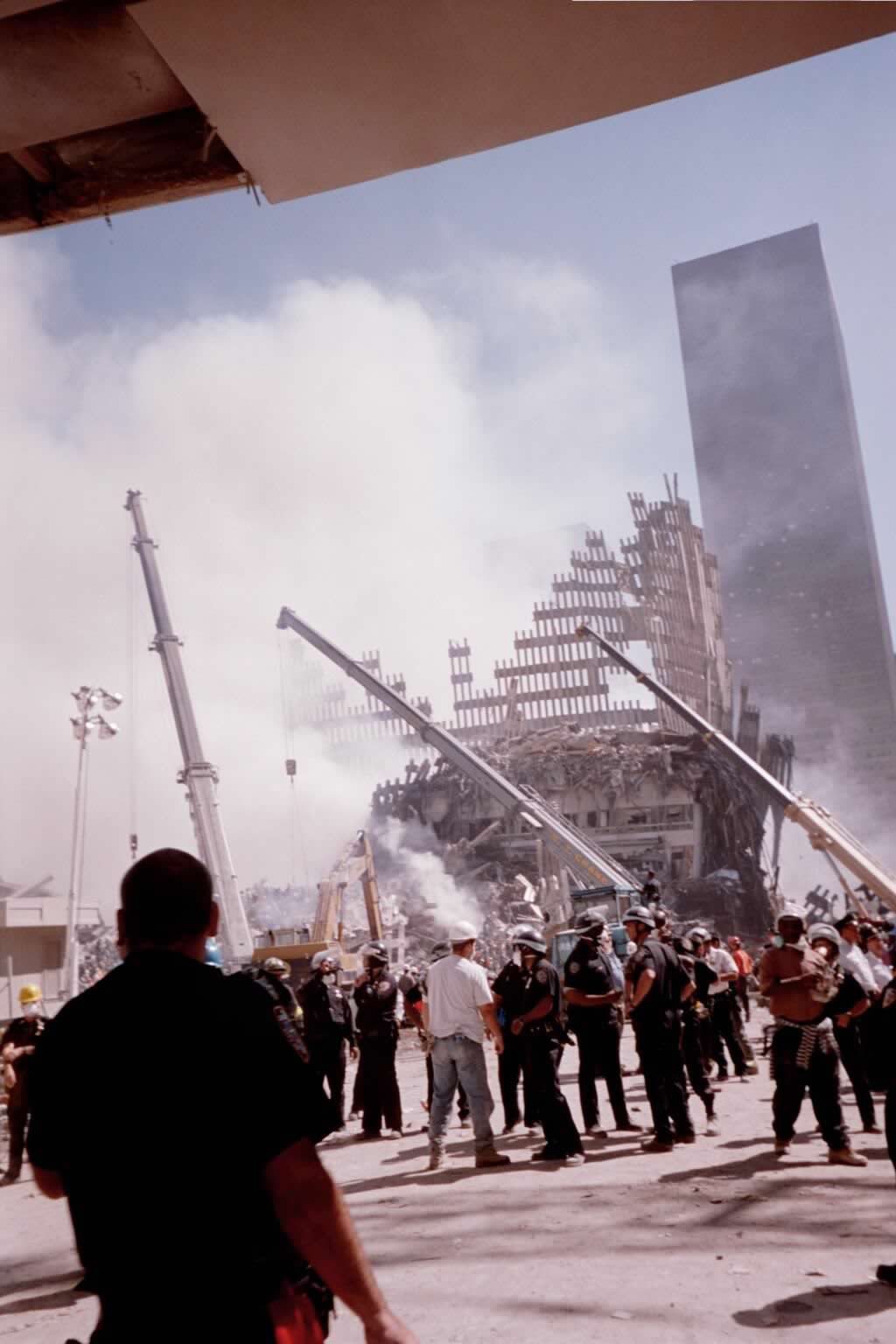
On September 13, 2001, I was sitting in my union’s office with several coworkers, from different Brooklyn stations, awaiting transportation to Ground Zero. We were collectively living in a strange kind of haze after the biggest terrorist attack on our nation, and our city. We had been told to report to our union office if we wanted to assist in the rescue and recovery mission but no one there that day knew what to do with us at the moment. There was a row of telephones on a long table and one of them began to ring. I was the closest, so I picked it up.

“Howdy!” said the friendliest voice I had heard in many days. “We’re from a local in western Montana and we just need for one of you to give us the go-ahead to put our truck into drive.”

Was this a wrong number? Who were they trying to get? What were all these phones for anyway?

“Excuse me?” I asked. “I’m sorry, I’m just waiting here and picked up the phone. Who were you looking for?”

“Well, howdy again, ma’am,” he said. He slowed his speech a little and his enthusiasm went down slightly, but only slightly. “Your brothers and sisters in western Montana have loaded up an 18-wheeler, don’t ask us how we got it, we ain’t telling. We’ve got supplies and a few extra humans to help out our friends in NYC. Now, we’ve got this behemoth pointed east. Joe here, assures us he knows how to drive it. I’m not asking for the paperwork. All we are looking for is the go-ahead to move this thing forward.”

He had put a huge smile on my face but I just automatically started crying. I was actually bawling if we are being honest. I’ll admit I was quite a bit sleep-deprived, which makes it fairly easy to turn on the tear spigot but that, I’m sure, only played a partial role. I was mostly filled with an overwhelming sense of love and gratitude towards this stranger on the other side of the country who had assembled supplies, volunteers, and even a very large truck under auspicious circumstances, apparently, just to help out people he had never met. I’m not sure what he thought when he heard me crying.

“Don’t worry, darling,” he told me quietly. “Love always wins. It might take a while before the light gets shined upon it, but evil always takes a backseat to good.”

I thanked him profusely for that, and for the mission he had set up. I told him I was in no position to authorize anything, and that maybe he should call back later. But he didn’t care. He felt that my answer indicated that his truck needed to hurry up and get to New York. They were just going to head east until they found us. He wanted us to know that help was on its way.

I will never forget that phone call.

***************

When the two airplanes struck each of the buildings of the World Trade Center I was working my other job at a cardiac monitoring service on Long Island. (Most of us work an additional job to support the job we are addicted to.) When news came that something huge was going on in downtown Manhattan, my boss rigged a television up and we all watched it together. Everyone there knew what I did at my other job and they all just looked at me quietly.

My then-boyfriend/future husband was working EMS and on the clock while all this was going on. I had some trouble getting in touch with him but our lieutenant (we worked at the same station at the time), told me he was ‘probably’ safe.

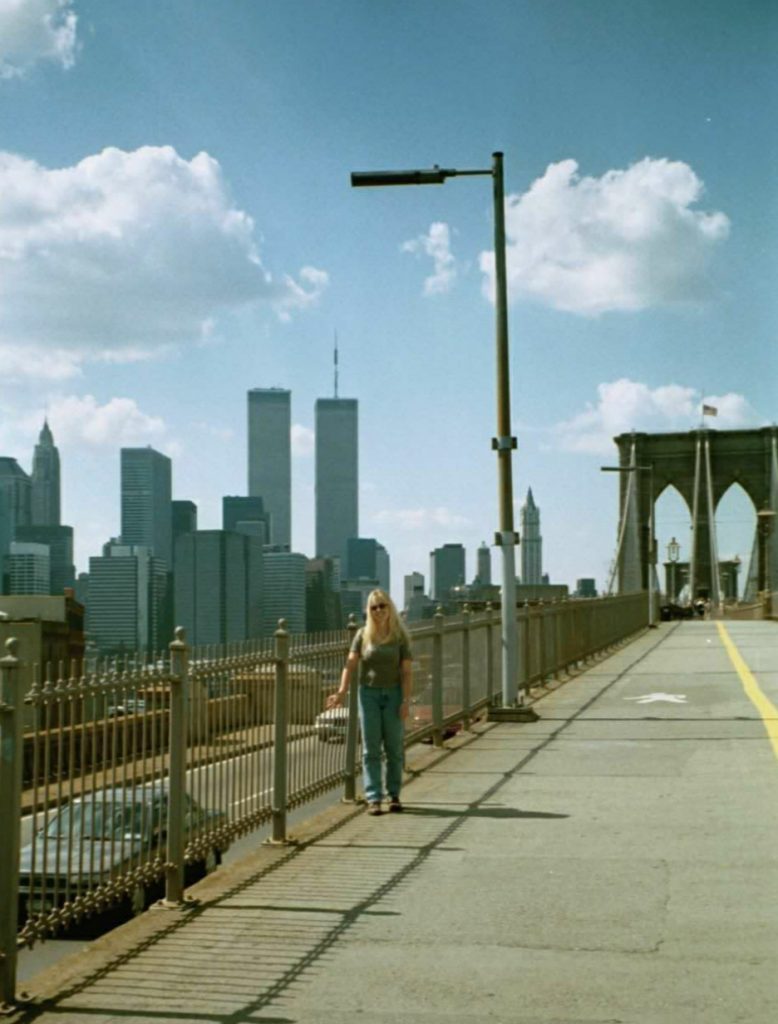
Me visiting ‘the city’ 8/29/01

I was able to get a hold of my partner, who lived close to the cardiac monitoring place, and he came and picked me up in his car. We drove to the city together.

Most of the roads towards the city had police roadblocks and we had to keep flashing our ID cards for much of the ride. We had ideas of picking up our equipment and heading to Manhattan, even though we were scheduled to work our unit that evening but first, went to our station to see what was being done from there.

Everything was up in the air. I don’t know what kind of planning was going on for that evening or the days ahead because it seemed that anyone in charge was in lower Manhattan and inaccessible. We weren’t sure what to do, no one was.

For the time being, our lieutenant told us, we were to stand down. A city bus was on its way to take us to Manhattan. They were working out the scheduling and the logistics.

Eventually, the bus arrived and we got on it. And then it was canceled. No more people would be going to Manhattan, the lieutenant told us. Too many units were there and not enough were covering the regular 911 needs of the city.

So on the evening of September 11, 2001, my partner and I worked our usual truck.

It was a strange time to be doing your regular job. The entire city was in shock, as were we. I remember most things as if they happened in slow motion. Reports floated their way to the station of the names of people we might know, people who were missing. The call volume was higher than average but quite a few of them were calls of anxiety. Many people were hearing things, seeing things that turned out to be unfounded. We took some drunks to the hospital, many of whom didn’t even know that a major disaster had taken place a few miles away.

I wondered about my sister, an air traffic controller, who must have worked her tail off to land all those planes. It’s a stressful job to begin with, but on that day everything that was flying had to land, immediately or as soon as possible. You can find real-time air traffic images online to see just how daunting a situation that was.

The air traffic on 9/11/01 at 9 am

We did our regular job again the next day too. Everyone was still feeling the effects of this major devastating event, even more so since more was known about it. So many people were missing, coworkers were missing. Several people I knew had already been confirmed dead.

It’s difficult to do your job when you’re an emotional tinderbox. There are drug dosages to be calculated and protocols to remember. You’ve got to pay attention when you’re driving. All the while you had to hold it together for everyone else, despite more and more information pouring in, more names of the missing, more buildings.

There were countless stories about people jumping off those buildings to avoid burning to death inside. You could only try to imagine the kind of desperation that takes. At the time, it was thought that hundreds could be trapped in the rubble. To think about those poor people, desperately waiting for help, was heartbreaking.

Our unit had developed a friendly relationship with Squad 252, which was in our area. We even had the code to the door, which surprised the firefighters that had been sent there to cover the firehouse. We went over to see how they were doing but the looks on the faces of the men there told us everything.

And yet I was still picking up drunks and people were still calling for colds that their antibiotics hadn’t cured in three days. Normally those calls don’t bother me. I often find them entertaining and they are a nice balance to the ‘real’ calls that involve suffering. But at that time there was nothing redeeming about calls like that, and there were so many of them, during the aftermath of a terrorist attack. Didn’t they even watch the news?

Back then, I like many others, had no landline. I was living with a friend and the only phone line in the house was dedicated to dial-up internet. My then, high-tech brick of a phone had no service for more than a day after the attack and when it finally did come back it had a very limited range. I desperately wanted to get in touch with my family. I was able to call my mother in Florida after a few days but my dad in Hawaii would have to wait much longer. It was like we were back in the days before the industrial revolution. Most people were having difficulty with phone service and yet others were still able to call for an ambulance because their foot had a rash.

I cannot describe how maddening this all was to me. When you deal with the onslaught of pain and suffering fairly regularly one of the biggest coping mechanisms is knowing that you tried and that you were able to help. Sometimes your efforts fail but the simple knowledge that you did everything you could makes all the difference in the world.

There is also something to be said, something important, about keeping busy. But nothing we were doing was satisfying. Nothing seemed like ‘helping’. It seemed like everyone wanted you to forget what was going on and just do what you used to do as if nothing had changed forever.

So, on my first day off I wanted to head to lower Manhattan and dig. But you couldn’t just drive over with your shovel and helmet. There must have been some organized efforts I could join, I thought. Or I would be one of the medical volunteers somewhere, I hoped. Anything. I would do anything.

But on the days previously, when I had been working, information about how to go about doing so was spotty and constantly changing. Initially, we had been signing up for extra ambulance shifts that would be dedicated to lower Manhattan but they had been canceled. I had tried to go over after and before my regular shift. (And I still had to pick up my car and the stuff I had left at my other job in order to try and accomplish these things).

The best lead I had was to go to the union office as I had heard they were bringing groups of EMTs and paramedics to work ad hoc posts that had been set up. I had spent less than five hours at home in three days and I couldn’t wait to go to Ground Zero because I was desperate to assist in some way, anything, to feel useful because driving people to the ER for anxiety wasn’t doing it.

A little ragtag group had assembled at the union office that day. I clearly had not been the only one who had heard this was the place to go. But the two people in charge at the office didn’t know what to tell us either. Their information was also constantly changing.

My then-boyfriend/future husband had gone to a different location where EMTs were being picked up to work at medical outposts that were being created. Paramedics were excluded, we were told, because paying us was too expensive (ridiculous, given the sparse difference in our salaries). It seemed they didn’t care that they had ‘volunteers’ who were willing to do things for ‘free’. This just added to the outrage, that in the middle of a nationwide tragedy, the same silly nickel-and-dime rules were applying. There was just so much to be angry about.

But then the phone rang, and I spoke to my new friend from western Montana.

I told the small group about the call and it empowered us to get up and go together. The union gave us a placard and we got into someone’s vehicle and made our way downtown, shovels in hand.

Along the way the roads were lined with hundreds of well-wishers holding signs of encouragement, handing out water and snacks at traffic stops, and cheering us on. My hope for humanity was returning again.

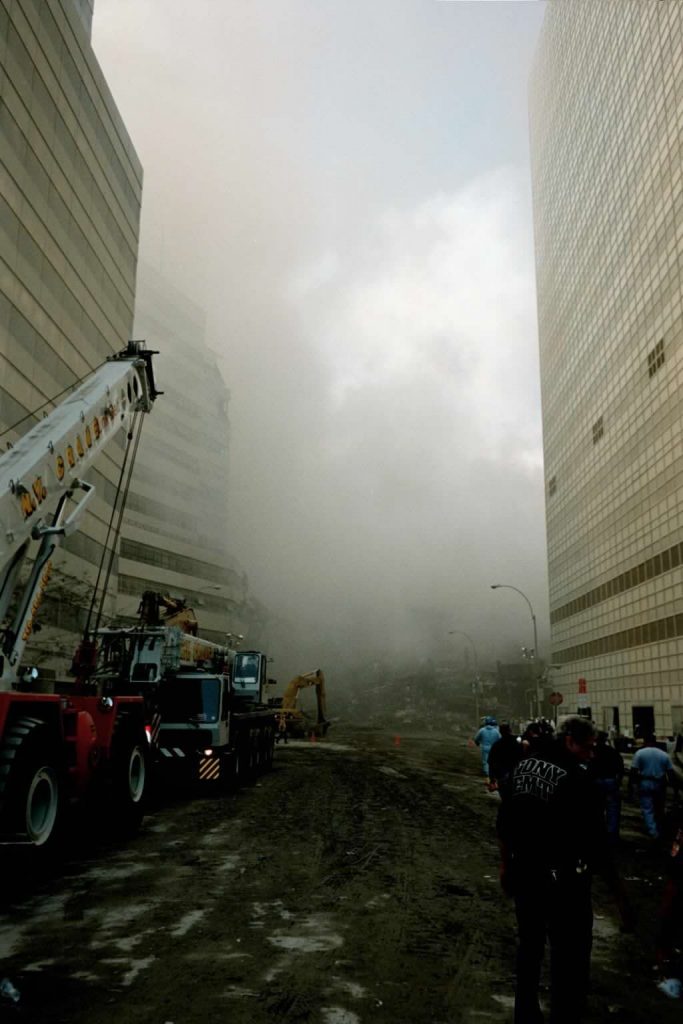
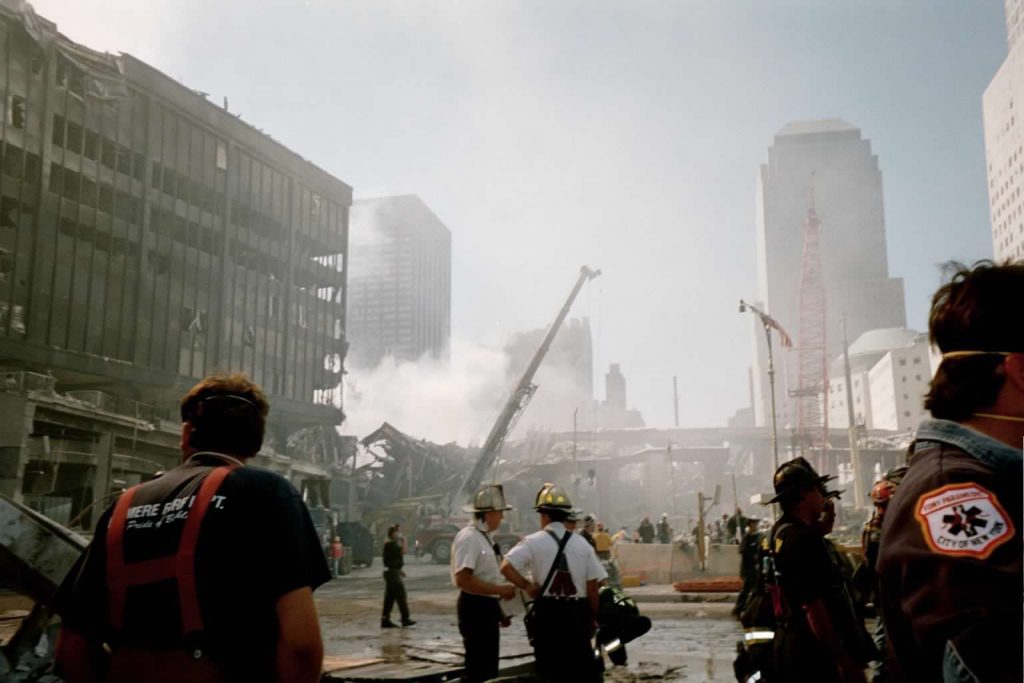
Lower Manhattan was surreal. It had been two days after the attack and the air was still thick with a big white fog of particulates. It was really overwhelming and surprisingly quiet.

Maybe it’s just my slow-motion way of remembering it, but sounds seemed dull, the way your neighborhood feels when it’s covered in a blanket of snow.

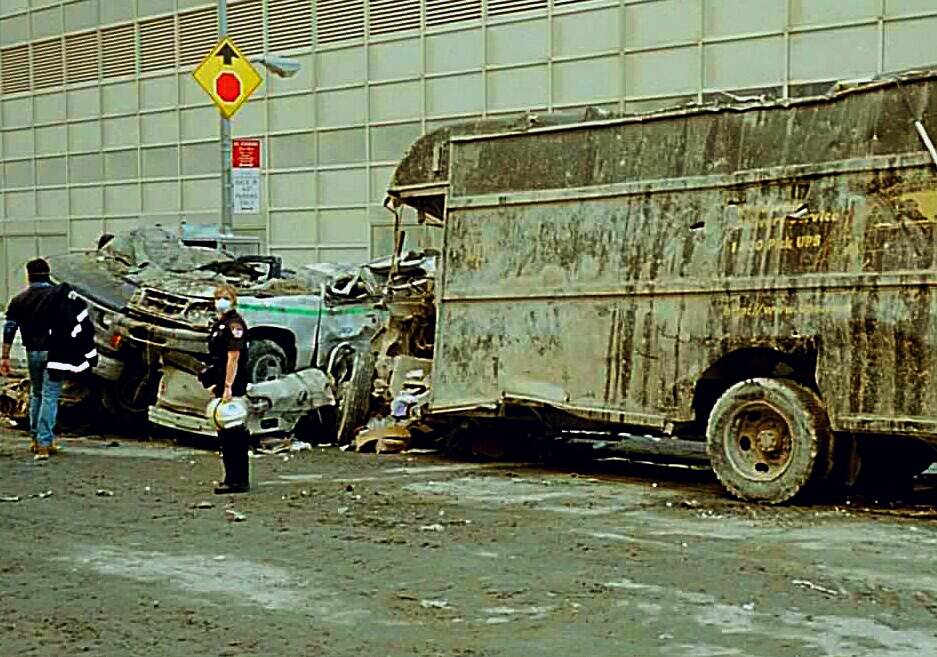
We parked in an area where other vehicles had been assembled, ones that had been recently used, as opposed to the ones covered in white dust and debris. As we walked towards what was left of the Trade Center we would often see a random person, almost everyone was wearing some kind of uniform, and they would give you a somber nod that you would return in kind.

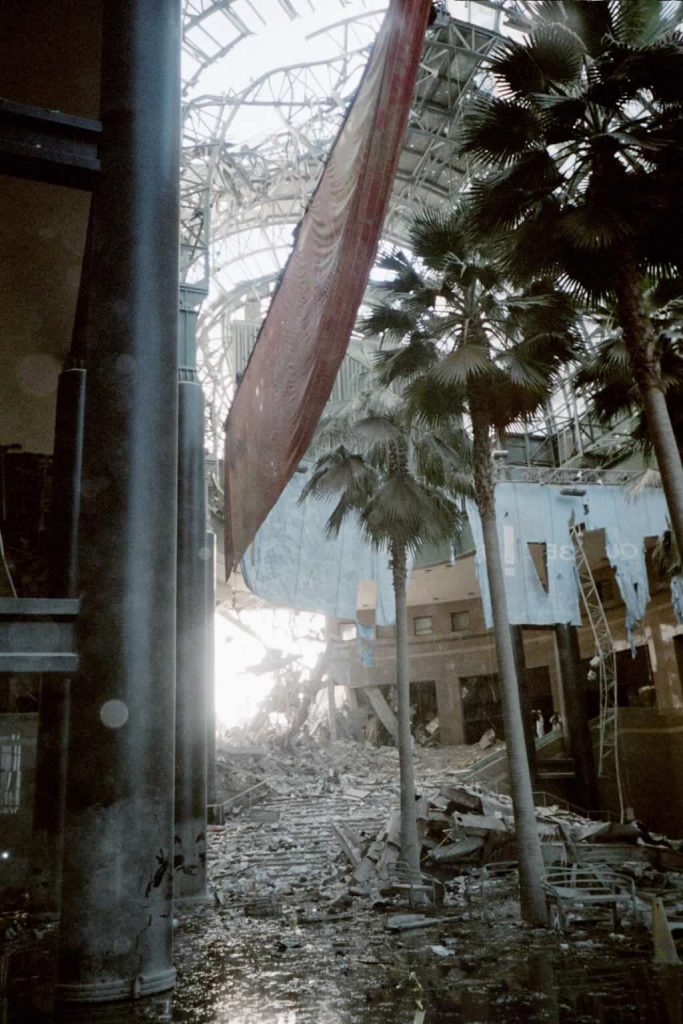
I was struck by the lack of “stuff” in the debris. It seemed to be mostly building material, steel, and rubble. Two major office buildings had come down and there was a surprising lack of office equipment, crushed or in pieces. There was also no glass. I assumed it was a large part of what was making up the white fog.

The air had a strange, acrid smell to it. After only a block or two, our uniforms were already covered in dust. At the first makeshift station we passed, we were handed an N95 mask, the kind I used to drywall my living room. At some point, later on in the day, I was warned by someone in a state uniform that my N95 mask was wholly inadequate and that I needed to get something better.

“Where?” I had asked.

“Oh, we don’t have any. Nobody does. But what you’re wearing, it’s not enough,” he told me. He’s the only one who said anything about it on any of the days I was there.

Everything’s good, here’s your mask, you probably don’t need it, air quality is fine…

We walked around seeing different people in different places. It was comforting to see familiar faces of friends you hadn’t been able to get in touch with. For this reason alone, I was glad to be there.

We spent a good while walking around, taking in the new landscape. I snapped a few photos with my disposable film camera. It was numbing to see what was still standing and what had been crushed.

At some point, I volunteered at a medical station that had no medical people at it. Someone there begged me and one of my group to stand by until they found a dedicated crew. It was in the lobby of a partially destroyed building. About an hour later, there was a sudden call to evacuate due to the instability of that building. My friend and I took off and went to look for someplace else we could be useful.

Much of the day consisted of stopping by, assisting, and then leaving when different orders came or new groups arrived. The amount of work ahead was, of course, insurmountable and it didn’t feel as if we had accomplished anything of significance but it felt much better than pretending nothing was wrong and following the same routine we had been doing.

The one thing that does stand out among all the sadness and shock was the massive number of people who came to help. They too, I believe, felt that doing something was an important way to get past the helplessness one feels when something terrible has happened.

So many individuals were donating their time, services, and resources. Massage tents had been set up, catering of all kinds was going on, tables were set up with all sorts of donated articles- t-shirts, gloves, flashlights, socks, helmets, climbing gear, and so many other things, it overwhelms me to remember.

And there were also the crowds, lining the roads leading to lower Manhattan. Access was blocked for most people and yet they found a way to participate and help. Their encouragement and positivity were a wonderful window of light in the dark room of our collective mental anguish.

I went to the site a few more times over the next several months. Over time, things became more organized. There were specific areas you could work, and eventually, Ground Zero became coordinated into a routine with procedures to follow and ways for things to be cataloged. The outpouring of love and appreciation from the public continued for a long time as well.

I never found out who the caller was on that day in the union office. I hope that he knows how uplifting his voice and his message were and how it meant far more than all the supplies they had managed to assemble in that short period of time. He was 100% correct about evil taking a backseat to good and he was definitely part of the ‘good’.

The GSW and the UTI

The woman who jumped into the back of our ambulance was gripping her crotch uncomfortably. She sat down on the bench and slid over to the middle, all the while her left hand maintained a vice-like grip on her privates. She looked at us with desperate pleading eyes.

“IT BURNS SO BAD WHEN I PEE!”

Even from a relative distance, I could smell the distinct, pungent odor of stale alcohol on her breath as she spoke. It was mixed with a faint odor of urine coming from her clothes.

“I’m DYING, you just don’t understand!” she continued. “I gotta pee all the time but then I don’t!”

Only a few minutes earlier, my partner and I had been following a police car going lights and sirens. There was information coming over the PD frequency that a shooting had occurred nearby and when the police car raced past us, we joined them. We notified our dispatcher that we were on the way to a potential GSW [Gun Shot Wound] and gave the location. Our ambulance arrived before we were even finished telling the dispatcher about it.

There was a block party going on and aside from the street being cordoned off, numerous cars and scooters were double-parked along the roads leading towards it. Unable to make it down the street due to barriers, we stopped at the intersection and parked haphazardly behind the police car which was also somewhat askew.

Ah, trauma…

Most EMS personnel love a good trauma call. Its adrenaline-inducing fast pace can provide a sensation similar to a runner’s high. It’s just enough euphoria to keep you interested, not too much to cloud your judgment. As a sporadic weekend athlete, I can attest that the endorphin reaction from trauma has a marked edge over the experience that happens after a satisfying run.

It was a hot summer night and we pulled up to mayhem. Shots had been fired into a block party crowd and people were running and screaming all around. Although several police cars were already at the location, we were the only ambulance and people immediately shouted directions at us.

“He’s over there!”

“That way!”

“He’s lying in the street!”

Everyone was indicating the same particular location in the disorganized chaos down the road. It was obvious that we definitely had one patient, perhaps there were more. We requested additional units from dispatch.

After collecting our trauma bag and a backboard we opened the large doors at the rear of our truck in order to take out the stretcher. That’s when the crotch-clutching woman clad in fuchsia hopped in.

“IT BURNSSSSS!” she cried.

“Lady,” my partner began. “You gotta get out! Someone’s been shot here!”

“I don’t care!” she said. Her look of desperate pleading took on a more angry expression. “My pee is on FIRE! I need a hospital!” She wasn’t asking.

My partner and I looked at each other in disbelief.

“Ma’am, please,” I tried. “More ambulances are coming, but for now, you’ve got to get out. Someone is in critical condition over there.”

“This ain’t critical? It’s been going on now for, like, TEN DAYS!”

Given there was something more pressing going on, we felt that she could probably endure the fire in her pants a little bit longer if she’d already been dealing with it for ten days. It was a legitimate triage decision.

People were still yelling at us and pointing down the block. They wanted us to hurry, he’d been shot in the chest, the consensus seemed to be saying.

A GSW to the chest?

This was EMS gold. It was a priority trauma job, something we could actually do something for. There was a real chance to make a critical difference for a victim of terrible violence. It was everything we had raced over here for.

But first, we had to send the pink tracksuit woman on her way.

One of the police officers on the scene wondered why we weren’t already running down the block with our stretcher. He came over and noted our dilemma. “Go,” he told us. “I’ll take care of this situation.”

We grabbed our gear and rolled the stretcher past groups of frightened and panicked party-goers. We quickly found a young man, he couldn’t have been more than 20, lying in the street near a table covered with spilled-over food items. He was using his fingers to plug up a hole on the left side of his chest.

“They got me,” he told us, gasping and out of breath.

The wound was fairly large, indicating a large caliber bullet. There didn’t appear to be an exit wound but we could tell there were some other bullet holes located on limbs which, at the time, didn’t concern us as much. We would have to work quickly to mitigate the anticipated blood loss.

“I GOT SOMETHING TOO!”

We turned around to see the same woman holding onto her genitals for dear life had followed us to the patient, the critical patient.

Good job, there, officer.

Well, at least he’d gotten her out of our truck.

“You’ve got to be kidding me,” said my partner.

“This ain’t no joke!” she replied angrily. “I saw you first. Plus, like, MY issue been going on longer. Ten days at least. TEN DAYS! You know what it’s like to pee FIRE for TEN DAYS? Let him get the next one.”

“That’s not how this works,” I answered. “If this has been going on for ten days, ten more minutes aren’t going to make much of a difference but for this man, ten minutes is a really big deal!”

It’s called the Golden Hour of Trauma. Studies have shown that the faster a trauma victim gets to an operating room, the better his chances of survival. There were things we could do on scene and/or en route, important things, but getting to an OR within an hour’s time was the critical factor.

The woman ignored me and laid herself down on our stretcher. The growing crowd came to our assistance as we worked to stabilize the man.

“EXCUSE ME!” screamed a bystander. “That bed is NOT for you!”

“Can’t you see that boy is bleeding from a HOLE in his CHEST? What is WRONG with you?”

“I’m the one who called 911!” said another. “And I sure as hell didn’t call for no ‘ho with gonorrhea.”

The woman quickly jumped up off our bed and got in the face of the bystander who had accused her of sexual improprieties. Her hand had finally released its grip on her genitalia and was now clenched into a fist directed at him.

“This is no STD! You don’t know what my problem is. Mind your own business.”

Another police officer quickly intervened. As he separated them, the pink-clad woman screamed up at the sky, “I’m a victim too, you know!”

The crowd responded with insulting remarks about the woman’s sexual history.

“No, the real victim is anyone who pays you $6 for a blow job.”

The woman wearing neon pink was prepared to fight each and every one of them but the police officer was able to steer her away before more violence ensued on Vernon Avenue.

It was obvious to even our lesser-trained bystanders that our 20-year-old GSW had serious, life-threatening injuries. He had been shot three times and it seemed that one bullet had pierced the air space around his lungs, causing pressure in his chest and increased pain while breathing. We were able to rapidly insert a needle into his chest cavity to release some of the air. Our patient expressed some momentary relief. He needed an operating room and a surgeon as quickly as possible.

As we started to rush our patient to the ambulance, we were eventually joined by the intoxicated woman in pink again. I have no idea how she kept escaping the watchful eye of anyone who volunteered to keep her away from us. She seemed to have lightning-fast abilities in catching up with us.

My partner got on the radio and requested an ETA [Estimated Time of Arrival] for any incoming units. Simultaneous trauma jobs in our vicinity had all available units tied up on other jobs. The voice over the radio was loud enough for the woman to hear that there would be a wait.

“Well?” said the woman, who had now resumed her impenetrable grip on her privates. She was hunched over now and limping. This woman who had evaded every law enforcement officer and bolted down the block to find us had suddenly deteriorated into a frail person who could hardly walk.

“I GOTTA GO! You can’t leave me here!”

When we reached our ambulance and loaded our actual patient into the vehicle, the usual discussion among the NYPD began as to who was going to escort the patient to the trauma hospital. With the added impediment of the complaining woman dressed in pink, a potential delay was gearing up to become even longer. Our patient needed to leave right away.

There is some dispute over the issue of patient abandonment which factored into our last-minute decision to take the woman along with us. Aside from the fact that our adrenaline stores were starting to wane, breaking down our wall of resistance, a very real question about whether or not we were violating our certification came into play.

Several legal terms were quickly considered, including “duty to act”, “abandonment”, and “nonfeasance”. There continues to be a debate as to how these issues are applied when more than one patient presents and one of those is critical. At that moment, it was easier to just take the woman with us than deal with unwanted consequences later or be delayed in any way by her removal.

The woman sat on the bench again, along with an officer. A notification was given to the nearest trauma center, which in our case, was in another borough. Patient #2 was displeased with our hospital choice.

“Queens?” she made a face indicative of the ingestion of a sour foodstuff. “Queens? Really? We ain’t got no hospitals in Brooklyn you approve of?”

“We’re going to a trauma center,” I patiently explained as I adjusted the IV and prepared for another.

“I know my infection is hurting but I wouldn’t say it’s traumatic. I’m sorry if I was being a bit over-dramatic.”

Was that an apology?

“We need a surgeon for this guy!” I said, no doubt my exasperation audible to this woman oblivious to the bleeding guy on the stretcher. The cop just shook his head. It was useless trying to explain, his telepathy told me.

I shook my head in agreement and took another blood pressure on the guy with all the bullet holes.

The woman resumed her tale of woe regarding the ongoing urinary tract infection [UTI]. She was familiar with them, had experienced them before, and wondered why she was cursed with them repeatedly.

Our gunshot patient interrupted his facial expressions of pain and suffering to say to me, “Is she being serious?”

I had no answer to give him.

We made it to the hospital in the vast reaches of Queens County very quickly. The staff was there, ready and waiting outside, to receive our GSW. As soon as the door opened, however, they met our UTI first.

“Ain’t this a nice surprise? I can’t believe you’re all here!” she remarked with a big smile. “The hospitals in Brooklyn don’t do this! I’m going to Queens from now on!”

There was some momentary confusion but everyone mostly ignored her as they focused on our young man on the stretcher. They circled around him, asking questions and shouting instructions to each other. They grabbed onto the stretcher and we all raced him down the corridor to the entrance.

The woman watched as the staff left her alone and she wasn’t happy about it.

She walked slowly, hand on crotch, and with a significantly more pronounced limp, behind us. My partner stayed back with her but she felt abandoned, yelling out “What about me!” at least once.

No one listened. Our guy was wheeled into the trauma room and they got to work on him right away.

“Was that the family?” one of the registration people asked. When I told her that she was another patient she gave me a sour expression, similar to the one the UTI lady had given me before. Apparently, these situations never occurred in Queens.

My partner escorted our UTI patient to the triage area and asked her a few questions for the paperwork we would have to do for our additional patient. She was indignant the entire time, wondering why not one of the many people who had greeted us as the doors of our ambulance opened, couldn’t have devoted their attention to her.

Since the triage nurse was in with our GSW, no one was around to listen to her complaints at the main triage desk. After waiting less than five minutes, she got up and started walking around the ER demanding a bed.

A hospital police officer quickly came over to mitigate the disruption to the busy ER.

“I need a bed! I gotta pee but I can’t!” she pleaded with him.

He looked around and directed her to the restroom.

“NO!” she yelled. “I gotta pee but I need a bed!”

“You want to urinate on a stretcher instead of a toilet?” he said, dumbfounded. “That’s the first time someone admitted it outright.”

At that point, our GSW was wheeled out of the trauma room for his trip to the operating room. He was surrounded by a large team of doctors and nurses as they quickly walked to the elevator. This enraged the woman even further. The critical trauma victim had gotten a team of specialized medical personnel and she, suffering from an infection in need of an antibiotic, was still waiting for a stretcher. It was outrageous, apparently.

The woman became very angry, shouting some derogatory words at the hospital police office and threatening to inflict violence on anyone who disrespected her ‘again’. The officer called for assistance at this perceived threat and the woman was handcuffed and restrained onto a stretcher.

She had gotten her bed at last.


Exact Words (part one)

Every three years, EMTs and paramedics in New York state need to renew their certifications. This involves attending a refresher course and then taking a written and a practical exam. Refresher set up has changed several times over the years, but in it’s best incarnation it involved three weeks at the Bureau of Training. During that time we would review for the state exam, practice skills, and go over new policies that may have changed since the last refresher. It was also a great time to meet coworkers from other parts of the service and share stories.

One refresher year, I was reunited with a friend I had gone through paramedic school with. At that time he was working in the Office of Medical Affairs [OMA]. Among other things, the people who work in OMA review random pre-hospital care reports. They generate statistics and monitor the quality of care patients are getting.

The call report has also gone through many changes over the years. Although now they are completely digital, for my entire career in the streets they were paper. They changed tiny spaces for the narrative into larger spaces, sections were added for billing purposes, the refusal area has seen it’s language changed, and other sections have been moved and changed over time. Even the report itself has gone from being an ACR [Ambulance Call Report] to being a PCR [Pre-Hospital Care Report] to now having that little ‘e’ in front of PCR [ePCR] to emphasize our jump to digital.

At the time I was taking refresher with my colleague from OMA, call reports started being scanned into a computer, as opposed to being stuffed into an envelope and mailed to OMA. I was under the assumption that they spent less time reading them now and more time analyzing the statistics generated by the computer, which were based on the filled in boxes.

Despite thinking that I had no audience, I still took great pride in writing my call reports. I tended to go beyond the dull narratives and a one-size-fits-all approach to writing them by adding details that would help me remember a specific call if I were ever questioned about it, either in an OMA review or in court. My favorite, and the favorite part of everyone who worked on my unit, was the “Chief Complaint”, which in those days, was a long, wide box on the top of the paper. It’s purpose was to explain why the ambulance had been called. I regarded it as the title of everything else that followed.

From the very first day we learned how to fill out the form, it had been reiterated to us over and over again that we are instructed to use the patient’s exact words. Most people ignored this directive, given the prevalence of foul language and extraneous sentences people tended to use when telling the story behind their phone call to 911. The majority of EMTs and paramedics made an effort to summarize the words that patients actually used, to gear it more toward what was actually going on, but not us. While others were editing those exact words to something more concise (“I have diarrhea”), my partners and I would delight in waiting for the patient to utter just the right sentence that described things the way he felt them (“My ass is like a fountain.”)

You have to take your joy where you can find it. If our service wanted exact words, then damn it, that’s what we were going to give them.

As I was sitting next to my friend in refresher, his department-issued cell phone rang while we were on a short break. Not long into the call, I heard my friend say, “…Oh yeah, she’s sitting next to me right now. Sure I’ll put her on.”

I reluctantly took the phone thinking, of course, that I was in trouble. No one from OMA just wants to say hello.

“Hello, is Nancy on 37V?” I said yes. “Hello, this is Dr. Andrews, in charge of OMA.” I knew Dr. Andrews as one of our doctors who took our telemetry phone calls and did some of our CME [Continuing Medical Education] classes. I didn’t know he had become the MD in charge of OMA. Despite the friendly tone in his voice,I was leery. It couldn’t be good if they knew your unit.

“I just wanted to let you know how much we enjoy reading your pre-hospital care reports over here.”

“You do?” I asked cautiously. I still wasn’t sure if this was a trap of some kind.

His voice remained friendly, “Oh yes! Not just yours but everyone on your unit. Reading these forms gets pretty tedious because they’re usually boring which is why we look forward to the ones from your unit. “

“Really?” I answered. “We were kind of under the impression that no one really reads them. It’s nice to know someone appreciates them as much as we enjoy writing them.”

“Oh you have no idea!” gushed Dr. Andrews. “We love them. We have a board where we write down the latest chief complaints from your unit. We put a star next to the ones where we recommend reading the comments as well.”

“No way!” I was flattered.

“Oh yes,” he told me. “It’s the 37V board. No one uses the chief complaint section the way you guys do. My personal favorite is ‘They sent two hot ones straight to my juice, yo!’ ” He was talking about the chief complaint for a man who had been shot twice in the testicles. It was a personal favorite of mine, as well. That one probably had one of those stars next to it.

He ran through a list of a few others they had enjoyed and told me to let my partners know that their pre-hospital care reports were appreciated as well. He said to keep up the good work and I thanked him again. As I handed the phone back to my friend I still couldn’t shake the thought that I had been set up in some way. But our PCRs did make for a fun read. He hadn’t been the first person to tell us.

Over the years we had written many of our best chief complaints down, to share with our coworkers and friends, and also for ourselves, to make us smile when there seemed to be little to smile about. My list includes:

“God wants me to suffer.”

“People tell me I smell bad so I want to make sure it’s not a disease before I take a shower I don’t need.”

“They beat me like a pinata.”

“I didn’t think I needed to read the directions that came with my new saw.”

“My foot is a new shade of green.”

“Cheap vodka makes me drive like an asshole.”

“I broke my arm on this shampoo bottle.”

“I’m just a loser. Take me to the hospital.”

“I am the great Mephistopheles of legend and lore. I inhabit this body now. Take me to your governing elders.”

“The aliens gave me an implant and I want it removed.”

“I’m just in it for the lawsuit.”

“You can’t brainwash someone who doesn’t understand and yet here I am.”

“He planted it in my rear end so hard, now my neck is crooked.” (this call concerned a car accident where the the driver of the front car claimed whiplash.)

“I just found out about ass cancer and I don’t want it.”

“When you’re a playa, penicillin is just part of the regimen.”

“A demon told me to stab myself but all I had was a pen.”

“My girl tried to give me a salmon named Ella with her warm-ass soup”

“My brother is in the hospital having a heart attack so I must be having one too because we’re twins.”

“I used to love eggs but now I don’t anymore.”

“My new girlfriend’s mother told me she didn’t like the way I looked. Do you think I look sick too? I don’t really feel sick.”

“I’m pretty sure I have a sexually transmitted disease. I deserve to have a sexually transmitted disease.”

“My goldfish gave me gonorrhea.”

“My asthma boy had a seizure.”

“There ain’t no kind of juice that ain’t coming out of that man’s leg.”

“WebMD says I have cancer.”

“That bish put a curse on me and I need it removed.”

“I went on a bender I don’t remember and now it hurts when I pee.”

“The hairs growing out of my mole are turning gray, like my beard.”

“My love juice is looking kinda green these days.”

“I got mascara in my eye.”

“My ex is a demon and I’m scarred by her love.”

“I made my boyfriend break my nose so I could get free plastic surgery.”

“My scalp is peeling off! I got these white scalp flakes on my shoulders!”

“I’m running out of reasons to go. You just write down anything you want.”

“Prostate cancer runs in my family.” (this was from a young woman who was very concerned over information discovered at a family BBQ)

“I can’t reach my toenails to cut them and they keep getting caught up in my socks.”

“I made a pact with tequila and now it’s coming to collect.”

“The peoples in the commercials for eczema medications looks so happy and I want to be like them. Tell them I have eczema.”

“This might look like a mosquito bite but it was from the government.”

“No one can touch me, I’m made of fruit.”

“My skin is dry but when I drink a lot of water all I do is pee, it completely bypasses my skin.”

“I know now that I can’t trust my dealer’s idea of a ‘good time’. “

“The roaches have it in for me. I see them watching. And plotting.”

“My face looked very puffy in this picture my mom took.”

“Take me to any hospital with a microwave that I can use on this food someone gave me that was cold.”

“I spilled orange juice on this paper cut and it must be seriously infected because it hurt like hell.”

“The bread machine sliced off my finger and it got lost in the dough.”

“The evil voice in my head learned how to play the drums.”

“It all started with a bad banana.”

“I got beat with a Slim Jim. The snack not the car opener.”

“There’s a bug in my ear and he talks too much.”

“I think I’ve got a disease.” (this guy would not elaborate as to what disease or why he thought he had one).

“I broke my tooth eating pudding.”

“I’m really into that hot nurse at Bellevue. I’m just going to get her attention.”

“The drugs they prescribed make me pee a lot.” (he’d been prescribed a diuretic, which tends to do that).

“I think I’m smelling too many things. This needs to be stopped.”

“I want the doctors to stop me from sweating.”

“The things I do in the bathroom ain’t right.”

“On my planet, eating paper doesn’t make your stomach hurt.”

“He been falling since the sugar ate his toes.”

“I wanna vomit so bad I could cry.”

“Every time I take tequila I wake up and everything is spinning.”

“I got a itch that makes me less of a man.”

“My cred got busted.”

“My eyes need to switch places. It’s gotta be done by Monday.”

“I don’t think crack is good for my heart.”

“He can’t stop wheazaling.”

“The gremlin I met when I was on mushrooms said I was going to die if I didn’t go to Methodist hospital and see someone called Dr. Joseph.” (strangely enough a Dr. Joseph was on duty that night)

“I need a bed and a woman.”

“There’s a smelly, yellow glue coming out of a hole in his head.”

“I was shot in the leg six years ago and today its thumping like a drum.”

“Someone needs to change my diaper.” (60 year old man)

“My hand smells. The left one.”

“I can’t reach this itch in the middle of my back.”

“I need a shrink to tell me why I attract crazy women.”

“I went to heaven in my dream but I know I’m going to the other place.”

“I gassed my face with roach spray trying to kill a mosquito.”

“The man on TV says I might have carbon monoxide in my home.”

“Women just don’t find me attractive.”

“My husband smells like pee, he must have sugar.”

“My big toenail is the same shade of yellow as my teeth.”

“I need a clean bathroom.”

“None of the doctors believe me when I tell them I’m pregnant.”

“My heart used to go ‘rum tum tum’, now it goes ‘boom boom boom'”

“I thought I could fly.”

“This tumor has it’s own zip code.” (this was for a large pimple, not an actual tumor)

“I want a doctor to prescribe me those new blue pills that will make me a hit with the ladies again.”

“I think I ate my tooth.”

“I beat the s**t out of someone, now my hand hurts.”

“Ny Quil made me have some scary dreams.”

“He beat me with my own [prosthetic] leg.”

“The old lady I tried to rob sprayed oven cleaner in my eyes.”

“God told me to cut off my hand because I didn’t need it anymore. But now I think it was probably the devil.”

“The pencil got stuck when I used it to stab the bug that lives in my ear.”

“This mole needs to come off. It’s the reason I can’t have babies.”

“God is the landlord who shut off the spigot.” (he had problems urinating)

“When they say not to put a fork in an electric outlet, they’re right.”

“That whiskey didn’t smell right but I drank it anyway.”

“My psychiatric drugs are making me crazy.”

“There’s a party going on in my ass.”

“My boy baby daddy stabbed my girl baby daddy in the ear with a skewer.”

“I don’t know man, I’ve been tired for like 30 years.”

“My stomach hurts when I eat a lot.”

“My driving instructor was right. I don’t know what I’m doing.”

“I took the Tylenol like they said but nothing happened and it’s been almost a half an hour.”


The Long Distance Girlfriend Experience

The ads on late-night television implied that for about $5 a minute, you could speak with an eager nymphomaniac clad in sexy lingerie and writhing about on the satin sheets of her king-size bed. “They’re definitely over 18!” many of the adverts proclaimed. The callers probably assume the woman they’re sharing sexual secrets with is doing so from the private comfort of her own home. How romantic (or hardcore) would it be to hold an intimate conversation in a cubicle next to 30 other cubicles?

The phone sex industry exploded in the 1980s with the emergence of 1-900 phone lines. 1-900 phone numbers charged exorbitantly higher rates than regular phone numbers, usually by the minute, and seemed tailor-made for carnal interplay, or psychic readings. Despite the best efforts of puritan government agencies and the later development of technology that delivered porn to your phone, sex chat lines continue to endure to this day. There is a lucrative appeal, apparently, to engage in naughty talk with an anonymous stranger. It provides an outlet for men to engage in a soft-porn fantasy: the long-distance girlfriend experience.

One day I was shipped out to work with someone in downtown Brooklyn and I ended up having one of those “nymphomaniacs” as a patient. It was where my innocent eyes were opened to the elicit world of landline love.

We were sent to an office building in the business district. When the doors opened up on the 6th floor, it looked much like the typical office settings I assume most people work in, though there were some notable differences. The cubicles were larger than any of the cubicles I’d seen elsewhere and the dividers seemed to be covered in a thick soundproofing material. Large billboards near the ceiling, holding messages about bonuses and incentives, had images of shiny, red-painted lips talking into phone receivers held by hands that had shiny, red-painted fingernails.

None of the employees resembled the woman in the pictures hanging overhead. No one wore lip gloss and any manicures were subdued. The uniform of the day appeared to be sweatpants and unmatched leisurewear. There wasn’t a teddy to be found, though there were plenty of hiking boots and flannel shirts. Aside from the relaxed dress code, another thing that let us know we weren’t in the standard American workplace included the two large and very intimidating security guards at the entrance.

A friendly woman greeted us immediately and told us she’d take us to the patient. The woman wore a lanyard around her neck attached to two pieces of official-looking ID proclaiming her name to be “Bambi”, quotation marks included. A quick glance at the other lanyard IDs revealed that a name ending in “i” was likely a prerequisite for employment. We were surrounded by a number of Rikki’s, Tammi’s, Freddi’s, and Toni’s.

As we walked down the path towards the patient we listened in on snippets of raunchy phone interactions. The women vocally expressing their enthusiasm for deviant sex acts did so while filing their non-red nails, thumbing through magazines, and various other multi-tasks. One woman’s attention was intensely directed towards a birdhouse she was building out of popsicle sticks, while at the same time feigning believable interest in bondage. Her face lit up when we admired her handiwork as we walked by.

The whole time we were walking, we were followed by a young man, dressed in a suit and tie, holding something. When we reached our patient, whose lanyard gave her name as “Candi”, quotation marks included, the man propped a prosthetic leg against the wall of the cubicle. He gave a polite nod and left.

“My leg!” shouted “Candi” with delight. “Thank you so much!” She was a fairly large, middle-aged woman with a haircut that resembled a crew cut. It looked as if a tremendous effort was being expended to breathe.

“Bambi” told us that when “Candi” started complaining of difficulty breathing they moved her into a bigger cubicle that had a window, which they opened so she could get some air. “Bambi” proudly told us that “Candi” was their most consistent Gold Star employee and hoped we’d give her Gold Star treatment. Going by the billboards near the ceiling, it meant that she was receiving the highest bonuses.

My partner asked what we were both thinking, “What gets someone a ‘Gold Star’?”

“Call me and you’ll find out,” “Candi” said through labored breaths but with a wink and a sly smile.

“Candi” was sweaty and very pale. Our visual medical impression told us something serious was going on. We got to work quickly putting her on oxygen and assessing her vital signs. When we asked her about her medical history she dumped the contents of her large handbag onto the desk. She dug around through the pile that included her wallet, some keys, a lighter, a pack of cigarettes, a few candy wrappers, and a very large rubbery dildo, to hand us her medication bottles. They indicated she had hypertension, diabetes, high cholesterol, and a thyroid condition. She also told us she had renal failure and was under the care of a cardiologist. For someone who was only 45, she had an extensive medical history.

She opened up her flannel work-shirt so we could put on the little pasties for our monitor and we listened to her lungs, which were clear. When I mentioned this to our patient, whose other ID said her name was Mary Robles, she gave a somewhat resigned expression. “Then it’s my heart,” she said.

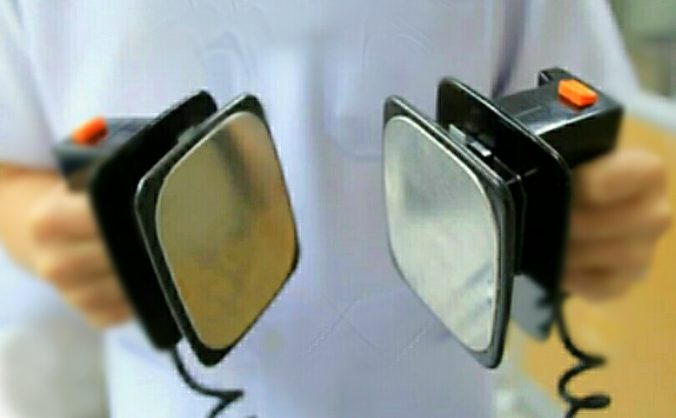
She pantomimed the cardiac monitor paddles from the days of old, imitating the recoil of being shocked by a jolt of electricity, as her thumbs pressed imaginary buttons. She’d obviously been through this before, apparently with machinery using 1970s technology. When I told her we used sticky pads now, not the old-school paddles, she nodded sadly, knowing as we all did, that the pads did not hold the same dramatic effect.

Our modern cardiac monitor indicated that her heart was beating erratically and very fast. At the time we didn’t carry any drugs that would fix it. As Mary/”Candi” understood, a dramatic jolt of electricity was the only thing we could do. But we did have some drugs that would help our patient with the pain of the procedure. We just had to call our MD to get approval.

“Bambi” waved over to the phone on the desk and told me I could use it to make the call. She went over to help “Candi” put her stuff back into her purse without telling me about the numerous assortment of buttons on the phone. It was hard to stifle a laugh as we watched her try to wrestle that dildo back into the overflowing purse. My partner turned his head as he attempted the easier job of starting an IV. Making the phone call turned out to be far more challenging.

For the youngsters who have never used a landline I’ve provided this video:

I had some difficulty figuring out how to get an outside line with their phone. I couldn’t find a button that produced a dial tone so I started randomly hitting each one. It seemed that each button I tried gave me access to the phone calls being made from the cubicles around me. Each call I inadvertently eavesdropped on was long past any foreplay discussion and some involved heavy moaning. It was rather eye-opening conversation and when “Bambi” noticed my reactions as I quickly hit other buttons, she stepped in to assist me.

Laughing, she explained that we were in a “Quality Control Cubicle” and a regular assignment at this office was listening in on phone calls. “If the customers only knew…” she said.

With her assistance I was able to get in touch with our telemetry doctor who gave us permission to use Valium to sedate Ms. Robles. He and I both expressed some concern over the procedure we were going to do, given the overall precarious health of the patient, but the MD admitted there was no other option. The patient, herself, wasn’t the least bit worried, however.

“Bring it on, I’m ready!” she said, loud enough for the MD to hear.

“Looks like everything will be fine,” he told me.

Cardioversion is a heart-stopping experience, quite literally for the patient, but also for paramedic caregivers as well. After you sedate the patient and charge up the machine, there’s usually a bit of apprehension before hitting the button that will deliver a few joules of electricity through the benign-looking pads we use now, instead of the familiar paddles seen on screens large and small. Interrupting the abnormal electrical activity going on in someone’s heart carries the risk of stopping it permanently. It has never happened for me yet, at least in someone who was sitting and talking to me, but there’s a first time for everything.

In the case of Mary Robles, sending those 100 joules of electricity to her heart did nothing but cause her to utter a loud, prolonged, moaning-type of yell, which fit in quite well with her current surroundings. I’m sure the soundproofing material of those cubicle walls did nothing to block the sound to her fellow moaners nearby. Except Mary/”Candi” wasn’t faking it, this time.

Her heart went right back to the very fast, erratic, and inefficient way it had been beating before. This meant we would be pushing that button again, this time with a slightly higher dose of electricity.

Our patient was unfazed. “Fire away!” she said after we shot her up with another round of Valium.

We were far more nervous than Ms. Robles when we pushed the button a second time. Once again, we delivered the jolt which brought forth another yelling type of moan. It was also followed with a relieved kind of “Whew!”

We all carefully watched the monitor with anticipation. Thankfully the jumbled electrical patterns organized themselves into a regular rhythm. Our patient knew what this meant even before we told her and she raised her arms and yelled a triumphant, “YES!”

She told us she felt much better and her vital signs reflected it as well. As she grabbed her prosthetic leg she told me that losing her leg made her better at her job. I gave a confused look and she just smiled. I still wonder what that meant.

As we headed to the hospital, she told me that many of the employees there were customers of hers. I asked her how she knew but she just gave me another wink and a smile.

Bleeding Hearts

Almost immediately after receiving our job for an “unconscious in front of a deli”, another call went out to a different unit, alleging that a person with “severe abdominal pain” was on the same corner. Two more ambulances and a fire truck were dispatched to a “Cardiac Arrest” at an address with cross streets strongly implying that they too were headed towards the same intersection.

The EMS equivalent of the Cavalry converged upon that one corner, which had a large deli at its crossroads. A disheveled man was sitting outside on an overturned milk crate. He had a dirty beard and the clear flask of a well-known brand of vodka dangled, somewhat, out of his jacket pocket. Though he glanced at us when we arrived, he made no effort to flag us down. The man was very much awake and seemed to be comfortable. We all assumed he was probably the intended target of all these 911 calls; people often call for strangers who have no idea that someone thought they were in need of emergency care. But we made a good effort to check around and inside the store to make sure there wasn’t someone else, someone with a true emergency, in need of medical personnel.

The man became angry with our efforts to locate patients who might have matched the medical complaints we had been summoned for (seizing, unconscious, and/or in cardiac arrest) and finally announced that he had called 911, not just once, but several times, for himself. He berated our unprofessional-ism for not recognizing that his non-distressed demeanor and lack of effort in announcing himself obviously meant that he was the person in cardiac arrest/having a seizure/experiencing severe abdominal pains.

“I hadda call THREE times! Three! It took you guys almost FIVE minutes. What if this was an emergency?”

“So you’re admitting this isn’t an emergency needing an ambulance?” we asked.

He backtracked a little. “Well, it most certainly IS an emergency. But not the dying kind.”

We let the other crews, who were getting off duty shortly, know that we could probably handle this medical enigma on our own. They thanked us and wished us luck.

The man walked over to our ambulance carrying a large plastic shopping bag that he was very protective of. A diverse bouquet of pungent body odors wafted towards me as stepped into our vehicle.

“Your entire agency should be dissolved by the city. Waste ‘a money. They just need taxis. Free taxis for everyone. No one needs these big trucks.”

We pointed out how our service is designed for medical emergencies and that we are supposed to handle life-threatening conditions.

“For what? They can go to the hospital if they have a medical condition.”

It was no use explaining.

Once inside, the man immediately demanded that we take him to a hospital that was not the close one nearby. He was geared up for an argument but he got none. The hospital he wanted wasn’t unreasonable, although it meant I’d have to try to block the smell a little longer.

“Them nurses there are NASTY!” he told me, as he shook his head. “Ugly too. But that’s the hospital it’s gotta be.” He looked sad but determined, as if he had resigned himself to a task for which he’d be martyred for.

He refused to answer my routine questions about his name and birthday. He was ready for another argument, explaining how I wasn’t entitled to any of his personal information. He went on a long diatribe about privacy issues but I had already put “unknown/refused” on my paperwork. When I asked to take his vital signs he also refused, telling me he’d “sign the paper”, meaning he understood how this all worked. He flipped my paperwork over to the correct section and signed the name he told me I wasn’t entitled to know.

When I asked him about his reasons for going to the hospital he seemed comfortable revealing some of his medical history. He told me he had high blood pressure but he wasn’t taking his medicine because it made him “less of a man”. He said he was “healthy as a horse, and hung like one too”. A big wink, in my direction, accompanied that information.

I also received a very long list of every injury that had ever befallen him. He had TMJ from being slapped by his ‘ex’, he lost a tooth by biting into a biscuit from a large fast-food chain he was currently under litigation with, and he fell down some stairs when he was drunk, which injured his hip. He ended his story by telling me that his last MRI showed he had bulging discs.

I just wanted something halfway relevant to give to the triage nurse. “Am I telling the ER that you have back pain?” I asked.

“No, Moron, I’m telling you I ALWAYS have back pain,” he shook his head again. The torture I forced him to endure…

He called me several other names and titles that illustrated his frustration with our procedures. I was a “bureaucrat” for requesting an exam and interviews instead of just taking him to the hospital where he “needed to be right away”. I was also a “lazy union drone”, an “idiot”, and my favorite, “a feminazi” because I was doing a “man’s job”. He told me I had foolishly “bought into that whole women’s rights nightmare” because I was a “man-hater”.

He went on to complain about my partner as well, for not refusing to work with a woman (“it takes the masculinity away from all of us”). He told us how much he hated the entire 911 system, the city itself, the shelter system, and he went on and on about our previous mayor, who he believed was still “running the show”. He hated “bleeding hearts” and the socialists who were destroying our city. He also complained about the city services he wanted but did not exist, like free taxis. He complained about the amount of money he received from his federal Supplementary Security Income, telling us a monthly total that was more than my partner and I took home with our regular salaries.

“You can’t live on that in this city!” he screamed.

I know man, I know…

One person, in particular, he decided to vent his frustrations about, was the woman who had purchased food for him from the deli. She was another “MORON” for not understanding that he’d been asking for money for food, not actual food.

“Maybe I wanna make my own choices,” he said. Then he referred to her with a really bad slur for a female. “She was like ‘I don’t want my money being used for alcohol. My religion is against alcohol. I don’t want to support any bad health habits…’ blah blah blah. Fucking bleeding heart…Those people are the ones destroying everything.”

As he was berating the woman who bought him the contents of his bag, he took everything out of it to rearrange the items. She had given him a large bottle of water, a big can of iced tea, an assortment of baked goods, a package of socks, a package of t-shirts, tissues, a small bottle of pain relievers, a few bagged snack items, cold cuts, and two large Styrofoam containers of food. She certainly was an evil monster.

“This asshole didn’t even have my food heated,” he told me with all seriousness. “You know, they let you reheat the food from the food counter in there. She must have known, there’s a sign right there on the sneeze-guard. I would have gone in to heat it myself but I’m banned from the store. I spit in a few of their food trays once. I didn’t like their choices and I had a right to express myself when they didn’t take my concerns seriously. Bunch-a bleeding hearts…” It seemed to be his favorite insult.

“Cold food. Can you believe it?”

As someone who ate between calls and on the run, sadly, I was all too familiar with room temperature sustenance.

We had just reached the ER when he was finished fixing the bag up the way he wanted it, with the food containers near the top. He promptly undid his seat-belt, slid over to the back doors, and expertly opened the back lock. Then he made his way over to the hospital entrance without waiting for either my partner or myself. Now that he had reached his intended destination, he no longer needed to have anything to do with us.

He punched the ‘secret’ code into the panel that opened the electronic doors and proceeded to walk past the triage area. A security guard followed him, telling him he needed to wait for the nurse.

“I don’t need a nurse,” he told him. “I know where I’m going.”

The security guard didn’t seem to know what to make of that but decided to just let him continue rather than pursue him any further. Our patient walked right over to a small, closet-sized room that the nurses used as a kind of lounge. It contained a locked bathroom, two chairs, and there was a microwave on a counter.

He opened the door to the microwave, put in the first of his two containers, and pressed the button for “potato”. The man had concluded his ultimate errand.

The entire ER came to a standstill as every nurse in the vicinity noted what was happening. Each face expressed disbelief and anger. They looked around at each other to see who was going to act first. Oh boy, were they outraged!

The nurse who was supposed to triage me marched right over to the small room with resolute determination. She was fuming. “Sir, this room is off-limits to patients.”

“I’m not a patient,” he told her matter-of-factly. “I’m just here to heat my food.”

“Sir! This is a restricted area. You need to leave! You can’t just come in and start heating your potato.”

“It’s not just for potatoes. I’ve got pork that needs to be heated to a specific temperature or I might get sick. There’s also some mac and cheese, some green beans… ‘Potato’ is the most efficient setting on a microwave. You don’t even know how to use this thing, do you?”

“This microwave does not belong to you. You can’t use it. You don’t belong in here.”

“Sure I can. My taxes paid for this microwave.”

“Sir, you don’t understand. You need to leave and get back over to triage,” she said as she pointed to the triage desk. You could tell that her patience had reached its limits.

“No, you don’t understand. This is the whole reason I came here, to use the microwave. I’m not sick. And if I were, I sure as hell wouldn’t come here.” He looked around the ER. “This place SUCKS!” He seemed surprised at everyone’s reaction as if he’d said something perfectly reasonable and they were all getting angry for nothing.

“Security! Security!” the nurse started yelling.

At the same time, another disheveled looking man, who was on a stretcher in the hall took a moment to defend the hospital. “Ahhhh, it’s not so bad…”

A different patient decided to tell our guy, “you don’t even pay taxes.”

“Yes I do,” he answered. “I pay taxes every single day on alcohol. Do you know how much the liquor tax is in this state? It’s robbery. I coulda bought 10 microwaves by now with all the cash I’ve given to this bleeding heart state.” Bleeding heart was, by far, his favorite term.

The security guard, now forced to contend with the disruption he might have intercepted earlier, simply parroted what the nurse was already saying. “Sir, you have to leave…”

“Hold your pie-hole,” said our patient as he dipped his dirty finger into different sections of his Styrofoam container. “I’ll be out of your hair in just three more minutes. Your appliance needs servicing, by the way. For 1000 watts, ‘potato’ should have done the trick by now.”

The bald officer decided to get to the root of the problem. Looking around, he asked, “Who brought this man here?”

I raised my hand.

“What’s wrong with him?” he asked me.

“I don’t know,” I replied honestly. “He refused to provide any information.”

“What? Are you all stupid?” announced the guy I had brought in. “I CAME HERE TO USE THE MICROWAVE.” He yelled each word slowly as if reprimanding a room full of misbehaving children who did not understand. Then, his mood switched over suddenly to humor us. “Now that I’m here, maybe I’ll lay down on one of these stretchers when I’m done. Probably have the ‘itis in a few minutes…” He laughed, seemingly oblivious to the unchanged demeanor of the crowd.

The nurse, who despite her constantly annoyed expressions was one of my favorites, became more of my hero when she decided to take control after giving a disgusted look to the security guard. She shoved past the foul-smelling man and took his food out of the microwave.

“The Jo-velle Deli on Louisiana and DeKalb. Excellent buffet. Smells great, right?” Our guy gave high marks to the establishment that banned him.

The nurse took the food and started marching with it, towards the electronic doors. Our man followed her, although he seemed to be confused about what was going on. When she got outside, the Styrofoam container was semi-tossed onto a broken stretcher in the ambulance receiving bay and she wordlessly went back inside.

After she signed our paper, which was accompanied by a “look”, we went back outside to find our man eating the food that terrible woman had purchased for him. He looked up at us and smiled, pointing to his meal.

As we got in our truck, he yelled at us to wait for him. He would be needing to microwave his other Styrofoam container soon and there was only one other hospital we could take him to now that he was banned from using the microwave at this one.

Fighting Demons

It was easy to see that the building had once housed a storage business. It was square and utilitarian and it said “Horizon Storage” on one of the walls. The only thing that let you know that it now served as a house of worship was a big wooden sign over the lettering of the previous owner. “Vision of the Awakened Triumph Church” it proclaimed. “The Rev. A. Thompson, PhD, Pastor”.

We walked into a large room where a congregation wearing their Sunday best had their attention fixated on several men, surrounding another man, who was wearing a burgundy suit. They were in a circle around him, each with an arm touching him, and they appeared to be praying. When the congregation saw us their serious faces of concern turned into smiling faces of relief.

“Hallelujah, and welcome!” they greeted us. Their friendliness and hospitality instantly endeared me to the congregation.

We went over to the man they were praying over and the other men moved away. The man dressed in burgundy instructed the others to continue with the service.

“It’s important,” he told them.

Although we were in the back of the room, it was difficult to hear the patient and we suggested going out to the ambulance. But the man insisted that he didn’t want to go to the hospital. He did not even want to be checked out in it. He said it was important that he stay. So we did the best we could to evaluate him where we were.

Brother Henry was a little disheveled. He had some dust on a sleeve and a few bruises on his hands. While he was telling us about a few more injuries, a nearby woman yelled at him to “Tell them how you went out! They don’t care about a couple of bruises. Tell them how you ended up on the floor unconscious!”

She told us that was why we were called. “We wouldn’t have called if it were just a few bruises,” she told us, as if no one would call for such a frivolous reason. (How I wished that were true.)

Brother Henry looked a little embarrassed but he shook his head and said with his voice rising, “I may have fallen down but I was never knocked out!”

We asked him if he was dizzy now or before the incident and he said no. Another woman said he had “problems with sugar” but Brother Henry assured us that he did not have diabetes.

All of this, coupled with our initial difficulty hearing, led us down a medical path to explore the origins of what happened. We hooked him up to our monitor and evaluated his vital signs several times while continuing to ask questions. At one point, the entire congregation broke out into song, and it was modified to be about us, being the instruments of the Lord. They also prayed for us several times. We felt like celebrities.

We could find nothing of concern with our exam but we still recommended Brother Henry seek additional evaluation at the hospital because he may have passed out.

Brother Henry interrupted, “Passed out? I never passed out.” We explained that we didn’t know what had caused the incident and he shook his head and said very emphatically, “Sure I do! I told you when you got here. I was fighting a demon.”

This took us both aback somewhat as we tried to figure out what metaphorical context he was referring to. Was he an addict? What other ‘demons’ are there?

It turned out, however, that he meant a literal demon, the kind that involved being a mythical beast intent on evil.

And everyone in the congregation agreed.

Brother Henry explained that he had given a particularly powerful invocation which had conjured up an entity that he described as half man, half beast. Everyone in the room nodded in solemn agreement. A small puff of smoke had appeared, through which the demon had entered, laughing. He said his head was large and somewhat resembled a buffalo.

“With wide horns!” said one lady. “That’s how he was gored!”

Brother Henry lifted up his shirt to reveal a red circular bruise. There were fresh scratch marks on the floor, which, we were told, were made by the cloven hooves of their common enemy. Henry showed us his damaged pant leg where underneath was a long red scratch and more bruising. He said the demon had kicked him. His description had the demon towering over all of them at around 7 feet. Others volunteered that he had long fingernails painted red and glowing yellow teeth. Not one of the 30-40 people in the room disputed this description or version of events.

“Where is the demon now?” we asked.

The demon had disappeared, they said, when it saw that he was no match for a powerful man of God. Brother Henry was a strong elder, they explained, and he was backed up by people of unshakeable faith.

Vision of the Awakened Triumph: 1, Demon: 0.

My partner and I just looked at each other for a minute. The paperwork was going to be tricky.

I quickly opened my call report paper and flipped it to the side where the RMA (refusal of medical attention) section was and Brother Henry readily signed in the appropriate areas. The Rev. A Thompson, PhD, witnessed it himself. It was either have him sign the RMA or haul all 40 of them to the psych ward for evaluation.

As we left, the friendly people of the church all wished us well and said they would pray for us. We could use it.

“What just happened in there?” my partner asked. I shook my head. I thought about the bruises and the rips in his clothing, the seriousness of everyone in the congregation.

What could have caused all those injuries? What had they all witnessed? Some sort of mass delusion? Maybe there was a reasonable explanation that they interpreted as a demon? Who could say? We weren’t there. I just hoped our paperwork wouldn’t be flagged by the reviewers at the Office of Medical Affairs.

Young Thespians in Jail

A huge building had gone up near our area. It took up a whole city block but it was unremarkable and there were no signs advertising what it was used for. We weren’t all that curious and just continued to drive past it with occasional passing interest. For many years we were able to blissfully ignore it.

But then, one day, our good fortune changed and we became very familiar with this large building, as we started going there all the time.

We found out that the building was a juvenile corrections facility, housing children age 16 and under who had committed the worst crimes and required a high level of security. They had an infirmary and a medical staff that had been getting by without calling for an ambulance for so long that their new about-face was somewhat perplexing.

Our first call there was for a 16-year-old boy having seizures. He had obviously never witnessed anyone having an actual seizure, either in person or on TV, or he could have provided us with a more believable performance. There are different kinds of seizures and some of them present differently, but our patient hadn’t mastered any of them and seemed to be making things up as he went along. With his floppy arm movements and erratic blinking, I had a hard time believing that the professional medical staff in the infirmary had bought into this pageantry.

Perhaps they believed he was in need of hospitalization because the kid didn’t have a seizure history and may have been worried the seizures were a manifestation of a hidden brain tumor.

We gave the young man an IV, which was easy to do since he temporarily halted his flowing, dance-like arm motions so we could get it without accidentally sticking him elsewhere. My partner and I had spoken at length about how painful that would be, while we were preparing our IV set up. I guess he had been lucid long enough pick up on that bit of information. After we secured our IV, the patient resumed his feeble attempts at seizing, but would again, temporarily, stop each time we pushed medications through the IV.

We have had many people fake seizures for us, for various reasons. Sometimes it’s to be dramatic, for others it’s an attempt at getting some Valium. We didn’t know the motivations for our current patient, but if he wanted Valium he’d have to do a better job at convincing us.

We could still give him “the cocktail”, however, as we called it, for our “Altered Mental Status” protocol. At the time we carried Thiamine (vitamin B1) which was part of the cocktail triad, along with Dextrose (sugar) and Naloxone/Narcan (the drug that reverses the effects of opioids).

It makes me sad that new paramedics will not have the ability to witness the placebo effect of the Thiamine wonder drug, since it has been taken out of our protocols currently. Thiamine was considered so benign that the board, who decide our protocols, found it to be an unnecessary expense. They had obviously never witnessed its miraculous efficacy.

If the kid envisioned a future on the stage, he could have learned something from us that day. Having had so many opportunities to practice our own acting skills, I’d like to think we did our routine convincingly. We used the standard script developed for these occasions. It’s one that all paramedics seem to have subconsciously downloaded into our psyches, possibly acquired subliminally when learning our protocols.

We start out with Dextrose and then deliver the Narcan, each time announcing to each other, with solemnity, that we hope the drugs work because the patient appears so seriously ill. We then kick up our level of resolve by moving to the standard, somber discussion about Thiamine.

“I guess we will have to give the Thiamine,” I announced with extreme concern.

“I know. I can’t believe the other drugs haven’t worked yet. We have no choice,” remarked my partner.

“But remember the last kid we gave it to? He’s a vegetable now, on permanent life support. I’m worried about its safety for teenagers. I don’t think they tested this enough on younger patients.”

“Yeah, but it’s still in protocol, at least until they settle the lawsuit. I’m not getting in trouble. Hand me the vial.”

“I don’t know, I really want no part of this,” I said with emphasis.

“It’s OK,” said my partner, nobly. “I’ll take complete responsibility.”

Miraculously, our 16-year-old made an instantaneous recovery in a matter of seconds. He sat up as if sleepy, wondering what was going on. What was happening? Did he have a seizure or something?

The dopey medical staff was also impressed, which had me seriously doubting the framed credentials hanging on the wall. We took him to the hospital to get “checked out”. We gave the ER staff a brief description of the psychedelic dancing he wanted to have interpreted as a seizure and they said they looked forward to the presentation.

A very short time after we dropped off the male, we were called back for a female. The juvenile center was certainly making up for lost time after all those years of handling the residents by themselves. Our second patient was 15-years-old and she was trying for the Academy Award in the Asthma category.

She had done a good job of convincing the inept staff that something asthma-like was going on. I wondered if they had ever dealt with a real asthma patient. The staff was in a panic, knocking things over and bumping into each other, trying to fill her nebulizer device. We, on the other hand, were extremely familiar with asthma and all of its manifestations. It made up a major percentage of our call volume. We gave her performance a decided thumbs down.

All of her ‘wheezing’ was caused by a concerted effort on her part to constrict her throat muscles. Her lungs were absolutely clear. Because she had to un-constrict her throat muscles to talk to us, her ‘asthma’ was temporarily abated when she answered our questions.

I discreetly pointed out to one of the nurses how miraculous her recovery was. The nurse seemed to feel it was their quick action with the nebulizer that was responsible, despite a floor wet with spilled asthma medication. My faith in those accreditations on the wall continued to wane.

We took the asthma-girl to the same hospital as the seizure-boy because it was the closest. As per the policy of the detention facility, each trip to the hospital meant that two corrections officers were needed to accompany the patient. At the hospital, the two pairs of officers met up. They resented that their day had been interrupted by extraneous visits to the hospital, as it left them short-staffed at the facility. They too suspected the youngsters were faking their illnesses and they were furious.

About two days later the ‘asthma girl’ had another attack, despite a handful of new medications prescribed by the hospital. We had only gone to our newly-noticed juvenile facility three times at that point, but it was already growing tiresome.

When we wheeled her into the pediatric emergency room, lo and behold, the seizure boy was there again also! He had suffered another episode. It was a spectacular coincidence.

I noted the time on my watch and saw that the pair’s latest medical attacks had occurred at the same time of day as their previous episodes. Their amateurish performances were on a schedule.

I took one of the disgruntled correction officers aside and inquired about the relationship between the two and was shocked to discover that not only were they boyfriend and girlfriend, they had landed in the facility for committing the same crime together. I could have never predicted it.

The corrections officer had much dirt to spill for us. It turned out that the lovers were not just terrible actors, but terrible human beings as well. He, and later the other officers, told us that the young couple had attempted to kill the girl’s grandmother when she became an impediment to the young lover’s plans.

She had not approved of her granddaughter’s dating choice and grounded her one weekend. The next day, they put drain cleaner in her coffee. Despite the unusual smell and taste, the grandmother had ingested enough to cause severe burns to her esophagus and was in critical condition at a hospital.

The pair had left the drain cleaner and the coffee cup containing the drain cleaner on the same counter, making it easy for the police to put two and two together. Their fingerprints were all over the bottle and the coffee cup, and neither of them had called 911 when the grandmother began choking and writhing in pain.

A neighbor happened to be walking past the apartment and heard the fall and the elderly woman’s attempts at screaming. The acting debut of the young criminal lovers, which consisted of pretending to be upset and shocked that grandma had drunk something so toxic, was not well received by the police or the neighbor.

Ever since their arrest, the two had been housed in separate areas of the same facility and there were never opportunities to come in contact with each other. It seemed that the only place the couple could be reunited was at the hospital, even if only for a short time. As a result, their “illnesses” became more and more chronic, wearing out the patience of the EMS community, and also the hospital staff.

Many people we knew had taken at least one of them to the hospital at some point, and all of them, thankfully, mocked their poor interpretations of an asthma attack and a seizure.

Having witnessed the damage drain cleaners can do when ingested, I had zero empathy for the plight of the star-crossed lovers and their efforts to be together. Nor did any of the other EMTs and paramedics, who were getting a little tired of having to participate in their charade of a medical emergency. It was curious that those two were the only patients we were ever called for.

How long would we all have to wait until they were sentenced and incarcerated elsewhere? We agreed that this thing needed to be nipped in the bud if we wanted to resume our ignorance of the large building on Pitkin Avenue.

We collectively decided that other hospitals should share in the poor acting abilities of the young would-be murderers. We were sure the corrections officers would be willing to assist us in the endeavor.

The next time we went there, it was for the female, who protested when we gave the name of our intended hospital destination. “Her doctors” were waiting for her at another hospital. Surprisingly, it was the same hospital her boyfriend had been transported to just an hour before. The corrections officers jumped right in and explained that their policy had been revamped to keep inmates separated outside the facility as well as inside.

During discussions of the new policy, our patient’s ‘asthma attack’ miraculously subsided and she decided that she no longer wanted to go. We had to take her anyway since she was not old enough to make the decision on her own and the facility required transportation.

Since her reason for going had been thwarted, she protested wildly over her desire to stay. But the concerned nurses at the infirmary noted how her disease had been progressing so badly as of late, and they would not be comfortable with her staying there.

The young actress was a victim of her own success.

Now that she was going against her will, she whined and complained about the waste of time it was for us to take her. Why was she going if she was OK now? She glared with hatred at me and the corrections officers when it was clear we weren’t going to turn the ambulance around, despite her best arguments.

After a short interval of quiet contemplation, she suddenly told us, and this was shocking, that she *didn’t* really* have* asthma! The whole thing had been a sham! Just to see her boyfriend!

She had put one over on us, but good.

I couldn’t believe we had been tricked. I tried my best to convey how stupid we felt, that as medical professionals, we had not been able to tell.

She smugly nodded, proud of the way she had manipulated us into believing her. She let us know that she was going to use the exact same skills to convince the jury that she shouldn’t go to prison. She admitted the case didn’t look good, but she was sure no one would want to send a young girl to prison for killing someone with so little time left on the planet anyway.

She was confident the acting skills she had honed on us could make a jury feel sorry for her, and probably her boyfriend, too. After all, look at how many professionals had bought into her performance. She smiled a self-satisfied smile of superiority that I hoped would serve her well in prison when she got convicted.

The Gator 2000

Every September, the people assigned to event planning at various city agencies get ready for the West Indian Day Parade, which usually occurs during Labor Day weekend. Calling the event a parade is like calling the Grand Prix a drive around town. It’s more of an all-day event with the parade ending into a street fair atmosphere of food stands, music, and partying. It draws a huge crowd every year making it a function requiring dedicated resources and planning. A major thoroughfare is closed down for the parade and after-party. With all its beautiful pageantry, music, and its famous Caribbean food stands, the festival brings people in from all over the city to join in the Carnivale-like atmosphere. But for a time, there was a far more exciting event that coincided with the West Indian Day festivities: the Gator 2000.

Along with sanitation and police, EMS dedicates personnel specifically to the event, scouting out people looking to work the event on overtime. One of the positions that EMTs can sign up for is the ‘gator’. Gators are specialty units that resemble golf carts. They are put in areas where getting a full sized ambulance through would be problematic. Gators are used at all major events now. They have also evolved to becoming semi-permanent beach response units in the summer, patrolling the boardwalks of Coney Island and the other city beaches, as their wide tires and lighter body make them ideal for reaching beach-goers on the sand.

As part of the planning for the West Indian Day parade, the Brooklyn Borough command center would deliver four or six gator vehicles to our station, as it was the closest the event. They would be parked in a narrow, fenced-in alley next to our building with the keys locked in the lieutenant office. The morning of the parade they were supposed to be picked up by the EMTs who had volunteered for the overtime and driven over to the parade. After the event they would directly return to wherever it is they’re stored the rest of the year.

The first time the Brooklyn division command came up with this sequence of events, placing the gators at our station for easy pick up, the tour one (overnight shift) lieutenants rationalized that it would be terrible if one or more of the gators weren’t operational when the EMTs came to get them in the morning. It was probably only an infinitesimal chance that something would cause the gators to fail on the morning of the event, given that they had probably been driven and tested out before arriving at our station. But gators are subject to the same mechanical maladies that other motorized vehicles are prone to-power issues, tire problems, etc. If one of them were deficient in some way there could be possible negative repercussions. So being diligent, proactive managers, they felt that a road race would be the ideal way to test out these little used vehicles. By putting them through a rigorous, obstacle laden test they would surely be able to handle the mundane driving done at an event where thousands of pedestrians limited their motion. So thanks to some brilliant, forward thinking supervisors, who were probably overlooked time and time again as assets to this service, the first Gator 2000 was inaugurated.

Our race was a true test of operator skill and vehicle mechanics. The course was a quick set around the four blocks that surrounded our station. Two gators would face off with the winner taking on the next challenger until an overall winner was crowned. It was a prestigious title, with personnel who had been later reassigned to other stations, coming back for one big night to defend their title.

Comparisons have been made to NASCAR rallies, but these comparisons are, of course, ridiculous. The Gator 2000 is a far superior race. Professional race cars going around in unobstructed circles along a smooth, well-maintained track is for pansies who can somehow find the redundancy fulfilling. Throw a few random potholes and several mindlessly wandering pedestrians into the mix for a real test of driver prowess.

The streets around the station weren’t usually wide enough to accommodate two gators side by side so the operators had to use their wits, skill, and creativity to pass the lead vehicle, sometimes even cutting across corners. When some do-gooders petitioned to have all the potholes filled and the streets paved one year, we feared our race may fall to the mundane oblivion of our NASCAR cousins. Thankfully, additional obstacles were created, in the form of safety cones randomly placed around the course. It was, however, allowed for the cones to be smashed over, usually. The rules were very fluid and were guidelines mostly, agreed upon by whomever came to work that evening. Things that had been acceptable the year before were often abandoned the next.

Gators have very severe speed restrictions, which were another challenge that a skilled motorist needed to make up for. The talent and ingenuity of the driver was highlighted at the Gator 2000, not a suped-up engine maintained by a mechanical crew on stand-by.

The start of the race had two drivers making an immediate right turn. They went down a long street with a playground on the right. One year an intrepid driver tried to use that area to cut across the field. Had he been successful it would not have breached any kind of ethical code. He would have been celebrated as a smart innovator. But sadly, the playground did not extend to the next block and the delay created a disadvantage he could not recover from.

The next block was a somewhat busy main road during the day. But even at 2 am you might have to compete with drivers of more conventional vehicles who didn’t know they were in a race.

The block after that was again fairly quiet. It was really the last and only place to overtake a gator with an established lead. The next corner led to last lap which involved a very established thoroughfare at all hours. There was only a short drive to the finish but that short drive was the longest part of the race as traffic had to be contended with.

As another credit to the incredible skills displayed at our short-lived event, no accidents or collisions ever occurred, with great surprise. No vehicles were ever damaged either, however the equipment that had been loaded into the gators sometimes became dislodged and toppled to the ground. It was quickly picked up by the excited spectators and replaced in the same arrangement as it had been put on, usually.

NASCAR, and the West Indian Day Parade for that matter, could only dream of being this exciting. Sadly, something this wonderful couldn’t last forever and after only three or four events it was retired when it’s inevitable popularity grew. Some of the higher ups in the Brooklyn division had gotten wind of our vehicular testing methods and decided to curtail innovative system of gator pre-gaming. The winners of our Gator Grand Prix were now legendary for time immortal.

« Older posts

© 2026 streetstoriesems

Theme by Anders NorenUp ↑