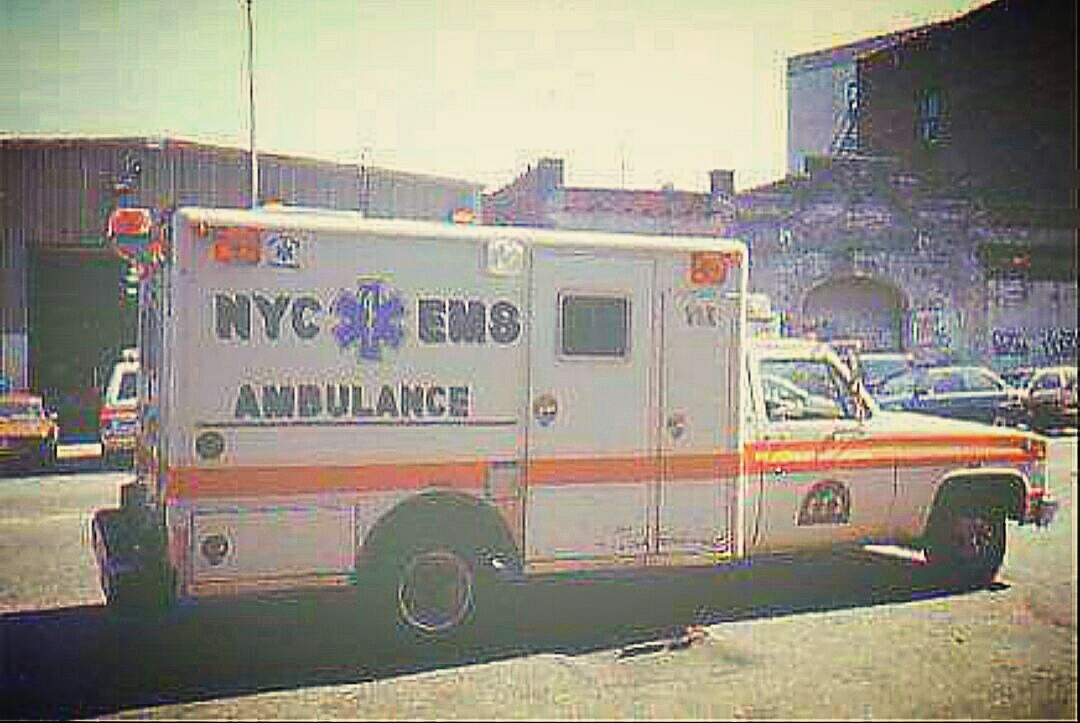
The career archive of a NYC paramedic

Author: Nancy Gwillym (Page 6 of 6)

The Purple Hippo Shooting

One day my partner and I were called to a wrist injury in the projects on the Upper West Side of Manhattan. The way the buildings were situated to the street made parking close to the address very difficult. Many housing projects have roadways that can get you closer but this one either didn’t or it was blocked in some way (not uncommon) so we had to walk a bit of a distance to get to the actual address.

The call was something of a low priority that we assumed didn’t even warrant the stair chair but we brought it with us. We always bring a specific set of equipment with us regardless of call type because things can often be much different on the scene as opposed to the way it was described to the 911 dispatcher. As EMTs, that set meant a tech bag, an oxygen bag, a semi-automatic defibrillator, and a carrying device, which 99% of the time is a stair chair.

Once at the apartment, we found that the 911 dispatcher had been 100% correct-it was a wrist injury. An approximately 35-year-old woman had fallen two weeks prior and her wrist was wrapped in an ace bandage. She had gone to the hospital twice during that two-week period where each time x-rays had been taken and exams conducted and her injury had been determined to be a sprain. She had been prescribed pain killers and given instructions on limiting motion to her wrist along with a date to return for a follow-up.

The woman believed that both determinations were wrong, that her wrist must be fractured because she still could not move her wrist without pain. We pointed out that her instruction sheet indicated her wrist would be painful for possibly a month, even with a sprain but she was positive her wrist was far more badly damaged than they had made it out to be and was requesting a third hospital evaluation at a different facility. This would also be her third ambulance trip for the same injury.

Despite the fact that she ambulated around her apartment very easily while getting her papers together, changing her clothes, and searching for her ID, when it came to getting to the ambulance she said she would be unable to do so without assistance. She was too weak to even walk down the hall, she said, and she required the stair chair which we thought we wouldn’t need. Thankfully, the elevator was working (not always guaranteed) so there was no actual lifting but she was rather heavy and pushing the chair was a slow endeavor as we had parked so far and most of the roadways were not smoothly paved.

As we were slowly making our arduous journey to the ambulance, shots suddenly rang out, many of them.

It was a sound we were familiar with and immediately understood the danger. My partner was able to maneuver the chair behind a large playground object. The bullets were coming from multiple directions, but it seemed the whimsical animal we decided to hide behind was a good shield. It was a large purple hippo.

In happier circumstances, I’m sure children enjoyed climbing the concrete hippopotamus. The patient, also familiar with what was going on, hastily unstrapped herself from our chair and took off running.

My partner cheerfully announced “10-96!” to me, which is our radio code for ‘left the scene’. This made me laugh, despite the circumstances.

When the gunfire died down, we quickly made our way to our ambulance and while we were putting away our equipment I was tapped on the shoulder by a young man about 16 or 17 years old.

“I’m hit,” he said casually and lifted up his shirt to show me a small wound to his abdomen. The side door to the ambulance was open and he got in.

My partner had been on the radio asking for PD and additional ambulances in case there were injuries. He hadn’t seen the man who approached me. As he made his way around the vehicle he saw the teenager sitting in our truck and asked him what he was doing. I had gone around to the other side of the vehicle to obtain a backboard, which was our protocol at the time. Another slightly comical moment ensued of my partner and I completely missing each other walking around the vehicle to get to different compartments to get various equipment.

Once reunited, we worked very quickly to treat the patient and prepare for our trip to the trauma center. There is a ‘golden hour’ that we use as a rule, getting the trauma patient to a surgeon in as little time as possible. We closed up our doors with an officer and the patient’s friend accompanying us.

It would turn out during the ride that the accompanying friend had actually shot the patient in the confusion. Apparently, there were multiple targets involved in the incident and shots were fired from many people aimed (poorly) at multiple others.

It was a surreal time where none of these circumstances were treated as unusual and my partner didn’t blink an eye when we arrived at the hospital with one patient and one, now-prisoner who was completely cooperative and contrite. There was no animosity between the two with the shooter letting his friend know “if you need blood, man, I got you. I’m O, the universal donor. Good luck.”

Everything went very smoothly and our man survived.

In the confusion, there had been no second call number given to shooting since it occurred at the same address. I had prepared two ambulance call reports for this call number- one for the wrist injury and one for the gunshot victim. There was also another gunshot victim who had been taken by another crew who was also under the same call number.

Later on, when our ambulance call reports were looked at by the police or the DA there was some confusion regarding which victim went to which hospital since it turned out that both shooting victims had the same first name. They had contacted us for statements about the incident and to clear up which patient was ours.

“And what’s up with this lady with the wrist fracture?” We were asked. “Will she be pressing charges?”
Administrative Terrorism

When I came on the job as an inexperienced, naive EMT I had little idea how things worked in the real world. I was lucky to be partnered with a person who was already a legend throughout the service. He wasn’t only good at being an EMT, he knew how the job worked, how the city operated and he had a diverse skill set that was often invaluable. He taught me many, many things but one of the most satisfying was something he liked to call “administrative terrorism”.

It was unfortunate, but I came to find out that some of our supervisors lacked many of the important verbal communication skills needed to motivate poorly-paid civil service subordinates. The reward structure that traditional jobs rely on to motivate their employees (bonuses, raises, and other benefits) doesn’t exist for us and rather than get creative many chose the route of bullying and berating; negative reinforcement at its worst. Administrative terrorism was born as a creative way to handle uncreative supervisors, turning a negative situation into something entertaining. It also broke up the day if you were bored. I was privileged to learn from the master.

One of our lieutenants that used all the tactics in the negative reinforcement playbook was someone I’ll call Lt. Pat. Lt. Pat was obviously taunted as a child and used his new position of authority to make up for the wrongs inflicted upon him in the past. He was wildly incompetent and somewhat comical for us, even without the encouragement our karmic acts of rebellion brought out. Lt Pat desperately sought the approval of those higher up which made him an easy target for my partner whose many talents included being able to imitate the chief in charge’s voice over the telephone.

One day, chosen completely at random my partner asked me to hang around the front of the office and report back to him later what occurred. I didn’t know it at the time but my partner had surreptitiously unplugged the fax machine a little while earlier. Mr. Pat was at the desk and due to hearing difficulty he kept the phone volume up to a level where I, and anyone within a 2 mile radius, could hear. The phone rang, Lt Pat answered in his authoritative manner.

“Hello. Lt. Pat? It’s Chief McAllen,” I could hear my partner say in his best Chief McAllen voice. ” I’ll be sending over a report through the fax machine. I’ll need you to answer a few questions at the end of it and fax it right back”.

“No problem, Chief,” Lt Pat answered confidently. “I’ll take care of it right away.” He continued with whatever he had been doing at his desk for a little while until another call came through.

“Pat?” my partner said. “I’m waiting on that report.”

“I’m sorry, Chief but nothing’s come over.” He answered.

“Ok. I’ll send it again.”

More time went by. Nothing came over the machine, of course. Another phone call was made.

“Pat. I don’t know if I stressed this enough to you but this is somewhat urgent. I need your answered questionnaire pronto.”

“I’m sorry Chief, but still, nothing has come over the fax machine. Perhaps you better send it again.” Lt. Pat sounded contrite.

“Ok Pat”, he said. “But make sure this thing gets done. Drop anything else and send it over right away.”

At this point Lt. Pat stopped everything he was doing and watched the machine. As someone who liked to limit the movement of his considerable girth he chose to not to get up and check out the machine directly, but he stared at it. He also looked at the clock somewhat nervously but of course, no paper, no sound came from the fax machine.

“Lt. Pat,” came the next call. “I sent this report out to 5 supervisors and I have 4 questionnaires sitting on my desk right now. Guess which one I’m missing?” He sounded exactly the right level of angry you could expect from Chief McAllen. “I’ve sent this time over about 5 times. Are you telling me you haven’t received even ONE?”

“But I haven’t!” said Lt. Pat. He sounded like a little schoolboy at this point. A nervous little schoolboy.

“Pat,” the chief voice replied. “You checked the machine, didn’t you? Nothing’s jammed? Receiver not off the hook?”

Lt. Pat finally made it over to the machine, phone in hand. The unplugged cord was situated in a very obvious way on the side of the table it was on which did not face the lieutenant desk. Lt Pat picked up the cord and dejectedly reported that he had found the problem.

“Was it turned off?” He said, in a rather condescending tone.

“It wasn’t plugged in…” At least he was honest. I have learned on this job that honesty is not the virtue that it is elsewhere. They pretend that it’s important but it’s rarely rewarded.

An exasperated ‘Chief McAllen’ hung up. As Lt. Pat scrambled to plug in the machine my partner strolled in with a piece of paper.

“Hey there, Lt Pat,” he said cheerfully. “Would it be OK if I fax”ed this dental form in to the union office? I’m having a root canal–” he was immediately cut off.

“NO!” Lt. Pat screamed. “NO! STAY AWAY FROM THE FAX MACHINE! I’m waiting for something! No one goes near the machine! No one!”

My partner flashed me a smirky grin with his back to Lt. Pat.

“Wait until he calls back the division to speak to the chief again.” He told me later. “No one will have any idea what he’s talking about. Whatever statistical anomaly they’re focused on right now will be put on the back burner for at least a week.”

The Beginning

I got involved in EMS because my mom moved to Florida. Needing a job to support my sudden non-rent-free lifestyle, I answered an ad in the newspaper (how employment was often procured pre-internet). It offered free training with the promise of future employment in a desperate bid to get a huge influx of naive do-gooders to join the ranks of the city’s ambulance service, which at that time was run by NYC’s Health and Hospitals Corporation. I quickly took the bait. Having been a fan of the “Emergency” television series back when TVs only had 5 channels, I welcomed this opportunity to be like Johnny and Roy, intrepid pioneers in a new medical field. I looked forward to an exciting job “saving people” until I could get my life together and do something else.

I passed my 3rd grade level reading and math entrance exam, took a physical and joined the training academy shortly thereafter. Our education started with CPR. When I received my coveted provider card it was with the mindset that my newfound skills were the catalyst towards changing dismal outcomes for the better. To say I was excited was an understatement.

After my EMT graduation I was off to “the city”. (For those of us who live in the outer boroughs, that means Manhattan). For the benefit of us newbies they held a “roll call”, where the lieutenant addresses everyone at the shift and gives out the unit assignments. On the following days things went back to normal and we just showed up, got our keys and left. But on day one the lieutenant apologized to me saying he had no choice but to put me with the only person available. The EMT I was supposed to have been paired up with had called in sick and this man with the vacuous eyes and ill-fitting uniform was the only one they could put me with. “Any problems,” the lieutenant told me, “you call me up right away. Keep your eye on this guy. And don’t be afraid to snitch. I’m expecting a phone call.” Great.

I discovered I had been paired up with “a skell”. This is someone who is lazy and takes unnecessary shortcuts. (There was also a term “skell” for the patients which had a slightly different definition). The naive, idealistic me was nervous and scared. I had no idea what to expect from a terrible partner. This wasn’t what had been sold to me at the EMS Academy. I expected equally enthusiastic coworkers. We were ‘saving lives’. How could you not be 100% into this? Instead I wondered if I would I be fired on my first day. Why would they do this to me? But also, how bad could it be?

Our first call was assigned, a cardiac arrest. I was going to use my CPR card! I was going to ‘save a life’! Right out of the box. It was exactly how my new position had been described to me. I was going to a high priority call to help someone in need.

My partner, however, hadn’t had his coffee yet.

Prior to firing up the lights and sirens he stopped at a local deli and in the most nonchalant tone ever asked me if I wanted a cup of coffee. I was astounded. “No!” I said. “We have a job! We are going to an arrest! Seconds count! We need to go! Now!”

“Well I’m getting a cup of coffee.” he stated. After was seemed like hours he emerged, cup in hand, and off we went, finally. “I like to drive holding my cup,” he said, “that way no one thinks we’re using the siren to get coffee. I can show them I already have it.” He laughed and took a sip, with enough practiced skill that it didn’t spill despite the bumps and swerves of our emergency response.

My initial consternation with my partners lackadaisical attitude was cut short when we arrived at our destination and my idealism took an even bigger hit. Our call had taken us to Chinatown and into a rundown building where our patient was on the fourth floor of a walk-up. It was a dingy and depressing looking apartment with bunkbeds and cots in every room. There was nothing on the walls and the windows were covered with sheets duct-taped to the frame. The centerpiece of the kitchen was a dirty bathtub, which I would come to find out later was not uncommon for many apartments on the lower East side. The paramedics were already there, having not made a pitstop en route for caffeinated beverages. They were working on an older woman who was laying on the floor of this relatively small apartment inhabited by at least 20 other people. A young boy stood nearby with a look of panic and sadness and it caused me to become slightly unfocused. My partner directed me over to the BVM where I would be providing artificial ventilations. His cavalier attitude had been completely transformed as he spoke to me both professionally and with patience. He seemed empathetic towards the emotional reactions I was, apparently, doing a poor job of hiding. The little boy was crying. For me this was just one of many cardiac arrests to come, for him this was his whole life. Everything he had and the direction of his life were all on the line here. To make matters worse things did not seem to be improving for this woman. Cardiac arrest is a very, very difficult thing to reverse.

The paramedics who were administering the drugs and watching to monitor were also kind and seemed to have a great deal of respect for my partners skills and experience as they bantered back and forth. The whole scene in my memory seems very surreal looking back. So much was going on and yet it seemed to be moving in slow motion. There many people standing around, watching, making my first foray into real CPR a bit unnerving. Also, as this was my first cardiac arrest, my first call altogether, I was unfamiliar with how casually emergency medical providers do their jobs while holding mundane conversations in the midst of someone else’s tragedy. It was something that I would soon take part in myself. No one was dismissing the seriousness of situation or being unsympathetic towards the family, (or as it turned out, living companions who barely knew each other). It was just normal to make conversation at work. It was just that our workplace was someone’s home and our job involved a dying woman.

As I squeezed the BVM to push air into this woman’s lungs I couldn’t help but be fixated on the young boy watching intently with hope and tears. He didn’t speak English. No one in the apartment did. A translator was found in the building somewhere and even her ability was limited. After putting a few snipets of information together it was discovered that the woman was the only relative the young boy had in this country and it was questionable if there were any family left in China. No one else in the apartment knew the woman. It was a mutually beneficial living situation for everyone there to share space and meals but people came and went frequently and most of the residents barely spent more than a few hours at time at the apartment, usually just coming to sleep in between different employment situations. My thoughts were with child and wondering what would become of him should the woman not survive, a circumstance that grew more likely with each passing minute and eventually actualized. Would any of the others there take him under their wing? Would he get sent back to China? Did he want to go back to China? I would never find out but I think about it often, actually. We were both thrown into an unpleasant reality that day, made to realize that everything can change and not always for the better.

Newer posts »

© 2026 streetstoriesems

Theme by Anders NorenUp ↑