streetstoriesems

The career archive of a NYC paramedic

Kevin At A Funeral

I had just become a paramedic and started working in East New York, Brooklyn. We were sent to an “asthma” call, which in those days, before EMTs started carrying nebulizers and albuterol, were assigned to paramedic units. The text stated that the patient would meet us outside.

“Well, that’s considerate,” I thought.

“You’re about to meet Kevin,” said my partner, who had spent years working in East New York and could easily discern from the text certain hallmarks of a ‘Kevin call’.

“He’s special,” he told me dryly, with a smirk on his face.

As noted, Kevin was outside waiting. He was smoking a cigarette and when he saw us turn the corner, he held up his arm in the familiar way New Yorkers do when they hail a cab.

Even if Kevin wasn’t the only white guy in an almost exclusively minority neighborhood, he still would have stuck out. His fondness for bright red track suits, often velour, enabled you to see him from a distance, which was possibly the objective. Apparently, he had a whole closet full of them. His ensemble included a gold chain with a large gold Star of David and a jacket that was zipped open, revealing chest hair like a 70’s porn star. He had a mop of messy, curly brown hair, pot-marked skin, and wore thin metal-framed aviator glasses with those lenses that change in the sunlight. He also had one of those newfangled cell phones, a novelty at the time.

“What took you so long?” he complained. He extinguished his cigarette and walked over to the side door. My partners amused smile provided me no comfort.

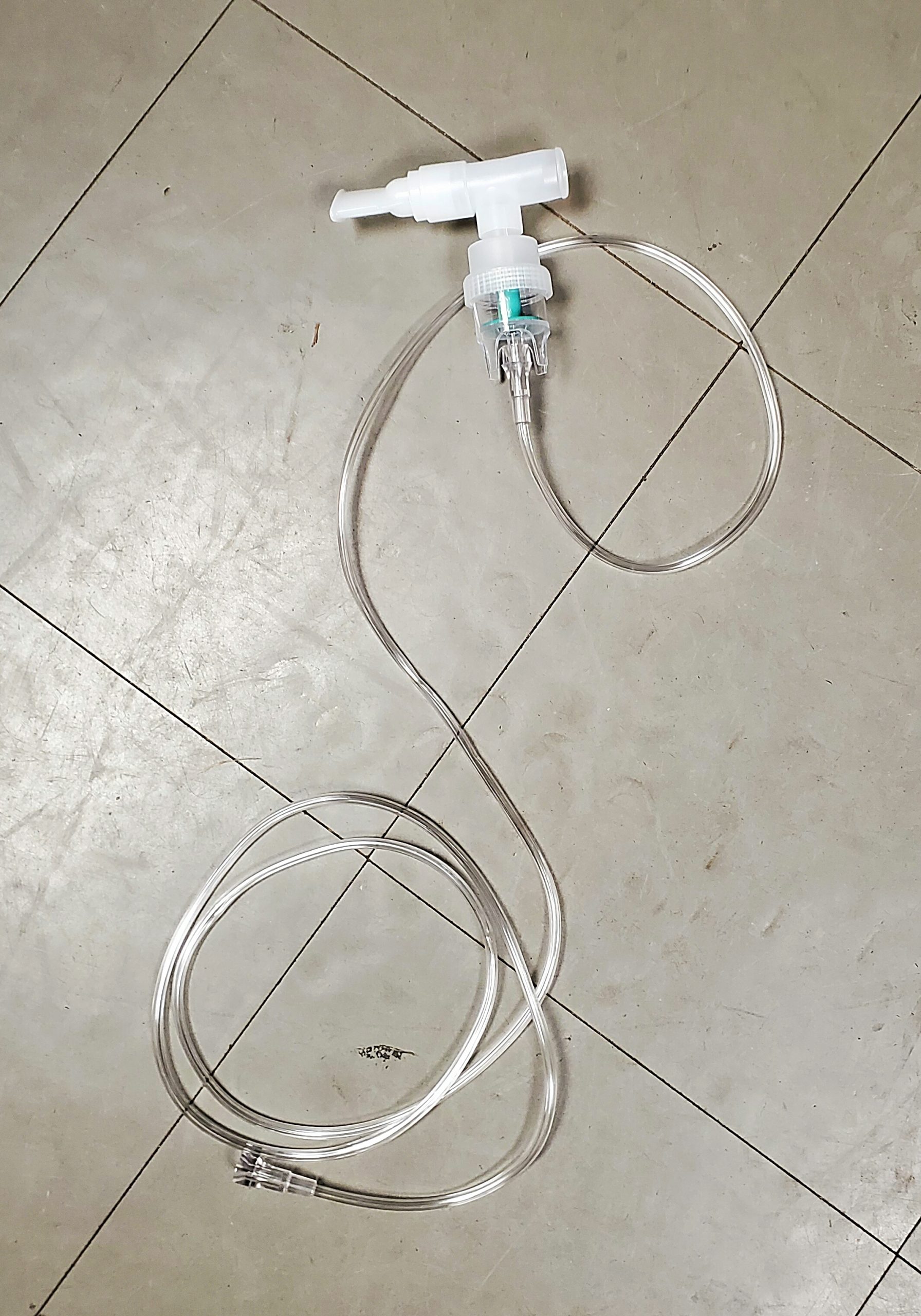
Despite appearing comfortable while breathing, I heard some wheezing, so I started to prepare a nebulizer by squeezing a tube of albuterol into the medication chamber, which was the protocol at the time. Before I screwed the device together, Kevin waved his index finger at me.

“Ah ah,” he reprimanded me, “I get two. You must be new.”

I instantly disliked him.

He also directed me to increase the oxygen flow by a few liters per minute, higher than our protocol specified and exceeding the nebulizer device’s design capacity. My partner rolled his eyes and shook his head.

“Come on, Kevin,” he said. “Don’t be giving my partner a hard time.”

“So she is new,” he said to him.

He turned to me and said, “I know because his regular partner is Devon. Or Shawn. Usually Devon. Shawn does a lot of mutuals.”

He turned back to my partner, who was driving that day, “We’ll be going to Methodist.”

Methodist was on the other side of the borough, far outside of our Ten-Minute-Rule. I was annoyed. What kind of taxi BS was this?

“Listen Kevin, you know we need permission to go so far away. Why don’t we go somewhere closer?” asked my partner, being almost apologetic.

“I’m not going to any of these hospitals. The hospitals around here have had enough of me. I’m done fighting with them. It’s time for a new round of nurses and doctors. Maybe I’ll finally get the care I deserve without having to demand it for once, though I’m not hopeful. Do you want me to call on my phone? I’ve got the number saved.”

He opened his fancy brick of a phone and searched through the directory.

As he scrolled down his list of saved numbers, I noted that it was filled, not with random names of possible friends or relatives, but with titles like ‘EMS complaints’, ‘City Law’, ‘Joe Bklyn Boro’, ‘EMS boro command’, ‘Nurses assoc’, ‘Councilwoman Barbara’, ‘NY hosp complaints’, ‘Medicaid complaints’, ‘City complaints’… The few names I did see noted included of many of our commanding officers, most of which were misspelled. He eventually reached our telemetry number and handed the phone to my partner.

“Hi,” said my partner, providing his name and our unit. “I’m calling for a hospital request outside the ten minutes…yes, it’s Kevin…he called you? Himself? That’s a new one…”

“I thought it would speed up the process,” he whispered to me quietly.

Our Ten-Minute Rule is a procedure for patients who don’t want to go to the closest hospital. Patients are generally entitled to go to any appropriate 911 receiving hospital anywhere within ten minutes from the closest hospital to their location, so if the closest hospital is 8 minutes away, they can go 18 minutes away from their present location. If they desire a hospital farther away, we were required to get permission from our telemetry department. It was my experience that almost all requests were granted, except under special circumstances like high volume at the hospital, certain holidays, and gridlock traffic situations.

My partner went through the procedure on the phone and, as expected, telemetry approved his transport. When he got off the phone, he told Kevin that telemetry wanted their number deleted from his phone. Kevin laughed and said it was memorized.

“They can tell you what to do, but they can’t tell me what to do. Don’t worry, when this is over, I’m going to call them and tell them myself.”

My partner asked him not to, and Kevin just nodded, but I had a feeling he was going to call them anyway.

On the long ride to the hospital, I listened to Kevin tell me all about my job. He had amassed a wealth of information as only someone who utilizes 911 way too often could.

Several times he refilled his nebulizer himself before the treatment was up, expertly going into our oxygen bag and knowing exactly where the medication was kept. When we got to the hospital, he informed me that I’d have to “restock”, as we were now “below par”.

He was well-versed in all of the lingo associated with our job. “Special” wasn’t the word I’d use to describe him.

Kevin soon became one of my regulars as well, regardless of what unit I worked. Everyone in our area knew him well, and they all had varying opinions of him. I heard stories about him making complaints about a responding crew to our complaint department while he was still in their ambulance. There were many stories about disputes he had with his neighbors, who also had varying opinions of him. Some crews enjoyed hearing his banter, and it was true, he did grow on you once you got past his demanding personality.

But his obnoxious ways never endeared him to the hospital nurses as he made his way through every Brooklyn facility and even some in the other boroughs. He continued to get evicted for rude behavior or arguing over the rules of the ER.

“Eventually, he rotates back,” they all told me, when he feels the staff may have forgotten him.

Most people, including myself, eventually adapted to his quirks, rationalizing that it was easier than arguing, and once you did so, Kevin was almost pleasant. He was especially nice to Devon, who I also worked with on that unit. If it appeared that Devon liked you, Kevin’s opinion of you could change completely.

It was hard not to like Devon. He was friendly, had a great positive attitude under pressure, and sometimes, if you were working with him, he’d take you to meet his grandmother.

Devon’s grandmother lived in the neighborhood. He’d often check up on her during his shift, as it was right in the middle of his assigned area. Devon’s grandmother was a friendly person as well and she knew everything about our job and loved hearing about entertaining jobs and the crazy situations we got into. She would listen to our tales while offering baked goods and coffee.

One day we came to work to hear that Devon’s grandmother had died. It was devastating for all of us at the station since most of us had met her through Devon. Some had been called to her home when she was a patient. Throughout the day we shared the news with our coworkers from other stations, letting them know the hours of the services and location of the funeral home, which was in the neighborhood.

On the first day of viewings, my partner and I drove past the funeral home where Devon’s grandmother’s funeral was being held. It was near one of the hospitals we frequented, and when we got to the ER, we met up with some other crews, where we discussed Devon’s grandmother and the funeral arrangements.

As we waited for stretchers to become available, we spoke about the huge turnout that we had witnessed on the way over with another paramedic crew. We mentioned the viewing hours when, suddenly, one of the curtains for one of the beds was flung open.

Kevin stood there in his hospital gown.

“I thought the hours were 7-10!” he said, dismayed to find that they were 6 pm to 8 pm.

“What are you doing at this hospital?” I asked. “I thought this place was on your ‘Never’ list.”

“It’s close to the funeral home. I came here so I could go to the wake when I got out of here. Now I’m gonna have to leave early,” he said, checking his watch.

I was taken a little aback. Kevin was going to the wake?

“Absolutely,” he said. “Devon is my man.”

Not long after, we drove past the funeral home again to find many people still outside. There were several large groups of men wearing suits and ties and women in their Sunday dresses who had spilled out of the home, some to smoke cigarettes and some appeared to be catching up with others before going inside.

And also standing out there was Kevin, who once again stuck out from a mile away, as he stood there with his bushy hair and glasses, wearing a hospital gown with no pants, and holding a nebulizer with its long tubing trailing behind him.

Electrons in the Basement

We were sitting on the corner of a busy intersection awaiting our next call. The day was threatening to be a busy one but not for us, at least not yet. Someone had left a magazine in the truck, and I was reading it during our downtime.

My partner, Jack, was in the driver’s seat, preferring to watch the rushed comings and goings of busy New Yorkers navigating their way through the crowded streets. To our right was a large McDonald’s restaurant that he quickly became fixated on.

“Check out this woman,” he said, laughing. “Someone really set her wig on fire.”

I turned to see an older woman adjusting a plastic rain bonnet despite the clear skies. “Maybe she’s just preparing for the worst,” I suggested.

Jack, who had been watching her for much longer, told me she had been going back and forth into the restaurant, each time yelling something to everyone inside as she was leaving. But this time she continued walking away and I went back to perusing my magazine. There was an article about The Universe and how it would send you what you needed. It seemed like too simplistic an answer for all of life’s difficulties. I continued to read it with the intention of balking at its ridiculous premise.

A short time later, I was startled to hear some knocking at my window. It was the woman with the rain bonnet. My partner grinned as I reluctantly rolled down my window.

“Excuse me,” she said. “Something needs to be done. Right now. There’s a lot of nefarious things going on in the basement of that McDonald’s. I know it. I can feel the electrons. I’m sensitive, you know. This isn’t my first rodeo. They’re being manipulated. The electrons are being manipulated. They must have a device in that basement. But they won’t let me see it. Every time I go in there, they threaten to call the police! Can you believe it? On me! Someone has obviously gotten to them. I don’t know what to do. They tell me they don’t even have a basement. Liars. I tried to show them. The electrons are being manipulated. I know it. It’s not the first time…”

My partner seemed to be enjoying himself as he watched the woman scream at me. The people who like to rant and rave always come to my side of the ambulance. I could see his mind working, however, and developed a little smile of my own.

“Ma’am,” he asked. “What would you like us to do?”

She looked at him as if the answer was obvious. “They’ve got to be stopped! If they keep doing these things to the electrons it’s going to be like last time, and nobody wants that to happen! I even think it will be worse. They have more electrons here. At least, I think they do. But I DON’T KNOW because they won’t let me into the basement!”

I didn’t know what to say but Jack took care of it all himself. Honestly, the way that man could think so quickly on his feet was a seriously underrated superpower.

“Ma’am,” he said. “I think I know exactly what you mean. We will be happy to help you out.”

“Oh thank you!” she said, with a look of great relief on her face. She had finally met someone who understood the gravity of the situation.

He confidently got out of the truck and went over to my side of the ambulance. The compartment that was right behind my door holds the equipment we take on calls with us. He took out our semi-automatic defibrillator and put it on the hood of our vehicle.

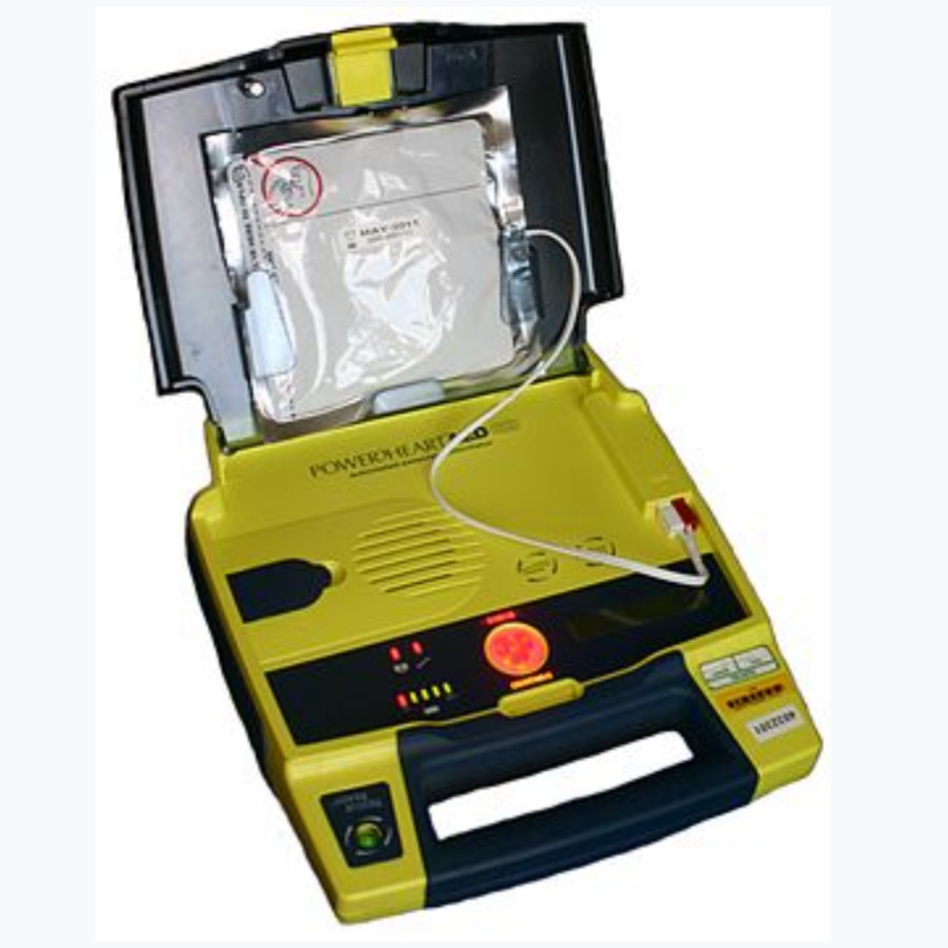
The semi-automatic defibrillator is a small machine that is designed to deliver an electric shock to a person’s heart in the hopes of resetting the rhythm of a person in cardiac arrest. These machines are designed to be user-friendly and easy to use. The machine that we were using at that time utilized voice prompts which, I was about to find out, was a lucky feature to have when there’s a crazy lady at your door complaining about electrons.

Jack lifted up a small panel on the top of the little machine to activate the set up instructions. “Check electrodes,” it said in it’s impersonal, electronic voice. It was directing us to attach the large adhesive pads to the patient’s chest in order for it to evaluate the heart rhythm. “Check electrodes,” it repeated. It would continue to nag us until the electrodes were finally connected to a patient.

“That’s very interesting,” remarked my partner, with some concern. The device continued to implore us to check the damn electrodes.

“What? What’s going on?” said the woman. She was starting to get nervous again.

“It’s detecting electRODES.” he said solemnly. “You heard it, didn’t you?”

She nodded.

“I was hoping it was just electrONS, but it’s electRODES. They’ve got electrodes.”

“I KNEW IT!” she said, nodding excitedly. “I knew there was something going on. But I did hear it say ‘electrodes'” She seemed to be studying the machine.

“Well, you see…” began my partner with a most serious expression on his face. “If it were just electrons, I think we would have been able to do something. But electrodes, that’s kind of out of our scope. This is a much bigger problem. Electrodes.” He shook his head slowly.

She continued nodding and together they appeared to be brainstorming.

“You’re going to need more help than we can give you. I but I know someone who can do it.”

She looked determined to do whatever it took. My partner reached into his pocket and pulled out a handful of quarters. He gave them to the woman. I could see where this was going, and it made me appreciate my partner’s genius once again.

He directed me to hand him a pen and paper. I watched him as he wrote down the phone number to our station.

“Ma,am,” he began, with utmost seriousness. “You need to speak with someone they call…The Lieutenant. This is his number. Only speak to him. You need to let him know what’s going on over here right away. This is serious. There are electrodes in that basement!”

She looked up at him with matched seriousness. She was up to the task at hand, that’s for sure.

“But I’m going to warn you,” he continued. “This man may pretend that he doesn’t know who you are. It’s very likely he’s going to say that he doesn’t know what you are talking about. He may even, and I hope he’s not this arrogant, he may even pretend not to know anything about electrons and electrodes!”

“That Bastard!” she gasped.

For a brief moment, I was conflicted. We had wanted some vengeance on Lt. Lloyd but this may have been too much. Lt. Lloyd’s adversarial managing style had caused us more than a few headaches but I didn’t think it would compare to what was coming from a determined woman complaining about electrodes manipulating a fast food restaurant. I dug into my bag to add some more quarters to devote to this project anyway.

“Now, you cannot let this man off the hook,” he said. “He’s the one. He may be the ONLY one. It’s his job to take care of this. You heard it yourself, right? Electrodes. Something needs to be done. Do you think you can handle it?”

She nodded vigorously. No ‘Lieutenant’ was going to put one over on this woman. No way.

She marched right over to the phone booth which was only a few feet behind her. She resolutely pushed in a quarter and punched in the numbers. We watched her as she yelled into the phone. Mid-rant she stopped and slowly looked at the handset. When she figured out she had been hung up on, she forcefully threw another quarter into the machine and dialed again. She looked over at us and we gave her the thumbs up sign. Encouraged, she went back to work demanding that the Lieutenant do something about the electrode problem in the basement. A few more hang-ups and re-dials ensued. The day was shaping up to be a pleasant one.

I had to admit that maybe I’d been wrong. Yes, woman’s magazine, sometimes the universe does send you exactly what you need.

A Jimi Hendrix Experience

Two frail-looking women sitting on the stoop outside gave us big, gummy smiles as we walked towards the open doorway.

“Top floor,” said the older-looking of the two, as she pointed at the stairs.

“Of course,” I said, with what I am sure was an eye-roll.

The woman laughed. “It’s always the top floor, ain’t it?”

She understood.

The large three-story house had probably been initially built as a large single-family home. Sometime during its history, one of the owners divided the rooms into apartments and eventually, into the current incarnation, subdivisions of Single Room Occupancies (SROs). Aside from these subdivisions, it was painfully obvious that no one had done any serious work on that house for many years.

The door directly ahead on the first floor was wide open, as were most of the doors we would encounter on the way to our patient. Through the door, we could see two men smoking crack pipes, unconcerned with any privacy issues. One of them gave us a friendly wave.

The building turned out to be a very cordial residence with many tenants giving us smiles, encouraging greetings, or at least respectful acknowledgment. All three gestures are a rarity in my experience, and I greatly appreciated them.

Each room had a copy of a handwritten sign taped to its door announcing that $350 rent was due on the first of the month. “No excuses!”

In NYC, $350 is bargain rent, but even so, it seemed to me that these tenants weren’t getting their money’s worth.

We could hear yelling upstairs as we carefully made our way up the treacherous stairs. I’ve been up hundreds, if not thousands, of poorly maintained stairs. You develop a very cautious approach to them, noticing every potential problem for the trip later on, when you would be navigating them with a patient.

The edges, which were once covered in metal reinforcement, were no longer being reinforced, as quite a few of the metal edge frames were without screws and in varying degrees of detachment. Some of them poked outward as if inadvertent booby traps were created for anyone unlucky enough to go beyond the first floor.

Much of the linoleum on the stairs had been worn thin, and on several steps, large chunks were missing altogether. Some of those empty patches had gaping holes underneath where you could attempt to peer into a dark abyss below. A benevolent person had attempted to warn stair users by drawing arrows pointing toward the holes with a thick magic marker.

“Hol”, they read.

The second-floor landing had a curious assembly of possibly discarded items, including a large barbell and a rusty birdcage containing empty light bulb boxes. We could see a skinny blond woman sitting in the hallway doing ‘The Nod’. This is a term sometimes used to describe the fascinating way heroin users will seem to sleepily tilt sideways but suddenly right themselves before falling.

When she heard us, as we made our way up the stairs, she perked up suddenly and gave us her own enthusiastic, tooth-deficient smile.

“Are we here for you?” asked my partner.

“Oh no!” she exclaimed, changing her smile into a serious expression that indicated our suggestion was preposterous. She pointed upward. “Keep going!”

The steps leading to the third floor had concerning stains on the walls that looked an awful lot like blood splatter. Both of us did a bit of wishful reasoning, deciding that it could very well be some sort of food stain. The entire building reeked of large quantities of food long past its expiration date. Perhaps this was a source of some of that stench.

As we entered the third-floor hallway, we were able to make out the words to an aggressive argument we started hearing when we were on the first floor. From the limited snippets of dialogue we were privy to, they appeared to be fighting about the rusty birdcage. The dispute was coming from the right side of the building. Thankfully, a woman behind one of the partially opened doors directed us towards the left side.

As we made our way down the hall, we encountered a disheveled woman. She was hunched over as she walked towards us and had a glazed look in her eyes. She pointed further down the hall and remarked, “Vern went and did a Jimi Hendrix!”

She continued walking while she told us, “I read his autobiography. He choked to death on his own vomit! Just like what Vern’s doing!”

Indeed, as we made our way into the tiny, cluttered room belonging to our patient, we found him lying on his side, his face in a pool of brown, chunky vomit. My partner and I immediately did our best to remove the man from the putrid, foul-smelling liquid as quickly as possible, with as little splash as we could manage.

The patient was a large man, mostly naked, and he was lying on an inflatable mattress that seemed to have a leak. It wasn’t filled enough to make it taut and with the man’s considerable girth leaning on it, it seemed more like a kiddie pool. Moving naked, unconscious people is fairly difficult all on its own. It’s much easier to grab onto clothing or sheets to move someone. This large man, being absorbed into the depths of his air mattress, was especially difficult.

Another skinny woman was in the room with him, and she made an attempt to assist us, which I greatly appreciated, despite the futility of her limited naked-man-lifting skills. We were able to un-wedge him somewhat and attempted to listen to his lungs, but his decreased respiratory rate made it difficult.

He had pinpoint pupils, and his lips were blue. Thanks to some obvious drug paraphernalia found nearby, we quickly diagnosed his condition as a result of opiate use. We quickly got to work administering naloxone, which reverses the effects of opiates.

As we were doing so, we noticed the room directly across the hall also had an open door. Our attention was momentarily directed to a man there receiving oral sex from yet another, frail-looking woman who seemed to have difficulty staying awake during the procedure.

The thin, toothless woman with our patient saw that we noticed what was going on and let out a huge howl.

“DEBRA BE OUT THERE PAYING THE LANDLORD!” She shrieked. It was loud enough for the Jimi Hendrix enthusiast to join her in laughter.

The man getting the blow job seemed mildly annoyed. “You just pay your own rent and stop worrying about everyone else,” he told her.

The blow-job recipient/landlord seemed completely unconcerned that one of his tenants was lying in a pool of vomit only a few feet away. I understand that he could have been preoccupied but, honestly, he didn’t seem to be enjoying himself. Despite the admittedly half-hearted effort going on in that room, he kept paying attention to the activities happening in our room and without much empathy. He didn’t attempt to help our patient even though he could have easily assisted us in moving him. He could have resumed his activities with the woman afterward and she probably wouldn’t have even noticed the interruption.

Our initial dose of Narcan (naloxone) improved our patient’s respiratory rate only slightly. But we were able to listen to his lungs well enough to determine he didn’t aspirate. Another dose of the wonder drug had our man awake and questioning what happened.

Once he came around, the woman that had been in the room with him shook her head and chided the man for taking too much.

“Greedy,” she said as she exited the room.

The man seemed a little embarrassed and told us he had gotten his heroin from a different supplier, and that was most likely the reason why he had taken enough to require a double dose of Narcan.

I cannot explain enough how refreshing it is when a heroin user admits he used heroin. Narcan only works on opioids. If it works, the cause is pretty obvious. The song and dance we go through when people deny it gets exhausting. The protestations are very unnecessary for our purposes.

Most of us in EMS develop a resigned acceptance of addiction as it wastes mental energy to stand in judgment of a large portion of our patient base. Also, over time, everyone becomes just another patient, where you just treat what you find, regardless of how it happened.

There are a lot of people who would have found our location and clientele distasteful, but not me, and probably not most of my fellow paramedics. In fact, at that point in time on that job, this call was turning out to be a great job. The patient was honest, bystanders were (mostly) helpful, and there were shockingly interesting side activities going on; this job had it all. It was also very nice to be in a place where everyone was friendly (except for the landlord).

It turned out that “Vern” was really a man named George. Once awake, he was very cooperative and grateful for our assistance. But he didn’t want to go to the hospital. We asked if he would just let us check him out a little better and perhaps decide later, based on the results of our exam. He found our request to be reasonable.

It turned out George was 55 years old and had just come back home after being in the hospital for over a week, thanks to issues with congestive heart failure. He had a little box overflowing with prescription bottles that let us know he also had diabetes and high cholesterol.

His vital signs were mostly normal, as was his EKG, but we still thought going to the hospital was a good idea. He was adamant about not going. We explained that since we treated him, and he didn’t want to go, he would have to speak with our telemetry doctor on the phone in order to refuse transport. He was OK with the procedure.

We were less so since it meant using George’s phone. We were still in the age of landlines, and George’s phone was covered in a dirty, brown film that was as resistant to the swipes of our cleansing alcohol pads as George’s heroin had been to Narcan.

Calling telemetry for an RMA (Refusal of Medical Assistance) is a long process. There is only one doctor at telemetry for all five boroughs and calls for medication orders take priority. There are other reasons for telemetry contact as well but calling for an RMA puts you at the very bottom of a long waiting list.

We went through the procedure with the paramedic call taker at telemetry who took the pertinent information and then put us on hold. While we were waiting, many of the other residents in the building stopped by to see how our patient was doing. They all universally derided him for not wanting to go to the hospital but George wouldn’t be swayed.

George decided that, while we were waiting, he would get dressed and prepare some food. He was hungry, he told us.

Much of his wardrobe seemed to have been obtained from various hospitals. He had piles of socks with the little rubbery soles and a huge assortment of patient gowns emblazoned with the names of every facility in the city. He grabbed one of the gowns and put it on like a shirt. Then he fashioned himself a sarong out of a stained hospital sheet (also imprinted with the name of a nearby medical facility).

Once his body was partially covered with institutionally stamped fabrics, George made his way down the hall where there was a shared kitchen. He promised he’d return once we were no longer on hold.

He moved much steadier than several of the other tenants of the building as he made his way to the microwave. My partner followed behind while I remained in the small room, listening to terrible hold music while trying not to look toward the oral sex debacle still going on in the room across the hall. You couldn’t really say the woman had stamina, but her persistence in the face of intermittent unconsciousness was somewhat admirable.

I was still on hold when George returned from the kitchen a few minutes later. He came back with a plastic shoebox sized container that had his name written on it in thick black magic marker.

Could George have been the one who looked out for everyone by putting the warning about “hol’s” on the stairs?

He had a determined, serious expression on his face as he rummaged around his room. The woman who helped us lift him from the mattress followed behind him, as did another man.

“What is it you need?” asked the woman.

George ignored her as he continued to look. He was lifting objects and opening containers on the only small table in the room. Then he suddenly stopped.

“WHERE’S MY MONEY ?”

Due to the volume of his voice, he seemed to be asking everyone in the building. A few heads popped out of open doorways.

One of them was the woman who had read Jimi Hendrix’s ‘auto’ biography. “Vern lose his money again?” She directed her question to another face sticking out of another door.

George was furious.

“You know something about my money disappearing over and over?” He marched over to her door.

“No, Vern, no!” she said very apologetically.

“You leave that girl alone,” reprimanded the woman who had helped us. “What you expect when you passed out on dope?”

George marched back over. “What do you know about it?”

All of this back and forth was going on while I listened to the worst of today’s popular hits modified into instrumental sounds designed to remind me I was still on hold. The blow job performance across the hall also remained unaffected by these outbursts.

George started looking for his money in an angry, more disorganized way. He was throwing things around and it didn’t seem that he was trying all that hard anymore.

“Calm down, George,” said a skinny little man.

I’ve always found that telling someone to calm down has the opposite effect.

George picked out a rather large knife from his plastic kitchen box. He waved it around the skinny man. His personality had instantly transformed from a mild and helpful person into a man very intent on violence.

I dropped the phone, and my partner and I moved down the hall towards the stairs. We requested assistance from PD over our radios. A few of the doors slammed shut and became locked. Everyone around George started yelling at him to put the knife down, including us.

George stood still, fuming for a few minutes. But then he tossed his big knife back into the plastic box. He looked a bit defeated.

The oral-sex-bartering landlord finally found something important enough to pause his rent payment. He zipped up his pants and went into George’s room. He took the plastic box and started to bring it back to the kitchen, muttering some unintelligible words in frustration.

George admitted he’d lost control. He apologized to everyone within earshot.

The episode seemed to have been resolved. George looked much calmer, less angry, and the potential weapon had been removed. It was a momentary outburst, probably. Though we no longer felt we were in imminent danger, we didn’t cancel our request for PD.

We slowly returned to the left end of the hall. I picked up the phone handset again and found it to still be playing electronic hold music.

George said he was going to try and fix himself a sandwich again. He was still hungry, even more so now. He blamed his outburst on possible hypoglycemia.

My partner decided to take some of our equipment and move it down the hallway in preparation of our leaving.

He hadn’t gotten far by the time the loud noises started. George and the landlord started physically attacking each other in the kitchen, punching each other, and throwing things. My partner tried to make his way down the stairs when they came closer to him.

I once again dropped the receiver, but this time, as I ran to the stairs, the two men were brawling on the landing.

The events that followed happened so quickly. In hindsight, it seemed longer but while we were experiencing it, it was over in an instant.

As they were exchanging fists on the stairway, the landlord failed to notice one of the magic marker-ed warnings on the steps and tumbled down the stairs after his foot got stuck in one of the open holes. He ended up falling about 12 feet down, landing basically on his head, and stopping right in front of my partner, who was holding the drug bag and monitor with a bewildered look on his face. The controversial rusty birdcage had toppled over with all the commotion and in a strange but not unexpected move, another resident grabbed it and secured it in his room as if he were guarding a long-lost artifact.

Luckily, around this time, PD started arriving. The first pair of cops raced up the stairs after hearing the very loud thud on the third floor landing.

George stood at the top of the stairs with a strange expression on his face. At the time, I thought he might be in shock thinking about the incredulity of the situation but it turned out, a different kind of shock was going on.

Physical shock is when your blood pressure starts to drop, due to a variety of reasons, but the most common is loss of blood volume from trauma. When George turned to look at me I saw his kitchen knife sticking out of the right side of his belly.

We requested BLS assistance (the EMTs) over the radio but one crew was already on scene. They had put themselves on the job when we had first requested police assistance.

We all worked very quickly – us, the EMTs, and the police, to secure both patients to longboards. We bandaged George’s knife in place so that he wouldn’t bleed out even faster than he already was and we quickly established IVs on both of them. I’m proud to say that I got the IV on George on the first try, as he was an extremely difficult person to find viable veins on, given his heroin use.

Fluid replacement is a small stopgap to the surgery he really needed and getting him down those terrible stairs was really the biggest priority. Thankfully, we had much assistance on the scene, but it did take a long time to navigate the stairs with two heavy patients in extremis. By the time we got to the first floor, George needed CPR as his heart had stopped pumping.

Both of our patients required ventilatory assistance, and we put our monitor on George. It showed him to be flatline, which, especially where trauma is involved, is almost impossible to reverse.

Both of our patients had breathing tubes inserted into their tracheas (intubation) en route to their respective ERs. I traveled with George to the hospital with one of the EMTs and a police officer assisting. My partner had a similar crew in the back of the other ambulance, dealing with the landlord’s head injury. Another crew of EMTs arrived to split up and drive us, and another crew of EMTs split up so one of them could drive their vehicle. It was a convoy of units that roared away from that scene.

The landlord was able to go to a trauma center, where we found out later that the severe cognitive impairment from his head injuries would cause him to live out his life in a nursing home. George was pronounced dead in the ER.

Sometimes I think about how, if he had just gone to the hospital in the first place, probably none of this would have happened. His life could have been saved for a completely different reason.
Non-Viable

Many people famously ask paramedics and EMTs “What’s the worst job you’ve ever had?” There is usually never just one job and it’s often not the kind of thing non-EMS people expect. It’s rarely about gore and mangled body parts but it does often involve severely tragic circumstances.

This story, about one of my ‘worsts’, stands out because it was entirely unnecessary, in my opinion.

The young woman who answered the door was cheerful as she welcomed us into her tidy, well-decorated home in a run-down, derelict building. Her apartment was cozy and comfortable, painted in muted hues of sage and sienna with contrasting moldings. Throw pillows embroidered with phrases like “Live and Love”, “Have a blessed day!”, and “Home is Where the Heart Is” could be found on every seat. Interesting art was arranged in eclectic collections on her walls. We walked past a bureau where a large wedding photo was prominent, showing that she was married to a much older-looking man.

“I did it all myself!” she said proudly after we complimented her surroundings. “The general rule here is that if I didn’t find it, I made it! I like to paint and shop at thrift stores. I also made the pillows and reupholstered the furniture.”

We thought she would jump into the reason for her call to 911 but she went on about her accomplishments regarding the decor. My partner and I were both impressed by all she had done. It said a lot about the tiny woman in front of us to have made such an interesting living space in such a decrepit building. 

We noticed that she kept a protective hand on her abdomen as she moved around. When she saw us looking, she told us she was a little over four months pregnant with her first pregnancy. We congratulated her and she quickly showed us the baby nursery she had set up for the impending newcomer.

The same dedication and creativity she had utilized for the rest of the apartment had also been put into the baby’s room. It was a pale yellow with cartoon animal stickers on the walls. Empty shadowboxes were hung up on them as well; each waiting to be filled with first shoes, a favorite rattle, and locks of hair. The crib had been found on a street corner, in the trash, she said. She’d fixed it herself and painted it to blend with everything else.

As she pointed out details of the room, she suddenly bent over in pain. She became unsteady and we helped her into a comfortable chair where she curled up, clenching her fists and squeezing her eyes shut.

“When you’re ready,” we told her, “please let us know what is going on.”

“Well,” she said hesitantly, “the first thing I need to tell you is that we HAVE to go to St. John’s.” 

Immediately stipulating a transport hospital is off-putting to most of us in EMS. Aside from relegating us to taxi drivers, it immediately impedes our interview process. We can’t grant certain requests without knowing whether a specialty center may be needed or if the desired hospital is diverting patients. The information for an informed transport decision relies on the current needs of the patient but a variety of other factors as well. In general, however, if the patient is receiving pre-natal care at a specific hospital it is almost always where we will take them.

We told her we could probably accommodate her request, depending on the underlying problem. St. John’s was a bit of a distance, but not entirely unreasonable. It was unusual, however, because she lived near two larger, highly renowned hospitals. Those larger hospitals were often requested by patients who lived near St. Johns, which was frequently described as a ‘shithole’ by our amateur reviewers.

Relieved that her choice would probably be honored, she told us her husband would be meeting us there and that she’d had a few bad experiences at the larger facilities. She said that incidents at these other hospitals had been connected to her current complaint.

She told us her pregnancy was “high risk” and that most doctors didn’t seem to be familiar with her unique set of complications. 

“That’s why I need St. John’s,” she told us. 

As my partner took her vital signs, I asked her the usual pregnancy-related questions: last menstrual cycle, anticipated due date, and the like. She told me there were papers on the desk in the living room from her various exams and hospitalizations that might be helpful in understanding what was going on so I went to retrieve them.

On the desk, I found a folder with the words “Baby Beginnings” written in beautiful calligraphy on the cover. When I flipped through the paperwork, I became perplexed and unsure of how to proceed.

She had discharge papers from almost every hospital in the borough. Each of them proclaimed that her pregnancy was ectopic and lodged near her ovary.

Ectopic pregnancies occur when the fertilized egg attaches itself to an area outside of the uterus. Usually, they become stuck in the fallopian tubes on the way to the uterus and remain there but they can also attach themselves in the abdomen and even, rarely, in the ovary.

Ectopic pregnancies are not “high risk”, they’re not viable.

An ectopic pregnancy will never result in the birth of a baby and no procedures exist to change that outcome. The improperly implanted embryo needs to be removed or the mother’s life becomes at risk should it burst.

The paperwork in our patient’s file attested to the critical need to remove the ectopic embryo. In capitalized and underlined words, the doctors had clearly advised our patient of this diagnosis and the urgency with which to proceed with surgery, especially given the advanced progression of the condition. They expressed alarm and dismay that she was disregarding their advice for “religious reasons”.

There was even a legal document in the pile, from one of the hospitals, advising the patient of the expected consequences of ignoring their recommendations and relieving the hospital of any litigation when (“not if”) that occurred. The patient signed it, and all the other AMA (Against Medical Advice) documentation with not only her name but also the words “In God’s name all things are possible.”

I brought the file back to the nursery with me to find the patient, again, doubled over in pain. She was holding the hand of my partner and they were praying together. 

The man I was working with wasn’t my regular partner but I considered it a somewhat divine intervention to have him here with this patient. I knew he was a man of faith who went to church regularly and read the Bible in his spare time. Perhaps, a like-minded believer could persuade her to save her life by removing the ectopic pregnancy. I was, of course, naive in not considering that it was a tactic that had already been tried by the chaplains who worked at the various hospitals she’d been to.

When the painful episode had passed, I watched as our patient studied my expression to see what I thought of everything I had read.

I didn’t exactly know what to say so I only stated, rather sheepishly, “It seems all the doctors have come to the same consensus.” 

“Those so-called doctors want me to KILL OUR BABY! They’re secularists who want everyone to have abortions! They have no faith! They don’t understand how miracles work!” she said bitterly. Her friendly smile had instantaneously evaporated, never to be seen again.

I handed the folder to my partner who quickly saw the words ‘ectopic’ and ‘non-viable’ and his smile also disappeared. He continued to read through the various forms and releases with growing concern.

“Ma’am,” he began slowly, “we have to get you to the ER right away!”

“Well, that’s what I called you for!” she said, rolling her eyes. “As long as we’re not seeing an abortionist, my baby will be OK.”

I decided that it would probably be a good idea to get moving. She wanted to go to the hospital, we wanted to take her. Let this new hospital try to talk her into the procedure.

After flipping through a few pages in her file, my partner, the holy grail of my hope, announced in an incredulous voice, “That baby needs to come out”.

I winced in resignation.

With no chance of the ectopic embryo ever coming to fruition, I felt the imagery that was invoked with the word “baby” made the situation worse. Her whole life was currently centered on awaiting the very thing he kept saying needed to be removed.

This sweet, friendly woman who transformed garbage into stylish home furnishings suddenly morphed into an entirely different personality. She became defensive and infuriated. My partner was not a man of God, after all, she proclaimed. He followed a false prophet and was working on behalf of the devil. Nothing would convince her otherwise.

I tried to change the subject by requesting another set of vital signs.

She agreed but would only allow me to do it. Then, she had another episode of extreme pain. I told my partner to set up the stair chair we would use to get her down all those steps. We wanted to get her out of there as soon as possible. 

At the time, I didn’t know what the likelihood of an ectopic pregnancy bursting at 17 weeks was but I didn’t want to be around if it happened. It turns out that at 17 weeks, she was overdue for a life-threatening event related to this rouge, fertilized tissue somewhere near her ovary.  

After what I felt was an excruciating long interval of securing all of the things she wanted to take to the hospital and putting her in our stair chair, I breathed a sigh of relief that we were on our way. Then, the phone rang.

Our patient was within arm’s length of the telephone and she picked up the receiver. Her husband was calling to be sure that we were taking her to St. Johns. He asked to speak with us.

Her husband had a heavy southern drawl, the kind that makes everything sound so friendly, even when they’re telling you off. He immediately thanked us for taking our wife to the hospital where “my two angels can finally get the care that they need”. 

“Sir,” I asked, “are you familiar with what an ectopic pregnancy is?”

“I understand that the baby hasn’t made his way to where he needs to be. Hopefully, with the assistance of our specialist at St. Johns, we can get the little fellow to the right place.”

“I feel there are unrealistic expectations that are keeping her in danger.”

The man sighed and seemed to be gathering up his patience with me. “Our expectation is to not have our child murdered.”

“Your wife’s life is in jeopardy,” I pleaded. “I’m sure your church has exceptions for this kind of thing.”

“Considering I am the head of my own congregation, I think it’s a bit presumptuous of you to decide what lives God wants to be saved or know what the one and true Almighty has in mind for any of us. God has blessed us with a beautiful future. Sure, he’s testing us with a high-risk situation but we are people of faith. We trust Him far more than the agenda of some of these so-called medical establishments.”

I was tired. I was frustrated. I didn’t understand their line of reasoning and I just wanted to get going. “Your wife’s life is on the line here, that’s our priority. Look, we have to go. Say goodbye to your wife.”

I gave the phone back to our patient who looked as if she was considering what I had said. She no longer appeared defiant and cautiously got off the phone.

Our carry-down went slowly but we successfully maneuvered down those broken steps and got her into the back of our ambulance. I was driving that day but I asked the woman if she’d prefer to have me with her and she nodded. 

Before we left, however, I asked my partner to assist me in putting on the MAST trousers. Anti-pneumatic shock trousers, or MAST were designed for cases of massive blood loss. MAST was a large device that looked like actual pants but could be inflated with an air pump. They worked on the premise of shunting blood from the extremities to where it was needed most: the heart and brain. They have since fallen out of favor but at the time it was a standard of care. I intended to have them on and ready should something happen.

Almost immediately after we began our drive to the other side of the island of Manhattan, our patient had another episode of severe pain. It subsided quickly but it was followed by another that caused her to cry out. She told me she thought she was bleeding. I opened the top section of the MAST pants to see a small red circle of blood on her pants.

I quickly took her blood pressure and was scared to see it falling. Her pulse was also racing and she was pale and sweaty. The change was faster than I could have imagined. This was a terrible situation and it had never happened to me before up until that point.

It wasn’t that difficult to inflate the MAST trousers, but the crashing of a formerly stable patient is extremely traumatic from a psychological standpoint, at least it was for me. Most of our calls involve someone who is stable or already in dire straits. Watching a person transition from the former to the latter is extremely distressing.

I told my partner in the front and he notified the dispatcher that we were diverting to the closest hospital, a trauma center, which happened to be one of the big, multi-specialty hospitals our patient had already gone to. I told her we couldn’t go to St. Johns and she didn’t seem too concerned about it.

“I’m going to die, aren’t I?” she said.

This was disturbingly chilling because even in my limited experience, I knew that when patients said things like this, they were often right. 

“We all are,” I told her.

“You know what I mean,” she said weakly. “I should have done it. All the doctors told me I’d never have this baby, that it was more like a miscarriage. I wanted so badly to believe that God wouldn’t do something like that to me.”

I didn’t know how to answer that. I just told her that it was good she was going to be treated quickly and that the hospital we were going to was excellent.

She gave me an eerie, subtle smile as if she were protecting me from a secret. Then, she simply said, “Thank you for everything. Tell your partner I’m sorry for what I said before and that I’m thankful for him as well.”

“You can tell him yourself,” I said.

For the time being, our MAST pants were doing what they were purported to do, which was raise the blood pressure. The hospital was less than a minute out. I thought we’d be OK.

We got to the ambulance bay where several doctors and nurses were waiting. At least one of them was familiar with our patient and knew what had probably happened.

Strangely enough, for a trauma hospital, there were several physicians who were not familiar with MAST trousers, probably because they were so rarely used. The protocol was to provide IV fluids and certain drugs that would raise the blood pressure before removing the air from them incrementally.

Unfortunately, that’s not what happened. In the generally hectic atmosphere of a trauma slot, the staff immediately began cutting away her clothes and also, our MAST trousers. The MAST pants had different sections and for a known pregnancy, even an ectopic one, we didn’t inflate the abdominal section. They could have just opened that part up and left the legs inflated, but they didn’t. The whole thing was quickly cut away and discarded, without an IV in place.

The woman’s blood pressure bottomed out, she lost consciousness, and within minutes the staff was doing CPR. They were never able to revive the woman.

It was difficult to unravel the emotions I felt at the time, and sometimes still continue to think about them. Seeing the life of a vibrant young woman extinguished is always a tragedy. I was both angry and extremely sad for so many reasons.

The husband made a complaint about us going to the ‘wrong hospital’ and tried to sue. I’m unsure how his lawsuits worked out but I had two days of pay taken away by the disciplinary arm of my agency. 

Our disciplinary department acknowledged that we had done everything correctly. We followed our protocols exactly and they even commended us for prophylactically putting on the MAST pants for the transport. They said they took issue with the way we didn’t honor our patient’s religious ideology sufficiently.

We argued the point with our union rep and I never felt they satisfactorily explained what we did wrong. It doubled the blow of this tragedy to be forced into a disciplinary hearing as a result of it, especially when, in their own words, we had done everything correctly. I went back and forth with the officials but in the end, it felt like I was David fighting Goliath only I didn’t have any rocks.

The Taxi Equivalency

[Please note that I am in no way an expert on billing or ambulance services across the country. This rant is just based on my experiences and the limited research I’ve done. Information on billing practices changes frequently and is something that should probably be addressed in the ongoing public debate about our healthcare crisis]

There’s nothing that causes a mass convergence to ambulances to a particular location faster than an interesting trauma job. It’s not the gory details that so many seem to assume is the appeal but the opportunity to do something worthwhile for a patient that encompasses the training and skills we are taught but do not often use.

Given the countless other calls we respond to, for the most mundane things that often don’t even require a cab, much less an ambulance, the chance to make a difference is at the heart of every adrenaline junkie. For every man with a limb caught in a machine, there are thousands of toothaches, cough/cold/flu, common rashes, headaches, and attempts to get a prescription renewal through the ER. It’s so incredibly frustrating to imagine how people will complain about waiting 8 minutes for an ambulance because they need to go back after an antibiotic they received (when you brought them two days before), has not cured their complaint yet but they will quickly jump into a taxi for something we can actually do something for.

Despite having a vague idea of what his daughter did for a living, my father drove himself to the hospital during each of his three heart attacks. He felt it an unnecessary expense. It’s not that he didn’t have insurance that would have covered the cost, he absolutely did. He just didn’t think that anyone should pay such outrageous prices, not even the large for-profit corporation he was paying 35% of his fixed retirement income to for his Medicare supplement. But this wasn’t some frivolous add-on as I desperately tried to explain to him.

The entire motivation to create paramedic units was to provide critical cardiac care, an area where timing is the difference between life and a diminished quality of life or death. A paramedic crew, in addition to providing provided pain relief and supportive care, could have evaluated his EKG to determine which artery was blocked and sent that information to a STEMI specialty hospital where he would have been sent to immediately clear the obstruction, saving valuable heart tissue. The necrotic atrophy he suffered as a result of waiting caused him to become a ‘cardiac cripple’, where the most basic tasks left him breathless and exhausted. Each subsequent infarction lost him more freedom, just because he felt $1,200 was too much for an insurance company to payout for a “ride”. [my dad lived in a different city but their ambulance services and pricing mirrored NYC’s almost exactly].

But insurance companies don’t work like that anyway. It’s not as if the bill says X amount and they send off a check for that exact amount. Their payments are based on a complicated formula agreed upon by the health care provider and the insurance company.

I remember the bill one of my patients, who had Medicaid, showed me. A municipal ambulance usually showed up at her door each time she called 911, which was fairly regularly, and we charged roughly $1,200.00, at the time. But one time she called, a contracted provider in our service took her to the hospital and that bill was over $2,000. Medicaid paid out $16 for us and $22 for the private hospital provider even though we were advanced life support and the private was basic life support. She was extremely upset by the disparity that she wasn’t paying for and wrote letters to Medicaid saying that we, the municipal providers, deserved the extra $6.

It’s another issue altogether, how calling the same number for the same service results in different prices, particularly when you didn’t specifically request one provider over another. I’m not sure how the different providers operating in the same 911 system, where calls are randomly assigned, can charge different prices. I can see their need for it, but it doesn’t seem fair for the average citizen who makes the call to 911 not knowing that the billing isn’t uniform.

Healthcare billing practices in general leave plenty of reasons to be anger inducing. Good luck trying to research how they come up with pricing and payouts. It’s a secretive system that lends itself to distrust and fears of corruption The only people who are generally charged the listed amount are people with no coverage, people who I can very much understand fearing the burden of an ambulance bill added on to an already massive ER bill.

I often see on social media posts (and my family and friends tag me to see even more) how ridiculous it is that an ambulance transport costs so much when a taxi is only a fraction of that expense. “We only went two miles!” and “I was charged $2,000 for an 8 minute ride!” The taxi equivalency is incredibly frustrating as it reduces our training and equipment down to a vehicle whose sole purpose is simply to get a person from point A to point B. If a taxi would have sufficed, you probably didn’t need an ambulance.

People with a hefty co-payment or those who fear having to make explanations and justifications to an insurance provider generally don’t use our service as a taxi equivalent. But many, many people do. It’s frustrating to be used as free transportion to the hospital for someone who will spend six hours waiting in an ER for a free bottle of Tylenol because they didn’t want to pay $6 at a pharmacy. It is especially heartbreaking when the call before it involved discussions with a different, critical patient over their very valid fear of an outrageous bill which kept them from getting the critical care you know they needed.

There was once a well-publicized shooting in the area I work, of a child hit by gunfire. To be clear, everyone races to a child in distress call. Units that don’t normally join in the rush towards trauma will run towards a critical child. Even though the first unit arrived less than three minutes after the shooting was reported (because many units monitor the police frequencies), the child had already been put in a neighbor’s car to be taken to the nearest ER. “He was hit by a bullet,” they said. “What were we supposed to do?” They also told us that “the neighbor works for Uber, so he knows where he is going.”

Sadly, the Uber driver didn’t know that the closest hospital wasn’t a trauma center, which is a place equipped to provide the immediate surgery critical to saving life from traumatic injuries. Pediatric trauma centers are another specialty altogether. All the hospital they went to could do for that child is provide the same kind of stabilizing care a paramedic unit was capable of (and would have done en route), and transferred him, by ambulance, to one of the few pediatric emergency rooms in the city. The delay was detrimental and tragic.

Hospitals are not all the same and while most provide similar care for most categories there are dozens of designated specialties that are unique to different facilities. Specialty centers go to great expense to maintain a detailed list of requirements for that specialty certification. Trauma centers, for example, are required to have an operating facility fully staffed at a moments notice. Keeping an operating room ready on stand by is an expense that most hospitals will not recoup from insurance payouts from individual trauma patients, it’s why there are so few of them. There are also specialty burn centers, stroke centers, cardiac catherization, limb replantation centers and several others. And there are no hospitals in NYC that have every specialty. Also, not all specialty centers are able to accommodate the constant influx of that specialty and will go on ‘diversion’ for that specialty should they become overwhelmed.

How would anyone know all this if they were in an Uber? They wouldn’t, but we would, thanks to a state of the art mobile data terminal that all ambulances in the 911 system are equipped with. It provides real time updates of availability and hospital acceptance.

How does a municipality pay for this, and the (pitiful) salary of the EMTs and paramedics using them, along with the thousands of dollars of monitoring equipment, supplies, communications (along with salaries of dispatchers and 911 call takers), the rotation of medications, vehicles and maintenance, facilities, software, and the thousands of other surprising things that go into a 911 ambulance? In part, by sending a $1,200 bill.

If you want to give yourself a headache figuring out billing practices, here are some links:

https://time.com/198/bitter-pill-why-medical-bills-are-killing-us/

The Predator in the Wall

This story takes place long before Killer, our station cat, moved in.

There was a large fire in my area and I was assigned as the Staging Officer. It was late into my tour, which meant I’d be stuck long after I should have gotten home. At one point during the incident, a firefighter, holding a box, moved past at least eight other EMS people and handed it to me. There was a cat inside, he told me, and he hoped I could take care of it.

I will always wonder why this stranger gave me, of all people, the cat. It’s as if he knew I had a bag of cat treats in my command car and cat food in my locker.

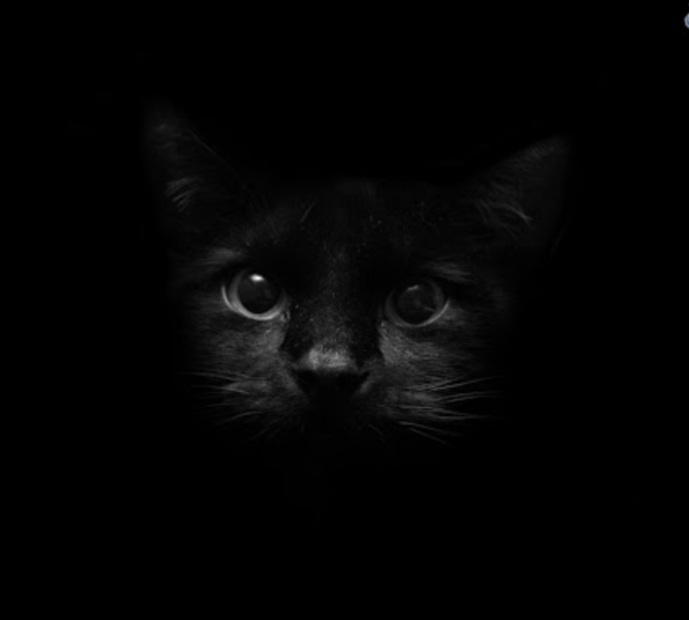
I brought the cat to the command car and slowly opened it. Inside a pair of wide eyes glared at me in fear. The all-black cat blended into the darkness of the box. I dug out my cat treats and dropped a few in the box. I also cut down my water bottle to make a little bowl out of what was left in it. The cat looked OK, no burns or breathing issues. He let me pet him cautiously. I tried to reassure him with the soft, cat baby talk that makes my own kitties know I’m wrapped around their manipulative, fluffy paws.

I closed up the box again, poked a few holes, and resumed my location at the fire as I tried to figure out what I was going to do with kitty. Taking him home was not an option. My house was already overflowing with furry and feathered housemates as a result of my terrible record of keeping animals ‘temporarily’ until other situations materialized.

It was an early Saturday morning and any rescues I knew of only had their answering machines on for the weekend. I was exhausted, had to be at work again in a few hours, and didn’t need a new project added to my day. I decided to bring him to my station, set him up in one of our large, empty storage closets, and postpone my rescue mission until the next day when I would be off. I let the day supervisors know of my plan and put a note on the door warning of the small predator inside.

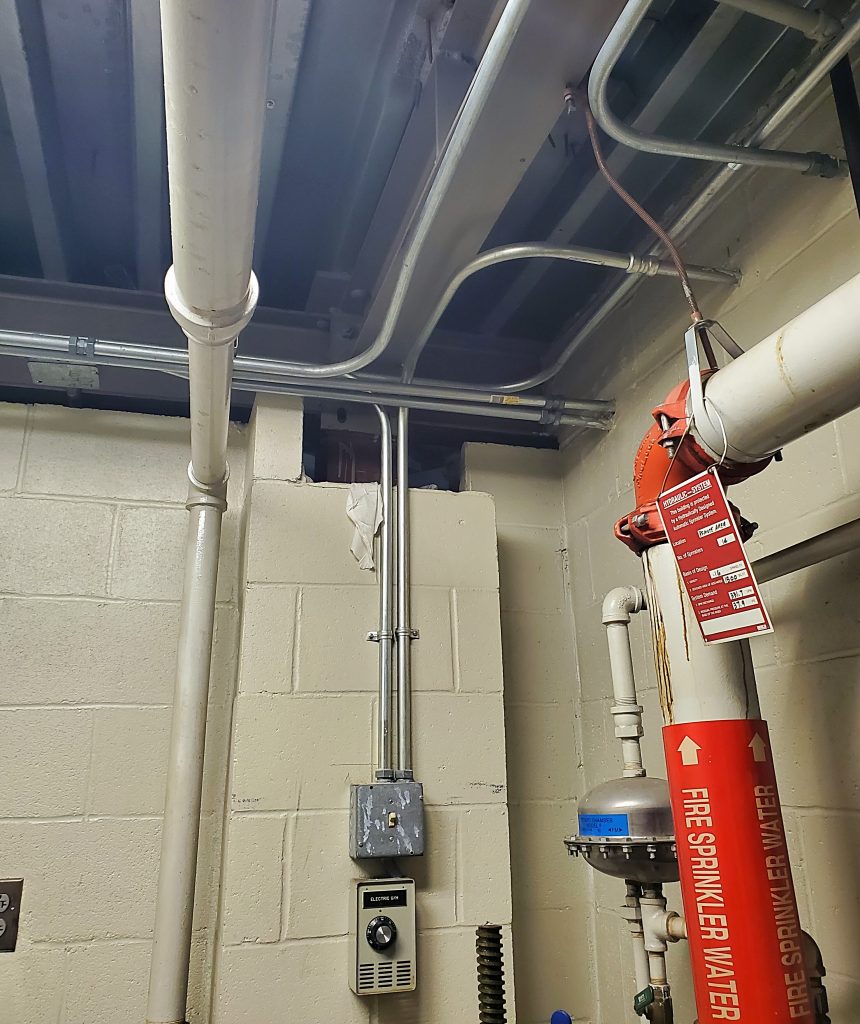
The closet I put him in was a meter room. It was about 5 feet x 5 feet and the only things in it were meters mounted on the left wall and some pipes in various places. The pipes and tubing were mostly thin and vertical and the meters were at least 5 feet off the floor. The room could only be accessed with a key on the lieutenant’s key chain.

I didn’t see the point in telling our new captain of this small development because the cat would be gone before she came back in. I rationalized that she would, of course, be OK with it if she did know. At any rate, I ascribed to the philosophy of it being easier to beg for forgiveness than ask for permission.

That evening when I came back to work, the station was abuzz about the cat in the closet. Back in those days, an animal at the station was a real novelty. Everyone was interested in him and it seemed that throughout the day many people had opened the door to get a peek at our visitor. But when I opened the door to check him, he was missing.

“What happened to the cat?” I asked one of the EMTs walking by.

“I don’t know. He was in there before. He was real mean,” he told me.

I asked who had taken him out. No one knew.

I continued to ask when I saw another EMT who seemed to know.

“I went to check out the cat,” he said. “He looked scared and he jumped on the pipe. I think he’s feral. He kept climbing.”

“But where is he now?”

“I think he kept climbing,” he shrugged. What was that supposed to mean?

I gave the closet another look. Most people would assume that the ceiling and the walls were attached. It looked that way from the ground. Between the ceiling and the wall was steel beam that, from the ground, looked like it was attached to the wall. But could there be a gap? We got a ladder and discovered that, yes, there was about one foot of space between the ceiling and the wall.

What kind of misfit put this place together? What was the point of that gap? And how did the cat know?

I shined a light into the gap and heard a hiss. Once again I saw those eyes peering up in the darkness. I had no idea how the cat had made it up there. Most of the piping was vertical. The horizontal areas of pipe were very, very high up. This cat had skill. I stuck my hand in the gap to reach the cat and got scratched. It was going to be a long night.

Two other women whose shifts had ended came over to help. Behind the wall, there seemed to be a square made out of cinder blocks that the cat was in. It was about one foot below the top of the wall.

We took turns injuring our hands by trying to lift the cat out of the cinder block square. He was either stuck or didn’t like the idea of being rescued, or both. It took a terrible angle to get our arms in a position to pick up kitty and when we did he fought us. We tried wearing gloves to minimize the blood loss but he would slide out of our hands with them on. Things were getting desperate after more than an hour of trying.

I decided to go in naked, no gloves. I was going to take my bites and scratches and just get the cat out once and for all. I figured that I would just deal with the injuries. How bad could it be?

I stuck both arms in. I felt the cat and got my hands around him. I suddenly felt hot pain in my hands as the cat scratched me. I held on. I started to lift him up and felt him clamp down with his razor-sharp teeth, the ones that are designed to kill things. The pain was unbelievable. But I held on. I felt my hands get wet with my own blood. I almost had him over the wall. Then he squirmed and I lost him. The cat won.

I pulled my bloody hands out of the gap. It was worse than I thought. They were completely red with blood and swelling. Parts of my hands were blue. I could barely move my fingers. Blood continued to pour as I wrapped my hands in some trauma dressings. A small crowd had gathered for the rescue event and now they gathered around the spectacle of my injuries.

The mob told me I had to go to the hospital. I agreed to go though I stalled for a time, wanting to know what the game plan for the cat would be.

A collective decision was made to get in touch with ESU. The Emergency Service Unit of the NYPD is a specialty unit designed to handle unusual situations. They have all kinds of special tools and tactics. Surely they could help us with the cat.

We called them unofficially, at the precinct, to see if they could stop by and give us advice or loan us something that could help. They came over quickly and told us they would be taking over the rescue operation. There was no way, they told us, that cat was not going to be rescued.

One of them saw my hands and told me that I should have worn gloves. I told him about the friction issues and he assured me they had gloves that would be able to grip the cat. I was skeptical but they had experience with situations like this, probably. I was just grateful that people with actual tools were going to work on this. That cat was in good hands. I decided to walk up the hill to the hospital that was next to our station.

It was an eye-opening experience to be at the hospital for an extended period of time, instead of the shorter intervals we normally spend there.

The hospital by our station, on a weekend, is a madhouse of all kinds of mayhem. I witnessed an entertaining argument between two people who didn’t speak the same languages. I saw stitches being given to someone with a gash down the entire length of her leg, and I watched another family demand that their adult son be transferred to a ‘better’ hospital despite getting excellent, attentive care.

I was parked in the minor trauma area, far away from the influx of madness but close enough to watch. I sat in a comfortable chair with my hands wrapped in loose, bloody bandages awaiting my tetanus, rabies, and antibiotic injections.

I had been waiting a long time when I noticed one of the ESU officers walking into the ER. His hands were covered in trauma dressings as well and they were becoming red. The hospital staff parked him next to me.

“There’s no friction with those gloves,” he said. I nodded and showed him my hands again.

As we sat and waited, the officer told me that they do many animal rescues. He said it’s much easier dealing with dogs rather than cats because even though dogs are more dangerous they are also more predictable.

“All bets are off with felines,” he told me. I understood.

It was just the two of us for a short time until a third set of bloody hands made their way into our now-exclusive section of the ER. One of my coworkers had given the gap one last shot before they started using power tools to break down the wall.

“They’re breaking down the wall?” I asked, somewhat horrified. Good Lord, what was the new captain going to say?

This whole operation had my name all over it.

I spent much time sitting there waiting and imagining the various scenarios. I pictured myself giving our Captain an explanation of how her meter room had been dismantled. None of them ended with “Why Nancy, that was a great idea!” The pain in my hands lessened under the weight of what was to come.

It turned out, the remaining cop had only to remove two cinder blocks for kitty to be liberated. One of the women took him home. She planned on taking him to an animal rescue organization she helped out at.

In the meantime, three uniformed people sat in a row in the trauma room. Six bloody hands loosely wrapped in bandages awaited treatment. We looked as if we had all been victim to a horrific razor blade attack. People walking by would look at us with concern asked what terrible disaster had transpired.

“Cat,” we’d answer in unison.

One small cat had done all of us in.

ceiling gap with cinder blocks removed

September 13, 2001

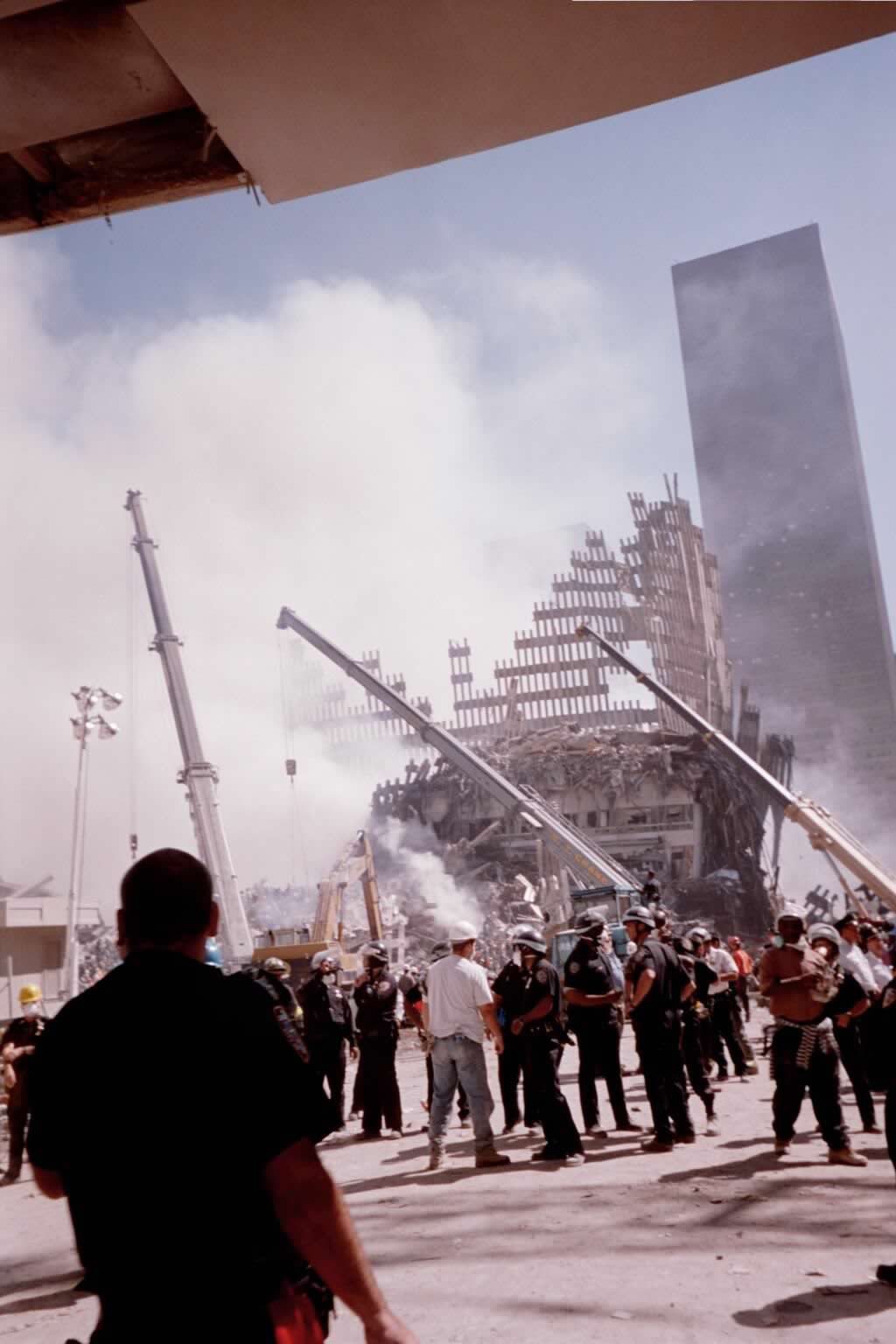
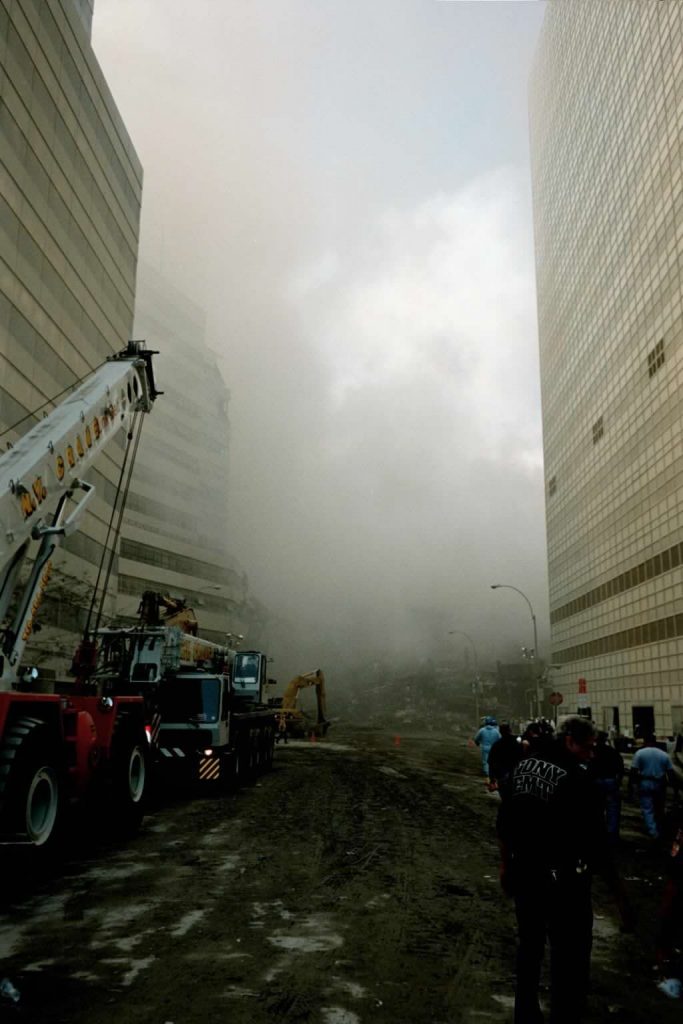
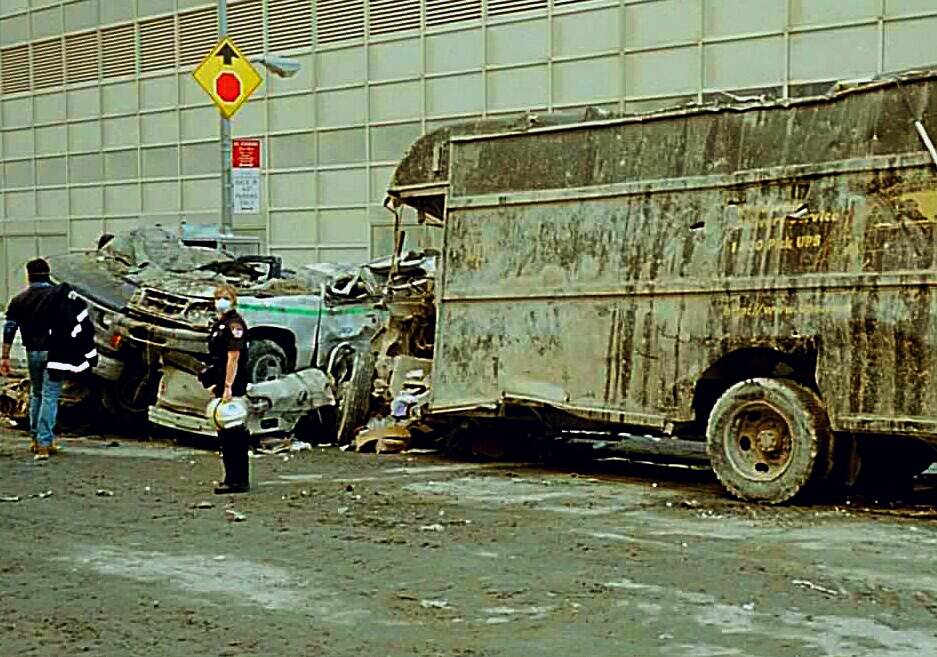
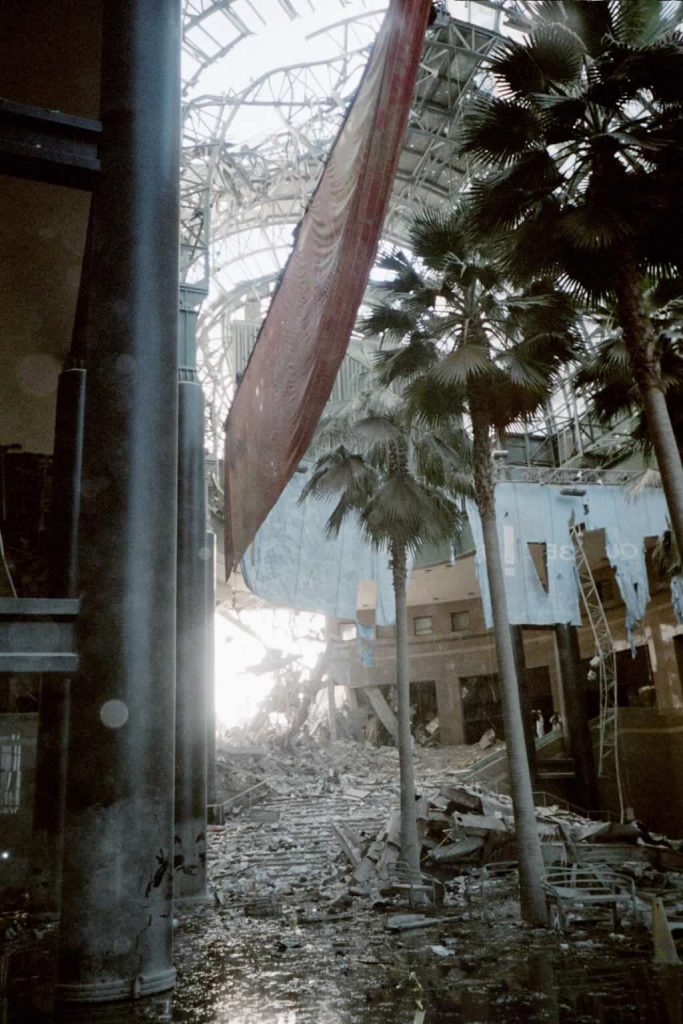
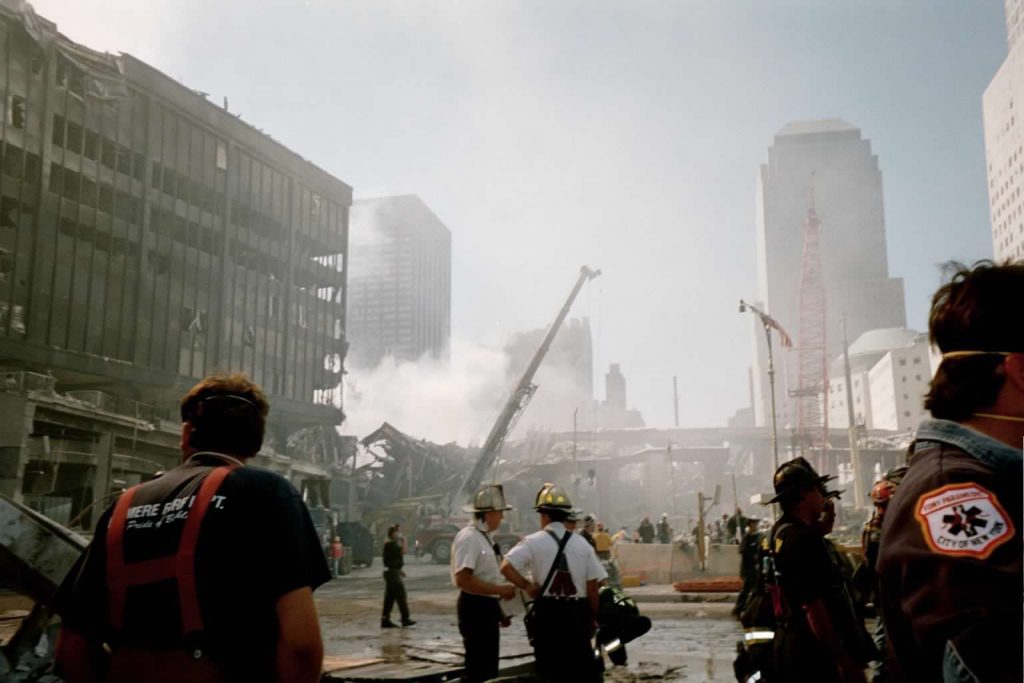
On September 13, 2001, I was sitting in my union’s office with several coworkers, from different Brooklyn stations, awaiting transportation to Ground Zero. We were collectively living in a strange kind of haze after the biggest terrorist attack on our nation, and our city. We had been told to report to our union office if we wanted to assist in the rescue and recovery mission but no one there that day knew what to do with us at the moment. There was a row of telephones on a long table and one of them began to ring. I was the closest, so I picked it up.

“Howdy!” said the friendliest voice I had heard in many days. “We’re from a local in western Montana and we just need for one of you to give us the go-ahead to put our truck into drive.”

Was this a wrong number? Who were they trying to get? What were all these phones for anyway?

“Excuse me?” I asked. “I’m sorry, I’m just waiting here and picked up the phone. Who were you looking for?”

“Well, howdy again, ma’am,” he said. He slowed his speech a little and his enthusiasm went down slightly, but only slightly. “Your brothers and sisters in western Montana have loaded up an 18-wheeler, don’t ask us how we got it, we ain’t telling. We’ve got supplies and a few extra humans to help out our friends in NYC. Now, we’ve got this behemoth pointed east. Joe here, assures us he knows how to drive it. I’m not asking for the paperwork. All we are looking for is the go-ahead to move this thing forward.”

He had put a huge smile on my face but I just automatically started crying. I was actually bawling if we are being honest. I’ll admit I was quite a bit sleep-deprived, which makes it fairly easy to turn on the tear spigot but that, I’m sure, only played a partial role. I was mostly filled with an overwhelming sense of love and gratitude towards this stranger on the other side of the country who had assembled supplies, volunteers, and even a very large truck under auspicious circumstances, apparently, just to help out people he had never met. I’m not sure what he thought when he heard me crying.

“Don’t worry, darling,” he told me quietly. “Love always wins. It might take a while before the light gets shined upon it, but evil always takes a backseat to good.”

I thanked him profusely for that, and for the mission he had set up. I told him I was in no position to authorize anything, and that maybe he should call back later. But he didn’t care. He felt that my answer indicated that his truck needed to hurry up and get to New York. They were just going to head east until they found us. He wanted us to know that help was on its way.

I will never forget that phone call.

***************

When the two airplanes struck each of the buildings of the World Trade Center I was working my other job at a cardiac monitoring service on Long Island. (Most of us work an additional job to support the job we are addicted to.) When news came that something huge was going on in downtown Manhattan, my boss rigged a television up and we all watched it together. Everyone there knew what I did at my other job and they all just looked at me quietly.

My then-boyfriend/future husband was working EMS and on the clock while all this was going on. I had some trouble getting in touch with him but our lieutenant (we worked at the same station at the time), told me he was ‘probably’ safe.

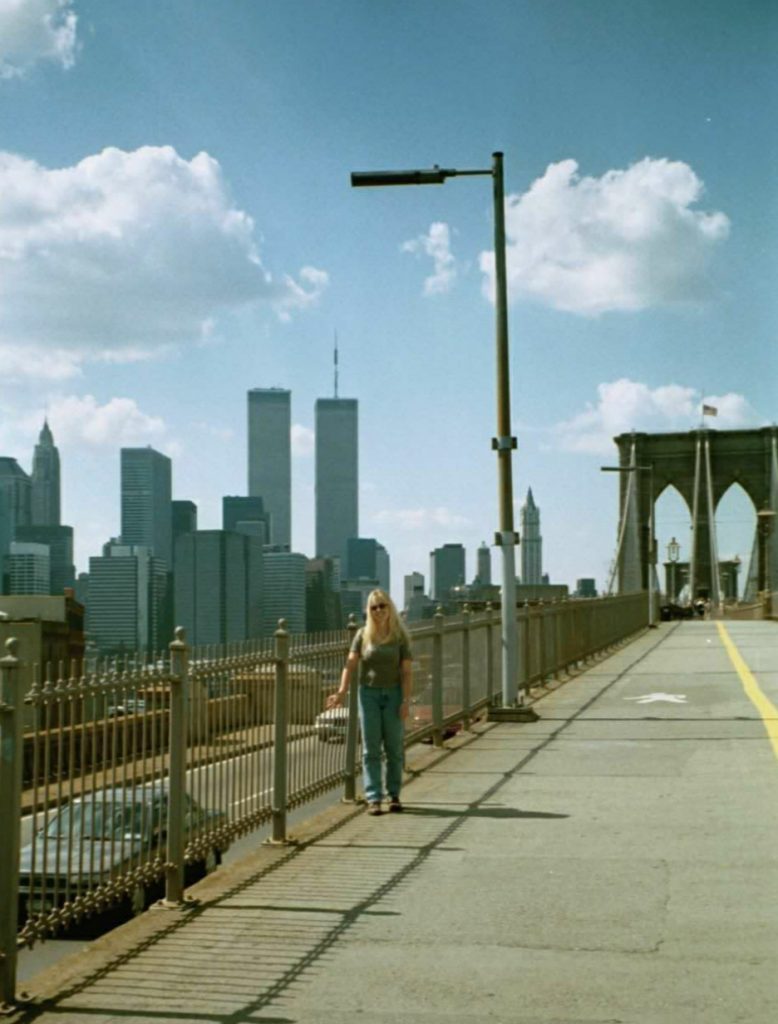
Me visiting ‘the city’ 8/29/01

I was able to get a hold of my partner, who lived close to the cardiac monitoring place, and he came and picked me up in his car. We drove to the city together.

Most of the roads towards the city had police roadblocks and we had to keep flashing our ID cards for much of the ride. We had ideas of picking up our equipment and heading to Manhattan, even though we were scheduled to work our unit that evening but first, went to our station to see what was being done from there.

Everything was up in the air. I don’t know what kind of planning was going on for that evening or the days ahead because it seemed that anyone in charge was in lower Manhattan and inaccessible. We weren’t sure what to do, no one was.

For the time being, our lieutenant told us, we were to stand down. A city bus was on its way to take us to Manhattan. They were working out the scheduling and the logistics.

Eventually, the bus arrived and we got on it. And then it was canceled. No more people would be going to Manhattan, the lieutenant told us. Too many units were there and not enough were covering the regular 911 needs of the city.

So on the evening of September 11, 2001, my partner and I worked our usual truck.

It was a strange time to be doing your regular job. The entire city was in shock, as were we. I remember most things as if they happened in slow motion. Reports floated their way to the station of the names of people we might know, people who were missing. The call volume was higher than average but quite a few of them were calls of anxiety. Many people were hearing things, seeing things that turned out to be unfounded. We took some drunks to the hospital, many of whom didn’t even know that a major disaster had taken place a few miles away.

I wondered about my sister, an air traffic controller, who must have worked her tail off to land all those planes. It’s a stressful job to begin with, but on that day everything that was flying had to land, immediately or as soon as possible. You can find real-time air traffic images online to see just how daunting a situation that was.

The air traffic on 9/11/01 at 9 am

We did our regular job again the next day too. Everyone was still feeling the effects of this major devastating event, even more so since more was known about it. So many people were missing, coworkers were missing. Several people I knew had already been confirmed dead.

It’s difficult to do your job when you’re an emotional tinderbox. There are drug dosages to be calculated and protocols to remember. You’ve got to pay attention when you’re driving. All the while you had to hold it together for everyone else, despite more and more information pouring in, more names of the missing, more buildings.

There were countless stories about people jumping off those buildings to avoid burning to death inside. You could only try to imagine the kind of desperation that takes. At the time, it was thought that hundreds could be trapped in the rubble. To think about those poor people, desperately waiting for help, was heartbreaking.

Our unit had developed a friendly relationship with Squad 252, which was in our area. We even had the code to the door, which surprised the firefighters that had been sent there to cover the firehouse. We went over to see how they were doing but the looks on the faces of the men there told us everything.

And yet I was still picking up drunks and people were still calling for colds that their antibiotics hadn’t cured in three days. Normally those calls don’t bother me. I often find them entertaining and they are a nice balance to the ‘real’ calls that involve suffering. But at that time there was nothing redeeming about calls like that, and there were so many of them, during the aftermath of a terrorist attack. Didn’t they even watch the news?

Back then, I like many others, had no landline. I was living with a friend and the only phone line in the house was dedicated to dial-up internet. My then, high-tech brick of a phone had no service for more than a day after the attack and when it finally did come back it had a very limited range. I desperately wanted to get in touch with my family. I was able to call my mother in Florida after a few days but my dad in Hawaii would have to wait much longer. It was like we were back in the days before the industrial revolution. Most people were having difficulty with phone service and yet others were still able to call for an ambulance because their foot had a rash.

I cannot describe how maddening this all was to me. When you deal with the onslaught of pain and suffering fairly regularly one of the biggest coping mechanisms is knowing that you tried and that you were able to help. Sometimes your efforts fail but the simple knowledge that you did everything you could makes all the difference in the world.

There is also something to be said, something important, about keeping busy. But nothing we were doing was satisfying. Nothing seemed like ‘helping’. It seemed like everyone wanted you to forget what was going on and just do what you used to do as if nothing had changed forever.

So, on my first day off I wanted to head to lower Manhattan and dig. But you couldn’t just drive over with your shovel and helmet. There must have been some organized efforts I could join, I thought. Or I would be one of the medical volunteers somewhere, I hoped. Anything. I would do anything.

But on the days previously, when I had been working, information about how to go about doing so was spotty and constantly changing. Initially, we had been signing up for extra ambulance shifts that would be dedicated to lower Manhattan but they had been canceled. I had tried to go over after and before my regular shift. (And I still had to pick up my car and the stuff I had left at my other job in order to try and accomplish these things).

The best lead I had was to go to the union office as I had heard they were bringing groups of EMTs and paramedics to work ad hoc posts that had been set up. I had spent less than five hours at home in three days and I couldn’t wait to go to Ground Zero because I was desperate to assist in some way, anything, to feel useful because driving people to the ER for anxiety wasn’t doing it.

A little ragtag group had assembled at the union office that day. I clearly had not been the only one who had heard this was the place to go. But the two people in charge at the office didn’t know what to tell us either. Their information was also constantly changing.

My then-boyfriend/future husband had gone to a different location where EMTs were being picked up to work at medical outposts that were being created. Paramedics were excluded, we were told, because paying us was too expensive (ridiculous, given the sparse difference in our salaries). It seemed they didn’t care that they had ‘volunteers’ who were willing to do things for ‘free’. This just added to the outrage, that in the middle of a nationwide tragedy, the same silly nickel-and-dime rules were applying. There was just so much to be angry about.

But then the phone rang, and I spoke to my new friend from western Montana.

I told the small group about the call and it empowered us to get up and go together. The union gave us a placard and we got into someone’s vehicle and made our way downtown, shovels in hand.

Along the way the roads were lined with hundreds of well-wishers holding signs of encouragement, handing out water and snacks at traffic stops, and cheering us on. My hope for humanity was returning again.

Lower Manhattan was surreal. It had been two days after the attack and the air was still thick with a big white fog of particulates. It was really overwhelming and surprisingly quiet.

Maybe it’s just my slow-motion way of remembering it, but sounds seemed dull, the way your neighborhood feels when it’s covered in a blanket of snow.

We parked in an area where other vehicles had been assembled, ones that had been recently used, as opposed to the ones covered in white dust and debris. As we walked towards what was left of the Trade Center we would often see a random person, almost everyone was wearing some kind of uniform, and they would give you a somber nod that you would return in kind.

I was struck by the lack of “stuff” in the debris. It seemed to be mostly building material, steel, and rubble. Two major office buildings had come down and there was a surprising lack of office equipment, crushed or in pieces. There was also no glass. I assumed it was a large part of what was making up the white fog.

The air had a strange, acrid smell to it. After only a block or two, our uniforms were already covered in dust. At the first makeshift station we passed, we were handed an N95 mask, the kind I used to drywall my living room. At some point, later on in the day, I was warned by someone in a state uniform that my N95 mask was wholly inadequate and that I needed to get something better.

“Where?” I had asked.

“Oh, we don’t have any. Nobody does. But what you’re wearing, it’s not enough,” he told me. He’s the only one who said anything about it on any of the days I was there.

Everything’s good, here’s your mask, you probably don’t need it, air quality is fine…

We walked around seeing different people in different places. It was comforting to see familiar faces of friends you hadn’t been able to get in touch with. For this reason alone, I was glad to be there.

We spent a good while walking around, taking in the new landscape. I snapped a few photos with my disposable film camera. It was numbing to see what was still standing and what had been crushed.

At some point, I volunteered at a medical station that had no medical people at it. Someone there begged me and one of my group to stand by until they found a dedicated crew. It was in the lobby of a partially destroyed building. About an hour later, there was a sudden call to evacuate due to the instability of that building. My friend and I took off and went to look for someplace else we could be useful.

Much of the day consisted of stopping by, assisting, and then leaving when different orders came or new groups arrived. The amount of work ahead was, of course, insurmountable and it didn’t feel as if we had accomplished anything of significance but it felt much better than pretending nothing was wrong and following the same routine we had been doing.

The one thing that does stand out among all the sadness and shock was the massive number of people who came to help. They too, I believe, felt that doing something was an important way to get past the helplessness one feels when something terrible has happened.

So many individuals were donating their time, services, and resources. Massage tents had been set up, catering of all kinds was going on, tables were set up with all sorts of donated articles- t-shirts, gloves, flashlights, socks, helmets, climbing gear, and so many other things, it overwhelms me to remember.

And there were also the crowds, lining the roads leading to lower Manhattan. Access was blocked for most people and yet they found a way to participate and help. Their encouragement and positivity were a wonderful window of light in the dark room of our collective mental anguish.

I went to the site a few more times over the next several months. Over time, things became more organized. There were specific areas you could work, and eventually, Ground Zero became coordinated into a routine with procedures to follow and ways for things to be cataloged. The outpouring of love and appreciation from the public continued for a long time as well.

I never found out who the caller was on that day in the union office. I hope that he knows how uplifting his voice and his message were and how it meant far more than all the supplies they had managed to assemble in that short period of time. He was 100% correct about evil taking a backseat to good and he was definitely part of the ‘good’.

The GSW and the UTI

The woman who jumped into the back of our ambulance was gripping her crotch uncomfortably. She sat down on the bench and slid over to the middle, all the while her left hand maintained a vice-like grip on her privates. She looked at us with desperate pleading eyes.

“IT BURNS SO BAD WHEN I PEE!”

Even from a relative distance, I could smell the distinct, pungent odor of stale alcohol on her breath as she spoke. It was mixed with a faint odor of urine coming from her clothes.

“I’m DYING, you just don’t understand!” she continued. “I gotta pee all the time but then I don’t!”

Only a few minutes earlier, my partner and I had been following a police car going lights and sirens. There was information coming over the PD frequency that a shooting had occurred nearby and when the police car raced past us, we joined them. We notified our dispatcher that we were on the way to a potential GSW [Gun Shot Wound] and gave the location. Our ambulance arrived before we were even finished telling the dispatcher about it.

There was a block party going on and aside from the street being cordoned off, numerous cars and scooters were double-parked along the roads leading towards it. Unable to make it down the street due to barriers, we stopped at the intersection and parked haphazardly behind the police car which was also somewhat askew.

Ah, trauma…

Most EMS personnel love a good trauma call. Its adrenaline-inducing fast pace can provide a sensation similar to a runner’s high. It’s just enough euphoria to keep you interested, not too much to cloud your judgment. As a sporadic weekend athlete, I can attest that the endorphin reaction from trauma has a marked edge over the experience that happens after a satisfying run.

It was a hot summer night and we pulled up to mayhem. Shots had been fired into a block party crowd and people were running and screaming all around. Although several police cars were already at the location, we were the only ambulance and people immediately shouted directions at us.

“He’s over there!”

“That way!”

“He’s lying in the street!”

Everyone was indicating the same particular location in the disorganized chaos down the road. It was obvious that we definitely had one patient, perhaps there were more. We requested additional units from dispatch.

After collecting our trauma bag and a backboard we opened the large doors at the rear of our truck in order to take out the stretcher. That’s when the crotch-clutching woman clad in fuchsia hopped in.

“IT BURNSSSSS!” she cried.

“Lady,” my partner began. “You gotta get out! Someone’s been shot here!”

“I don’t care!” she said. Her look of desperate pleading took on a more angry expression. “My pee is on FIRE! I need a hospital!” She wasn’t asking.

My partner and I looked at each other in disbelief.

“Ma’am, please,” I tried. “More ambulances are coming, but for now, you’ve got to get out. Someone is in critical condition over there.”

“This ain’t critical? It’s been going on now for, like, TEN DAYS!”

Given there was something more pressing going on, we felt that she could probably endure the fire in her pants a little bit longer if she’d already been dealing with it for ten days. It was a legitimate triage decision.

People were still yelling at us and pointing down the block. They wanted us to hurry, he’d been shot in the chest, the consensus seemed to be saying.

A GSW to the chest?

This was EMS gold. It was a priority trauma job, something we could actually do something for. There was a real chance to make a critical difference for a victim of terrible violence. It was everything we had raced over here for.

But first, we had to send the pink tracksuit woman on her way.

One of the police officers on the scene wondered why we weren’t already running down the block with our stretcher. He came over and noted our dilemma. “Go,” he told us. “I’ll take care of this situation.”

We grabbed our gear and rolled the stretcher past groups of frightened and panicked party-goers. We quickly found a young man, he couldn’t have been more than 20, lying in the street near a table covered with spilled-over food items. He was using his fingers to plug up a hole on the left side of his chest.

“They got me,” he told us, gasping and out of breath.

The wound was fairly large, indicating a large caliber bullet. There didn’t appear to be an exit wound but we could tell there were some other bullet holes located on limbs which, at the time, didn’t concern us as much. We would have to work quickly to mitigate the anticipated blood loss.

“I GOT SOMETHING TOO!”

We turned around to see the same woman holding onto her genitals for dear life had followed us to the patient, the critical patient.

Good job, there, officer.

Well, at least he’d gotten her out of our truck.

“You’ve got to be kidding me,” said my partner.

“This ain’t no joke!” she replied angrily. “I saw you first. Plus, like, MY issue been going on longer. Ten days at least. TEN DAYS! You know what it’s like to pee FIRE for TEN DAYS? Let him get the next one.”

“That’s not how this works,” I answered. “If this has been going on for ten days, ten more minutes aren’t going to make much of a difference but for this man, ten minutes is a really big deal!”

It’s called the Golden Hour of Trauma. Studies have shown that the faster a trauma victim gets to an operating room, the better his chances of survival. There were things we could do on scene and/or en route, important things, but getting to an OR within an hour’s time was the critical factor.

The woman ignored me and laid herself down on our stretcher. The growing crowd came to our assistance as we worked to stabilize the man.

“EXCUSE ME!” screamed a bystander. “That bed is NOT for you!”

“Can’t you see that boy is bleeding from a HOLE in his CHEST? What is WRONG with you?”

“I’m the one who called 911!” said another. “And I sure as hell didn’t call for no ‘ho with gonorrhea.”

The woman quickly jumped up off our bed and got in the face of the bystander who had accused her of sexual improprieties. Her hand had finally released its grip on her genitalia and was now clenched into a fist directed at him.

“This is no STD! You don’t know what my problem is. Mind your own business.”

Another police officer quickly intervened. As he separated them, the pink-clad woman screamed up at the sky, “I’m a victim too, you know!”

The crowd responded with insulting remarks about the woman’s sexual history.

“No, the real victim is anyone who pays you $6 for a blow job.”

The woman wearing neon pink was prepared to fight each and every one of them but the police officer was able to steer her away before more violence ensued on Vernon Avenue.

It was obvious to even our lesser-trained bystanders that our 20-year-old GSW had serious, life-threatening injuries. He had been shot three times and it seemed that one bullet had pierced the air space around his lungs, causing pressure in his chest and increased pain while breathing. We were able to rapidly insert a needle into his chest cavity to release some of the air. Our patient expressed some momentary relief. He needed an operating room and a surgeon as quickly as possible.

As we started to rush our patient to the ambulance, we were eventually joined by the intoxicated woman in pink again. I have no idea how she kept escaping the watchful eye of anyone who volunteered to keep her away from us. She seemed to have lightning-fast abilities in catching up with us.

My partner got on the radio and requested an ETA [Estimated Time of Arrival] for any incoming units. Simultaneous trauma jobs in our vicinity had all available units tied up on other jobs. The voice over the radio was loud enough for the woman to hear that there would be a wait.

“Well?” said the woman, who had now resumed her impenetrable grip on her privates. She was hunched over now and limping. This woman who had evaded every law enforcement officer and bolted down the block to find us had suddenly deteriorated into a frail person who could hardly walk.

“I GOTTA GO! You can’t leave me here!”

When we reached our ambulance and loaded our actual patient into the vehicle, the usual discussion among the NYPD began as to who was going to escort the patient to the trauma hospital. With the added impediment of the complaining woman dressed in pink, a potential delay was gearing up to become even longer. Our patient needed to leave right away.

There is some dispute over the issue of patient abandonment which factored into our last-minute decision to take the woman along with us. Aside from the fact that our adrenaline stores were starting to wane, breaking down our wall of resistance, a very real question about whether or not we were violating our certification came into play.

Several legal terms were quickly considered, including “duty to act”, “abandonment”, and “nonfeasance”. There continues to be a debate as to how these issues are applied when more than one patient presents and one of those is critical. At that moment, it was easier to just take the woman with us than deal with unwanted consequences later or be delayed in any way by her removal.

The woman sat on the bench again, along with an officer. A notification was given to the nearest trauma center, which in our case, was in another borough. Patient #2 was displeased with our hospital choice.

“Queens?” she made a face indicative of the ingestion of a sour foodstuff. “Queens? Really? We ain’t got no hospitals in Brooklyn you approve of?”

“We’re going to a trauma center,” I patiently explained as I adjusted the IV and prepared for another.

“I know my infection is hurting but I wouldn’t say it’s traumatic. I’m sorry if I was being a bit over-dramatic.”

Was that an apology?

“We need a surgeon for this guy!” I said, no doubt my exasperation audible to this woman oblivious to the bleeding guy on the stretcher. The cop just shook his head. It was useless trying to explain, his telepathy told me.

I shook my head in agreement and took another blood pressure on the guy with all the bullet holes.

The woman resumed her tale of woe regarding the ongoing urinary tract infection [UTI]. She was familiar with them, had experienced them before, and wondered why she was cursed with them repeatedly.

Our gunshot patient interrupted his facial expressions of pain and suffering to say to me, “Is she being serious?”

I had no answer to give him.

We made it to the hospital in the vast reaches of Queens County very quickly. The staff was there, ready and waiting outside, to receive our GSW. As soon as the door opened, however, they met our UTI first.

“Ain’t this a nice surprise? I can’t believe you’re all here!” she remarked with a big smile. “The hospitals in Brooklyn don’t do this! I’m going to Queens from now on!”

There was some momentary confusion but everyone mostly ignored her as they focused on our young man on the stretcher. They circled around him, asking questions and shouting instructions to each other. They grabbed onto the stretcher and we all raced him down the corridor to the entrance.

The woman watched as the staff left her alone and she wasn’t happy about it.

She walked slowly, hand on crotch, and with a significantly more pronounced limp, behind us. My partner stayed back with her but she felt abandoned, yelling out “What about me!” at least once.

No one listened. Our guy was wheeled into the trauma room and they got to work on him right away.

“Was that the family?” one of the registration people asked. When I told her that she was another patient she gave me a sour expression, similar to the one the UTI lady had given me before. Apparently, these situations never occurred in Queens.

My partner escorted our UTI patient to the triage area and asked her a few questions for the paperwork we would have to do for our additional patient. She was indignant the entire time, wondering why not one of the many people who had greeted us as the doors of our ambulance opened, couldn’t have devoted their attention to her.

Since the triage nurse was in with our GSW, no one was around to listen to her complaints at the main triage desk. After waiting less than five minutes, she got up and started walking around the ER demanding a bed.

A hospital police officer quickly came over to mitigate the disruption to the busy ER.

“I need a bed! I gotta pee but I can’t!” she pleaded with him.

He looked around and directed her to the restroom.

“NO!” she yelled. “I gotta pee but I need a bed!”

“You want to urinate on a stretcher instead of a toilet?” he said, dumbfounded. “That’s the first time someone admitted it outright.”

At that point, our GSW was wheeled out of the trauma room for his trip to the operating room. He was surrounded by a large team of doctors and nurses as they quickly walked to the elevator. This enraged the woman even further. The critical trauma victim had gotten a team of specialized medical personnel and she, suffering from an infection in need of an antibiotic, was still waiting for a stretcher. It was outrageous, apparently.

The woman became very angry, shouting some derogatory words at the hospital police office and threatening to inflict violence on anyone who disrespected her ‘again’. The officer called for assistance at this perceived threat and the woman was handcuffed and restrained onto a stretcher.

She had gotten her bed at last.


Two Idiots Change a Tire

Not long after starting my new job on the ambulance, I was partnered with another graduate of the Bureau of Training’s Cadet 6 class. At best, we had only about five shifts between us, all with more experienced partners, at least. Although the ink had barely dried on our EMT certifications, we were handed the keys to a $250,000 vehicle and set loose on the residents of Manhattan. It was a glorious time to be in EMS.

When I first started, it was not uncommon for two people from the same class to work together immediately after graduation. There were some lieutenants who frowned upon it and tried to divide established partners for a shift so they could impart their knowledge on us novices, but more often than not, they’d cave to the objections of people who did not want to be split up to “babysit” the newbie.

It’s probably good that our service moved towards an internship type of system that would have prevented this, but back then the impetus was really more on filling vacant seats with anyone they could get. The patients would probably be OK, they reasoned. We were both EMTs, they reminded us, so we should know what we are doing. And as new EMTs, our knowledge was even better than our seasoned cohorts because it was still fresh in our minds.

At the start of our shift, we loaded our brand-new helmets and pristine, newly-stocked tech bags onto, possibly, the worst vehicle in the fleet.

It spewed black smoke out of the tailpipe. The then-standard carpeting on our center console was covered in long-expired foodstuffs. Since the cabinets in the patient compartment slid open as if they had been greased, our supplies were all over the floor. But we checked and cleaned up our ambulance and headed out for what ended up feeling like the longest shift in eternity.

We decided to take turns driving because none of our other partners had let us do it before and we had no idea when we ever would again. Our ambulance for the day had terrible handling and seemed to veer toward the left all the time. It was also incredibly loud and would randomly backfire. Now that our service has switched over to diesel vehicles, it’s one feature I look back on fondly.

Our first patient was a 19-year-old man who lived with his girlfriend on the top floor of a four-story walk-up. (This kind of building dynamic would become a standard theme for me for the next 30 years).

The man’s neck was hurting after sleeping in an uncomfortable position in a drafty room. For some reason, we ended up carrying this guy down those four flights of stairs on a backboard with a cervical collar. The board and collar was standard procedure for a neck injury but technically, some trauma should have been involved.

I remember him clutching his teddy bear the whole way down those grueling stairs. I don’t know what we were thinking. Days and months later, whenever we saw each other after this shift, my Cadet 6 partner and I would always bring up how stupid we were for doing this.

“Remember the teddy bear carry down?” one of us would say. “Why didn’t you stop me?”

We did all kinds of stupid things that day, things we would never think to do three months later when we would officially pass the delineation point where we could finally be called “seasoned” EMTs.

We took patients to the hospitals they insisted on, even if the hospital they wanted didn’t have the services they needed. (There were no computer terminals in our vehicle that gave us up-to-date information on hospital availability back then.) And we spent far too much time trying to park in ways that wouldn’t inconvenience other motorists.

As the day went on, it became more and more difficult to ignore the wheel issues that were plaguing our driving efforts. So we got out and did something much more idiotic than carrying a teddy-bear-clutching 19-year-old down four flights of stairs for no legitimate reason. We went out mechanical for a flat tire.

The tire, we figured out later, had probably been flat for weeks, having been conveniently overlooked by the more experienced (smarter) crews. But because we were stupid, we called for the tire truck.

The way the procedure was meant to go was that a tire truck would arrive at your location and hand you the tire and the tools. Then he’d lean against his truck and watch you change the tire while he smoked a cigarette and thumbed through pornography.

I remember the fat, bald “Tire Mechanic” snickering as he handed me the tire iron. He obviously didn’t think a woman could change a tire and part of me wanted to prove to him that I could.

I had changed tires on my own car a few times; I knew I was capable. But the other part of me was thinking about how the “mechanic” was making three times my salary and he was just going to stand around and watch. I seriously considered ways I could mess the whole operation up.

It wouldn’t be hard to screw up the tire procedure, I quickly learned. I was pretty sure I zoned out during the tire-changing demonstration during our Emergency Vehicle Driver Training class anyway. Hopefully, my partner had paid attention.

It was a hot June day and we were getting filthy and tired. But we muddled our way through it. It was arduous work just to get the lug nuts off. It had been ridiculous to equivocate my car tire-changing skills with this behemoth. It wasn’t like changing a regular tire because they were bigger and two of them were loaded onto one axle.

Then, when we started loading the new tire on, the fat, bald guy suddenly noticed that he’d given us the wrong kind. He had to put down his Hustler magazine and go through his stock again.

Since we had inconvenienced him, he made some snarky comments under his breath as he went through his supply. After he gave us the new, correctly sized tire, he resumed his leaning position on his truck and found the previous spot in his porn rag. He made sure that I could see what he was looking at and gave me a disgusting wink. His repulsiveness assured me that naked women in print was probably the most he could hope for, sexually.

One important thing I did learn, finally, was the art of time management. At one point, I reminded my partner what time it was and how much time was left in our shift. He instantly understood that we were going to make sure this activity would be the last thing we did on our shift together.

So, we took our time and worked to ensure that everything we did was done methodically, slowly, and re-examined. Our tire truck guy kept checking his watch with a sigh as if we were delaying an impending meal break. He stopped giving me snickering winks and started getting impatient, which gave me some inner satisfaction.

When we were finished, our white shirts, which had already gotten a little dirty earlier, were now covered in grease and soot. They would never be truly white ever again. My hair had a new shape and had expanded further outward (it was the 80s). My partner’s hands were cut up and his glasses were askew. Our new cavalier attitude towards our appearance did not go unnoticed by our coworkers.

“But you survived, didn’t you?” they said.

Exact Words (part one)

Every three years, EMTs and paramedics in New York state need to renew their certifications. This involves attending a refresher course and then taking a written and a practical exam. Refresher set up has changed several times over the years, but in it’s best incarnation it involved three weeks at the Bureau of Training. During that time we would review for the state exam, practice skills, and go over new policies that may have changed since the last refresher. It was also a great time to meet coworkers from other parts of the service and share stories.

One refresher year, I was reunited with a friend I had gone through paramedic school with. At that time he was working in the Office of Medical Affairs [OMA]. Among other things, the people who work in OMA review random pre-hospital care reports. They generate statistics and monitor the quality of care patients are getting.

The call report has also gone through many changes over the years. Although now they are completely digital, for my entire career in the streets they were paper. They changed tiny spaces for the narrative into larger spaces, sections were added for billing purposes, the refusal area has seen it’s language changed, and other sections have been moved and changed over time. Even the report itself has gone from being an ACR [Ambulance Call Report] to being a PCR [Pre-Hospital Care Report] to now having that little ‘e’ in front of PCR [ePCR] to emphasize our jump to digital.

At the time I was taking refresher with my colleague from OMA, call reports started being scanned into a computer, as opposed to being stuffed into an envelope and mailed to OMA. I was under the assumption that they spent less time reading them now and more time analyzing the statistics generated by the computer, which were based on the filled in boxes.

Despite thinking that I had no audience, I still took great pride in writing my call reports. I tended to go beyond the dull narratives and a one-size-fits-all approach to writing them by adding details that would help me remember a specific call if I were ever questioned about it, either in an OMA review or in court. My favorite, and the favorite part of everyone who worked on my unit, was the “Chief Complaint”, which in those days, was a long, wide box on the top of the paper. It’s purpose was to explain why the ambulance had been called. I regarded it as the title of everything else that followed.

From the very first day we learned how to fill out the form, it had been reiterated to us over and over again that we are instructed to use the patient’s exact words. Most people ignored this directive, given the prevalence of foul language and extraneous sentences people tended to use when telling the story behind their phone call to 911. The majority of EMTs and paramedics made an effort to summarize the words that patients actually used, to gear it more toward what was actually going on, but not us. While others were editing those exact words to something more concise (“I have diarrhea”), my partners and I would delight in waiting for the patient to utter just the right sentence that described things the way he felt them (“My ass is like a fountain.”)

You have to take your joy where you can find it. If our service wanted exact words, then damn it, that’s what we were going to give them.

As I was sitting next to my friend in refresher, his department-issued cell phone rang while we were on a short break. Not long into the call, I heard my friend say, “…Oh yeah, she’s sitting next to me right now. Sure I’ll put her on.”

I reluctantly took the phone thinking, of course, that I was in trouble. No one from OMA just wants to say hello.

“Hello, is Nancy on 37V?” I said yes. “Hello, this is Dr. Andrews, in charge of OMA.” I knew Dr. Andrews as one of our doctors who took our telemetry phone calls and did some of our CME [Continuing Medical Education] classes. I didn’t know he had become the MD in charge of OMA. Despite the friendly tone in his voice,I was leery. It couldn’t be good if they knew your unit.

“I just wanted to let you know how much we enjoy reading your pre-hospital care reports over here.”

“You do?” I asked cautiously. I still wasn’t sure if this was a trap of some kind.

His voice remained friendly, “Oh yes! Not just yours but everyone on your unit. Reading these forms gets pretty tedious because they’re usually boring which is why we look forward to the ones from your unit. “

“Really?” I answered. “We were kind of under the impression that no one really reads them. It’s nice to know someone appreciates them as much as we enjoy writing them.”

“Oh you have no idea!” gushed Dr. Andrews. “We love them. We have a board where we write down the latest chief complaints from your unit. We put a star next to the ones where we recommend reading the comments as well.”

“No way!” I was flattered.

“Oh yes,” he told me. “It’s the 37V board. No one uses the chief complaint section the way you guys do. My personal favorite is ‘They sent two hot ones straight to my juice, yo!’ ” He was talking about the chief complaint for a man who had been shot twice in the testicles. It was a personal favorite of mine, as well. That one probably had one of those stars next to it.

He ran through a list of a few others they had enjoyed and told me to let my partners know that their pre-hospital care reports were appreciated as well. He said to keep up the good work and I thanked him again. As I handed the phone back to my friend I still couldn’t shake the thought that I had been set up in some way. But our PCRs did make for a fun read. He hadn’t been the first person to tell us.

Over the years we had written many of our best chief complaints down, to share with our coworkers and friends, and also for ourselves, to make us smile when there seemed to be little to smile about. My list includes:

“God wants me to suffer.”

“People tell me I smell bad so I want to make sure it’s not a disease before I take a shower I don’t need.”

“They beat me like a pinata.”

“I didn’t think I needed to read the directions that came with my new saw.”

“My foot is a new shade of green.”

“Cheap vodka makes me drive like an asshole.”

“I broke my arm on this shampoo bottle.”

“I’m just a loser. Take me to the hospital.”

“I am the great Mephistopheles of legend and lore. I inhabit this body now. Take me to your governing elders.”

“The aliens gave me an implant and I want it removed.”

“I’m just in it for the lawsuit.”

“You can’t brainwash someone who doesn’t understand and yet here I am.”

“He planted it in my rear end so hard, now my neck is crooked.” (this call concerned a car accident where the the driver of the front car claimed whiplash.)

“I just found out about ass cancer and I don’t want it.”

“When you’re a playa, penicillin is just part of the regimen.”

“A demon told me to stab myself but all I had was a pen.”

“My girl tried to give me a salmon named Ella with her warm-ass soup”

“My brother is in the hospital having a heart attack so I must be having one too because we’re twins.”

“I used to love eggs but now I don’t anymore.”

“My new girlfriend’s mother told me she didn’t like the way I looked. Do you think I look sick too? I don’t really feel sick.”

“I’m pretty sure I have a sexually transmitted disease. I deserve to have a sexually transmitted disease.”

“My goldfish gave me gonorrhea.”

“My asthma boy had a seizure.”

“There ain’t no kind of juice that ain’t coming out of that man’s leg.”

“WebMD says I have cancer.”

“That bish put a curse on me and I need it removed.”

“I went on a bender I don’t remember and now it hurts when I pee.”

“The hairs growing out of my mole are turning gray, like my beard.”

“My love juice is looking kinda green these days.”

“I got mascara in my eye.”

“My ex is a demon and I’m scarred by her love.”

“I made my boyfriend break my nose so I could get free plastic surgery.”

“My scalp is peeling off! I got these white scalp flakes on my shoulders!”

“I’m running out of reasons to go. You just write down anything you want.”

“Prostate cancer runs in my family.” (this was from a young woman who was very concerned over information discovered at a family BBQ)

“I can’t reach my toenails to cut them and they keep getting caught up in my socks.”

“I made a pact with tequila and now it’s coming to collect.”

“The peoples in the commercials for eczema medications looks so happy and I want to be like them. Tell them I have eczema.”

“This might look like a mosquito bite but it was from the government.”

“No one can touch me, I’m made of fruit.”

“My skin is dry but when I drink a lot of water all I do is pee, it completely bypasses my skin.”

“I know now that I can’t trust my dealer’s idea of a ‘good time’. “

“The roaches have it in for me. I see them watching. And plotting.”

“My face looked very puffy in this picture my mom took.”

“Take me to any hospital with a microwave that I can use on this food someone gave me that was cold.”

“I spilled orange juice on this paper cut and it must be seriously infected because it hurt like hell.”

“The bread machine sliced off my finger and it got lost in the dough.”

“The evil voice in my head learned how to play the drums.”

“It all started with a bad banana.”

“I got beat with a Slim Jim. The snack not the car opener.”

“There’s a bug in my ear and he talks too much.”

“I think I’ve got a disease.” (this guy would not elaborate as to what disease or why he thought he had one).

“I broke my tooth eating pudding.”

“I’m really into that hot nurse at Bellevue. I’m just going to get her attention.”

“The drugs they prescribed make me pee a lot.” (he’d been prescribed a diuretic, which tends to do that).

“I think I’m smelling too many things. This needs to be stopped.”

“I want the doctors to stop me from sweating.”

“The things I do in the bathroom ain’t right.”

“On my planet, eating paper doesn’t make your stomach hurt.”

“He been falling since the sugar ate his toes.”

“I wanna vomit so bad I could cry.”

“Every time I take tequila I wake up and everything is spinning.”

“I got a itch that makes me less of a man.”

“My cred got busted.”

“My eyes need to switch places. It’s gotta be done by Monday.”

“I don’t think crack is good for my heart.”

“He can’t stop wheazaling.”

“The gremlin I met when I was on mushrooms said I was going to die if I didn’t go to Methodist hospital and see someone called Dr. Joseph.” (strangely enough a Dr. Joseph was on duty that night)

“I need a bed and a woman.”

“There’s a smelly, yellow glue coming out of a hole in his head.”

“I was shot in the leg six years ago and today its thumping like a drum.”

“Someone needs to change my diaper.” (60 year old man)

“My hand smells. The left one.”

“I can’t reach this itch in the middle of my back.”

“I need a shrink to tell me why I attract crazy women.”

“I went to heaven in my dream but I know I’m going to the other place.”

“I gassed my face with roach spray trying to kill a mosquito.”

“The man on TV says I might have carbon monoxide in my home.”

“Women just don’t find me attractive.”

“My husband smells like pee, he must have sugar.”

“My big toenail is the same shade of yellow as my teeth.”

“I need a clean bathroom.”

“None of the doctors believe me when I tell them I’m pregnant.”

“My heart used to go ‘rum tum tum’, now it goes ‘boom boom boom'”

“I thought I could fly.”

“This tumor has it’s own zip code.” (this was for a large pimple, not an actual tumor)

“I want a doctor to prescribe me those new blue pills that will make me a hit with the ladies again.”

“I think I ate my tooth.”

“I beat the s**t out of someone, now my hand hurts.”

“Ny Quil made me have some scary dreams.”

“He beat me with my own [prosthetic] leg.”

“The old lady I tried to rob sprayed oven cleaner in my eyes.”

“God told me to cut off my hand because I didn’t need it anymore. But now I think it was probably the devil.”

“The pencil got stuck when I used it to stab the bug that lives in my ear.”

“This mole needs to come off. It’s the reason I can’t have babies.”

“God is the landlord who shut off the spigot.” (he had problems urinating)

“When they say not to put a fork in an electric outlet, they’re right.”

“That whiskey didn’t smell right but I drank it anyway.”

“My psychiatric drugs are making me crazy.”

“There’s a party going on in my ass.”

“My boy baby daddy stabbed my girl baby daddy in the ear with a skewer.”

“I don’t know man, I’ve been tired for like 30 years.”

“My stomach hurts when I eat a lot.”

“My driving instructor was right. I don’t know what I’m doing.”

“I took the Tylenol like they said but nothing happened and it’s been almost a half an hour.”


« Older posts

© 2026 streetstoriesems

Theme by Anders NorenUp ↑